12 Dec 2025 - {{hitsCtrl.values.hits}}
BY Ishan Sheriffdeen
 |
| Ketsu Zhang |
In recent years, the worldwide shift to electric vehicles has been one of the most prominent trends in the automobile industry. Environmental factors have driven the growth of zero-emission vehicle technology, and the popularity of cleaner and more environmentally friendly electric vehicles (EVs) and plug-in hybrid electric vehicles (PHEVs) has increased.
With electrification seen as the most prominent future trend in the automobile industry, latest technologies are revolutionising the way vehicles are designed, manufactured and sold, and the vehicles themselves have become much more than a means of transport.
And when it comes to EVs, industry experts are of the view that China is 10 years ahead and 10 times better than any other country. The country over the past two decades, has taken several initiatives to accelerate EV adoption through industry policies and subsidies. From consumers and carmakers to electricity providers and battery suppliers, everyone in China is entitled to finances and assistance in connection to EVs. The Chinese government’s aim is to make EVs financially attractive to all its citizens.
As per the country’s roadmap for the automobile industry, by 2040, new energy passenger vehicle penetration is targeted to reach over 85 percent, with Battery Electric Vehicles (BEVs) accounting for 80 percent of that figure. Intelligent and connected vehicles are poised to move into a rapid, market-oriented growth phase over the next 5 to 15 years, underpinned by a mature infrastructure and data ecosystem.
Aligning with this trend, Chinese car manufacturers are embracing new technological paradigms in different ways, vertically integrating their supply bases, responding quickly to market demands, and forging government partnerships.
Among the Chinese EV manufacturers, BYD, which stepped into the new energy industry in 2008, providing a zero emission energy ecosystem with its solar panels, energy storage systems and electric vehicles, has grabbed global attention for the technological proficiency and cost-effectiveness it has showcased over the years.
“BYD currently sells most of the EVs worldwide, and for this year, the target is to market more EVs than combustion engine vehicles. The company surged onto the global stage, challenging industry giants with its aggressive expansion and pioneering battery technology,” Deputy General Manager of BYD’s Asia-Pacific Auto Sales Division, Ketsu Zhang told Mirror Business.
“As the company completes the 30th year in business, its blend of vertical integration, cutting-edge automation, and global supply chain mastery has redefined the EV landscape,” he added.
In recent years, BYD has experienced remarkable growth and success. The numbers tell a compelling story: BYD’s production has surged from approximately 500,000 units to over 4 million in almost seven years. This represents an over 700 percent increase, a clear indicator of the company’s aggressive expansion strategy. BYD has today secured its spot as the world’s top new energy vehicle maker.
Production network and strategy
BYD’s manufacturing footprint spans multiple continents, with a significant concentration in China. Key facilities include the Xi’an plant in Shaanxi (the company’s largest production base at present), with an annual production capacity of 1,000,000 vehicles, and the Changsha plant in Hunan, capable of producing 600,000 vehicles annually. The Hefei facility in Anhui, operational since June 2022, is set to reach a capacity of 1.32 million vehicles upon completion of its three-phase development. Collectively, BYD’s domestic production capacity in China has reached 5.82 million vehicles annually as of 2024.
Internationally, BYD has expanded its presence with manufacturing plants in several countries. In July 2024, the company inaugurated a facility in Rayong, Thailand, with an annual capacity of 150,000 vehicles. This plant is BYD’s first wholly-owned operation outside China and employs 10,000 workers. It also operates a production base in Uzbekistan. In the meantime, BYD has officially confirmed plans to build an electric car factory in Indonesia, with operations scheduled to start in January 2026.
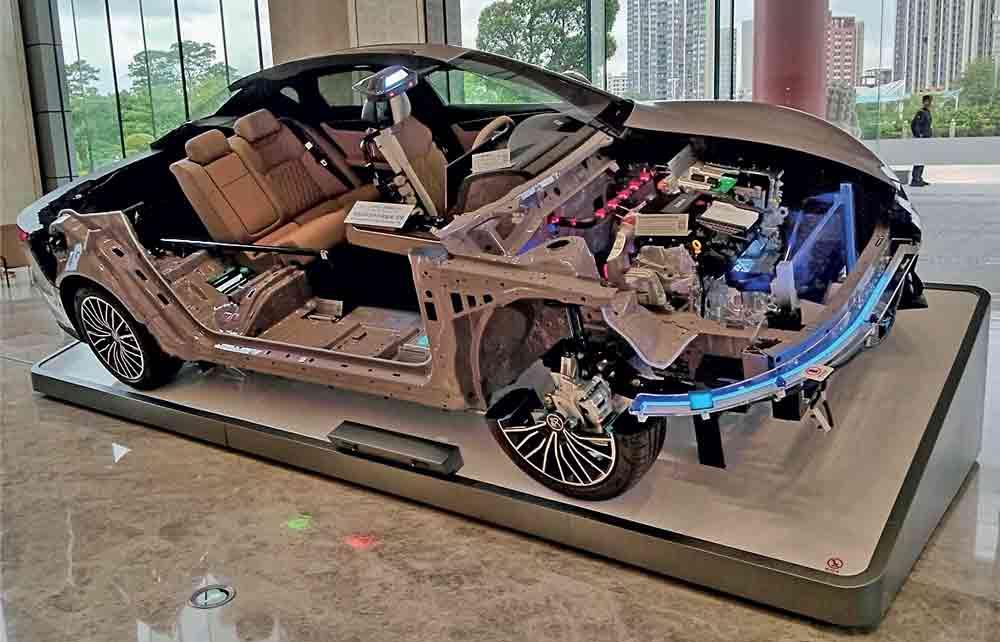
In addition to the Blade batteries, Cell-to- Body tech, and the e-Platform, BYD offers a range of other innovative technologies
Meanwhile, BYD is said to be already getting significant traction in major European markets, and it is aggressively pursuing a plan to build more factories in Europe. The company is in the process of installing the production machinery at its first European factory in Hungary, where it is expected to begin pilot production in the first quarter of 2026, with full production scheduled to begin before the end of the second quarter. This factory is part of a global production shift that includes new BYD factories in Brazil and Turkey to complement the existing factory in Thailand that has been shipping vehicles to Europe since August this year. Industry sources reveal that Spain is currently the leading contender for another BYD factory in Europe.
Battery production and innovation
BYD’s top-notch battery manufacturing lies at the heart of its success in the electric vehicle market. The company’s subsidiary, FinDreams Battery Co., focuses on lithium iron phosphate (LFP) technology, featuring the groundbreaking “Blade Battery,” celebrated for remarkable safety and efficiency.
The distinctive feature of BYD ‘Blade Battery’ is the arrangement of battery cells in a blade-like formation which increases the contact area between cells and electrical pathways resulting in efficient heat transfer. Additionally, this unique design helps reduce the risk in the event of a vehicle collision.
The BYD ‘Blade Battery’ has been continuously integrated into its electric vehicles, making it a technology with significant implications for the global electric car industry standards. Looking forward, the company expects to unveil solid-state EV batteries by 2027, aiming to boost energy density and improved safety.
With regard to access to resources, BYD has secured the supply of critical materials such as lithium and tungsten used to build electric vehicles. To secure a steady supply of critical raw materials, the company has moved into mining operations. In 2023, the company secured mining rights in Brazil’s “Lithium Valley,” marking its first mining investment beyond China.
Robust ecosystem
BYD’s success in rapidly scaling up to become a leading global EV manufacturer can be largely attributed to a strategic approach that weaves together production innovation, supply chain optimisation, and deep vertical integration.
Over the past decade, the company has leveraged its heritage in battery production to build a robust ecosystem stretching from raw material sourcing to final vehicle assembly. This strategic control has minimised external dependencies, reducing exposure to both cost fluctuations and supply constraints. At the same time, BYD’s emphasis on advanced production processes has facilitated consistent model rollouts, amid growing demand across international markets.
Vertical integration
One of BYD’s defining strategies has been the in-house production of key components. Rather than relying on external suppliers for core components, BYD manufactures batteries, power electronics, electric motors, and semiconductors in-house. This vertically integrated model became more prominent after the launch of the Blade Battery in 2020, which introduced a new cell-to-pack format, noted for enhanced safety and improved energy density.
BYD’s production line is highly automated, featuring robotic handling systems that not only accelerate assembly but also maintain exacting quality standards. Since its introduction, the Blade Battery has been deployed across multiple BYD models, contributing to lower manufacturing costs by consolidating module assembly and eliminating conventional pack structures. By late 2022, BYD’s total battery production capacity had surpassed 135 GWh, enabling the company to meet soaring NEV demand while controlling costs.
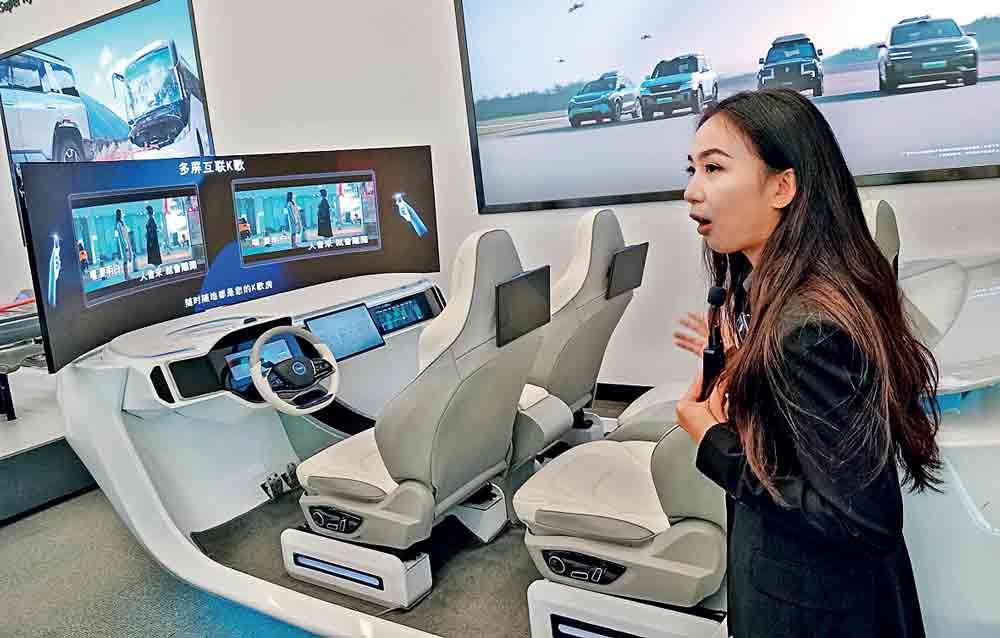
BYD’s intelligent cockpit system platform is equipped with Android intelligent system, which brings smarter, safer and more comfortable driving experience to the vehicle user
This strategy contributed to the company delivering 1.86 million new energy vehicles in 2022, nearly triple the volume of the previous year. Unlike BYD, its main competitor relies on external suppliers for a significant share of its batteries.
Platform standardisation & modular design
Another crucial element of BYD’s strategy is the use of platform standardisation and modular architecture. The e-Platform 3.0, introduced in 2021, consolidated core EV elements – such as the motor, controller, and chassis – into a single framework. This design reduced parts count and simplified assembly, enabling production lines to switch between different vehicle models with relative ease.
In practical terms, a shared platform also streamlines parts sourcing and logistics, as consistent components can be utilised across multiple vehicle lines. This commonality - an example of Design for Manufacture (DFM) - not only saves costs but also allows BYD to pivot quickly in response to shifting market trends. As an example, models such as the BYD Dolphin and Seal, both built around the e-Platform 3.0, were taken from concept to commercial production in well under two years. In addition to cutting manufacturing times, this approach has made it easier to share components across multiple product lines, streamlining procurement and helping maintain consistent quality standards.
DiSus technology
BYD’s DiSus system is the first self-developed intelligent body control system launched by a Chinese automobile company.
DiSus system makes full use of NEV’s advantages in electrification and intelligence to build up a comprehensive system of perception, decision-making, and execution to significantly improve the driving experience. It offers collaborative control in body dynamics (lateral, longitudinal, and vertical motions), that provides a foundation for the future development of Advanced Driver Assistance Systems (ADAS).
Developed entirely in-house over a five-year period with an investment of billions of yuan, DiSus system not only fills the technological gap in China but also surpasses international standards. The system has now introduced several variants: DiSus-C, -A, P, X, Z.
Simultaneous engineering & rapid product development
Another crucial factor in BYD’s rise is its simultaneous engineering methodology. Rather than isolating design, engineering, and manufacturing functions, BYD’s teams operate in parallel from the early concept stage through to production. By integrating R&D, design, and manufacturing decisions, BYD can rapidly incorporate new features or rectify potential production hurdles.
A prime example is how the Song, Qin, and Han model ranges share core components – such as chassis, electrical architectures, and battery systems – significantly reducing customisation complexity and parts duplication. This commonality also speeds up product updates; for instance, when BYD rolled out software enhancements for the Qin and Han in 2022, production lines were able to incorporate changes mid-cycle without lengthy retooling or halts.
Automation & gigacasting
High levels of automation have played a key role in BYD’s ability to scale. Automation extends from welding and painting, to pack assembly and final inspection, supported by real-time monitoring systems for quality control. BYD’s Xi’an plant reported 97 percent automation early as in 2020, using automated guided vehicles (AGVs), robots, and intelligent warehousing for maximal efficiency.
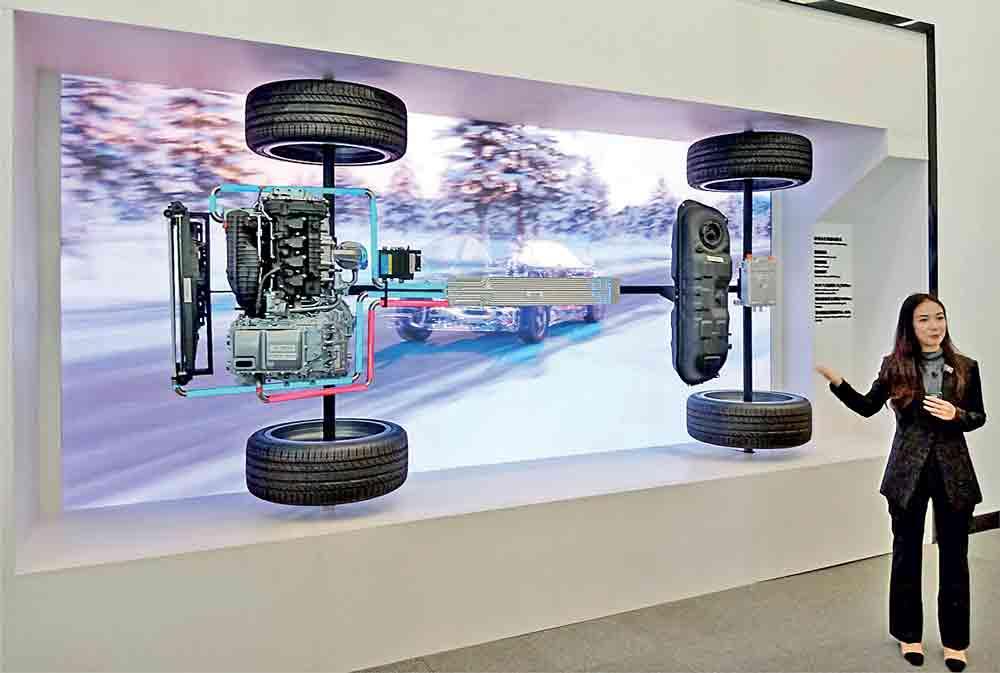
The internal components of a vehicle utilising BYD’s DM-i Super Hybrid Technology. This system is a plug-in hybrid technology that uses a large-capacity battery as the primary power source
BYD maintains comprehensive in-house testing labs dedicated to batteries, motors, and electronics, employing high-precision equipment to detect faults at micro-levels. Coupled with real-time data analytics, these testing protocols minimise defects and enable proactive refinement of production parameters. Iterative feedback loops - where test results feed directly back into design and assembly – have helped BYD reduce component failure rates and enhance overall vehicle reliability. The company is rolling out local datacentres across Europe to support its autonomous and internet-connected vehicles.
According to company sources, BYD has invested in the construction of an “integrated body” gigacasting project, where the initial investment stands at 390.5 million Yuan (US$ 54 million) for the construction of a Gigacasting shop and for the purchase of the 9,000t Giga Press and its related supporting equipment.
Global supply chain coordination
Beyond China, BYD’s strategy of localising elements of production- such as electric bus chassis in Hungary and battery assembly in Brazil - demonstrates a flexible, region-specific approach to supply chain management. The ability to source components locally, align logistics precisely with production schedules, and collaborate with regional suppliers ensures stable inventory levels and cost efficiencies.
This model has been validated by BYD’s global expansion, including facilities in Thailand which has reached the milestone of producing its 70,000th vehicle, about 16 months after commencing operations. Each new site leverages regional advantages, such as local raw material availability or automotive expertise, to extend BYD’s competitive edge.
In addition to technological advancements, BYD is also focusing on fleet electrification and commercial vehicles, including electric buses and trucks, which are gaining traction globally. The company is further enhancing its models by integrating advanced driver assistance systems (ADAS) as a standard feature, providing cutting-edge safety and automation at no extra cost.
Collaboration
Going forward, Zhang is of the view that a more open, collaborative approach among all auto giants and connected firms is vital for a rapid transition to EVs globally.
“To promote new technologies and new products, we need partnerships. Consumers should be properly educated on battery EVs, PHEVs etc and about their impact at a global scale. One company alone cannot do that. A network of firms including automakers, technology companies and AI companies would allow each other to benefit from the latest developments in their respective fields and ultimately pass on the advantages to consumers.”
“When it comes to New Energy Vehicles and EV technology, there are many countries still at an early stage. If you take India for an example, the EV penetration is only 5 percent. In such a backdrop, OEMs (Original Equipment Manufacturers) and other auto makers should collaborate to promote the new technologies and products effectively in these countries. The collective vision has to be the promotion of new technologies and products for the future,” Zhang noted.
Zhang said a multi-dimensional approach is also essential at country-level, to attract more consumers towards electric mobility. According to him, initiatives such as public awareness campaigns highlighting technological impacts and environmental benefits, financial incentives (in the form of reduced import taxes by governments, bank loans with lower interest rates, installment based solar-vehicle packages) and university and technical collaborations to train EV technicians and battery specialists could lead to making EV adoption more practical particularly in developing countries.
11 Jun 2026 1 hours ago
11 Jun 2026 2 hours ago
11 Jun 2026 2 hours ago
11 Jun 2026 2 hours ago
11 Jun 2026 2 hours ago