20 Jan 2026 - {{hitsCtrl.values.hits}}
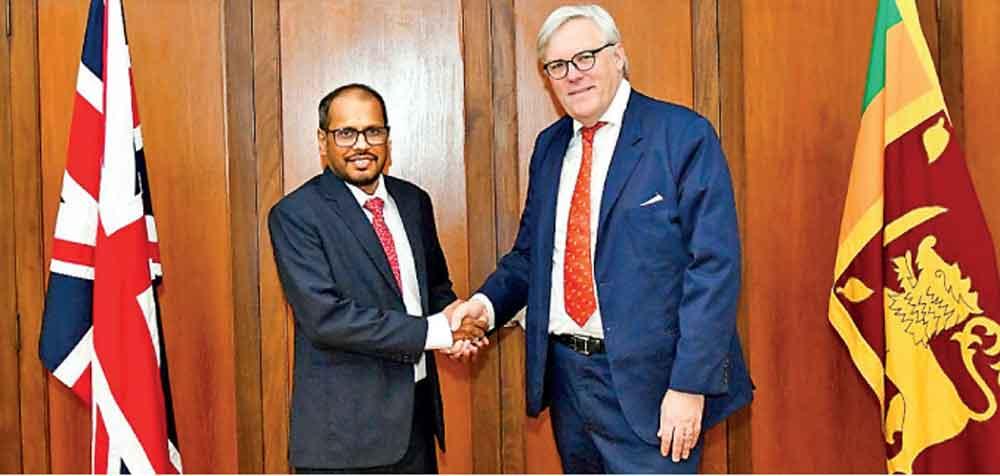
From left: Export Development Board Chairman and CEO Mangala Wijesinghe and British High Commissioner Andrew Patrick recently held discussions on the enhanced trade opportunities arising from the revised UK DCTS
A recalibration of Britain’s post-Brexit trade preferences is set to materially alter how Sri Lanka’s exporters, particularly the apparel manufacturers, structure their production and sourcing, highlighting a shift from tariff relief to supply-chain flexibility as the core trade advantage.
Under the United Kingdom’s Developing Countries Trading Scheme (DCTS), which came into force in June 2023, more than 92 percent of Sri Lankan product lines already enjoy duty-free access to the UK, the country’s second-largest export market. That access has now been reinforced by liberalised rules of origin, effective January 2026, removing key sourcing and processing constraints that had shaped export decisions for years.
The revised framework allows Sri Lankan apparel exporters to source up to 100 percent of raw materials globally while retaining zero-tariff entry to the UK market — a marked departure from earlier requirements. The change directly affects an industry that accounts for nearly 73 percent of Sri Lanka’s exports to the UK, valued at about US $ 660 million in 2024 and US $ 610 million in 2025.
In parallel, the UK has simplified the processing rules under the DCTS, removing the earlier condition that two substantial manufacturing processes must take place in Sri Lanka. The streamlined requirements are expected to ease compliance and reduce operational friction for exporters, particularly in complex, multi-stage apparel production.
Beyond garments, the revised scheme expands regional cumulation benefits, permitting Sri Lankan manufacturers to source inputs from an 18-country Asia Regional Cumulation Group while still treating those inputs as originating in Sri Lanka for preferential access. The move broadens sourcing options while preserving zero or reduced tariff treatment across a wider range of exports.
Sri Lankan and UK trade officials have positioned the revised DCTS as a platform for deeper integration into the UK and global supply chains. Discussions between Sri Lanka Export Development Board Chairman and CEO Mangala Wijesinghe and British High Commissioner Andrew Patrick have focused on leveraging the enhanced scheme, alongside Sri Lanka Expo 2026 and brand promotion initiatives aimed at strengthening market presence in the UK.
17 Jun 2026 1 hours ago
17 Jun 2026 1 hours ago
17 Jun 2026 2 hours ago
17 Jun 2026 3 hours ago
17 Jun 2026 3 hours ago