13 Dec 2025 - {{hitsCtrl.values.hits}}
By Rajkumar Kanagasingam
|
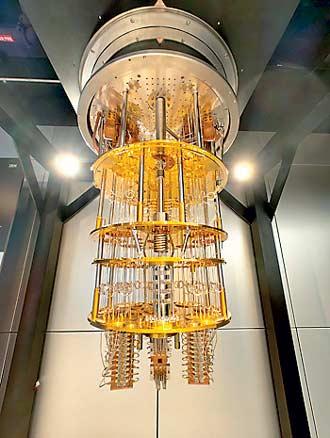
Picture of an IBM Quantum System One, taken at the ThinkLab of IBM’s TJ Watson Research Center in Yorktown Heights, New York |
Quantum computing dominated this year’s Singapore FinTech Festival, signalling a decisive shift from laboratory research to strategic priority for global finance. Early pilots in risk modelling, portfolio optimisation and payments security show that quantum capability is nearing its “AI moment”—a stage where technological acceleration begins to outpace regulation, talent and security infrastructure. For financial institutions built on cryptography and digital trust, this transition presents both immense opportunity and profound systemic risk.
Speakers emphasised that quantum adoption breaks with traditional technology cycles. A study by Boston Consulting Group was widely referenced, noting that up to 90 percent of quantum value will be captured by early adopters rather than fast followers. In this environment, waiting for standards to mature could mean losing the competitive edge entirely. Banks and capital markets players were urged to identify use cases now, build pilot programmes and prepare their systems for a quantum-safe future.
A second challenge underscored throughout the festival was the rapidly widening talent gap. Quantum engineers, applied physicists and cryptographers are in critically short supply, and the pipeline is not growing fast enough to meet global demand. Several speakers compared the moment to the early internet era, but warned that the complexity and specialised expertise required for quantum technologies make early investment in education and research even more important.
One of the clearest explanations of the coming risk came from Ray Harishankar, Vice President and Fellow at IBM. He urged the audience to frame the issue as “quantum risk” rather than “quantum threat”—a capability shift with potential misuse if institutions are unprepared. The core vulnerability lies in the mathematical foundations of RSA and elliptic-curve cryptography (ECC), which protect most of the world’s digital communication today. A sufficiently powerful quantum computer running Shor’s algorithm—a Cryptographically Relevant Quantum Computer (CRQC)—could break both almost instantly.
Harishankar warned that adversaries are already acting. Encrypted data is being stolen today and stored for future decryption once quantum capability matures, a tactic known as “harvest now, decrypt later.” To address this, he highlighted the urgency of adopting post-quantum cryptography (PQC), a class of quantum-resistant algorithms selected and standardised by NIST. Yet upgrading global cryptography—used in more than 20 billion devices—is unprecedented in scale. He argued that systems must now support “crypto-agility,” enabling organisations to swap cryptographic components quickly and repeatedly as algorithms evolve.
Professor Urbasi Sinha of the Raman Research Institute and University of Calgary added a complementary perspective through Quantum Key Distribution (QKD), which secures communication using the laws of quantum physics rather than mathematical difficulty. Because quantum states collapse when observed, eavesdropping becomes immediately detectable. India has made notable progress with free-space QKD tests, moving-receiver demonstrations and readiness for satellite-based quantum communication. Long-term work on quantum repeaters could eventually support a global quantum-secure network.
The convergence of quantum computing with artificial intelligence brought the sharpest warning. Cybersecurity expert Ralph Echemendia, known as “The Ethical Hacker,” argued that AI already enables autonomous reconnaissance, exploit generation and real-time attack execution. When quantum capability amplifies these tools, he said, defence systems may be overwhelmed. He described this trajectory as “synthetic evolution”—AI learning faster than humans, accelerated even further by quantum computation. He called the emerging competition a race for “weapons of mass encryption,” where control over quantum-secure and quantum-breaking capabilities may define digital power.
The message from the festival was unequivocal: the quantum era has begun. Institutions must act now—deploy PQC and QKD, build crypto-agile architectures, invest in scarce talent and integrate ethics and governance directly into system design. Decisions made today will determine the resilience of global finance in a quantum-enabled future.
(The writer is an Industry Fellow at the Global Fintech Institute (Singapore) and Founding President of the Fintech Association of Sri Lanka.)
07 Jul 2026 13 minute ago
07 Jul 2026 22 minute ago
07 Jul 2026 3 hours ago
07 Jul 2026 3 hours ago
06 Jul 2026 06 Jul 2026