19 Jan 2017 - {{hitsCtrl.values.hits}}
Sri Lanka has borrowed US $ 125 million from the World Bank (WB) to modernize its agriculture sector, as the country aims to make the sector more efficient and attractive as a modern business, more responsive to consumer demand and more environmentally sustainable and resilient to climate change. 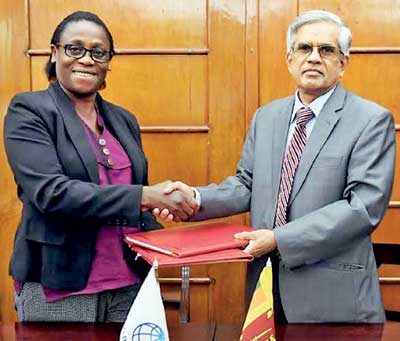
Sri Lanka’s agricultural sector has evolved over the past years. A major milestone has been the achievement of rice self-sufficiency – a goal of successive agriculture strategies since independence. But the share of population employed in agriculture has remained around 30 percent over the past decade, even as the sector’s share in national gross domestic product (GDP) has declined to 10 percent.
This persistent inequality makes it urgent to rethink the direction of agricultural development and explore new opportunities and strategies on how to sustainably increase rural incomes and promote a modern agriculture sector that meets the needs of the upper-middle-income country that Sri Lanka aspires to be.
World Bank Country Director for Sri Lanka and the Maldives Idah Pswarayi-Riddihough and Finance Ministry Secretary to Treasury R.H.S. Samarathunga signed the agreement for the project on behalf of the World Bank and Government of
Sri Lanka.
Pswarayi-Riddihough said, “Sri Lanka’s history is deeply rooted in agriculture and its paddy cultivation tradition. The past practices can inform the future by preserving and building on the country’s farming traditions. There is now space to diversify and promote high-value, export-oriented food crops.”
She added, “This shift is crucial for income growth, poverty reduction, reducing inequality and better nutritional outcomes. The new approach corresponds directly with the World Bank Group’s twin goals.”
The project will support value chain development to promote commercial and export-oriented agriculture, with focus on higher value agriculture products, such as fruits and vegetables. It will also provide investments to improve productivity and diversify production patterns through modern agriculture technology demonstrations in key areas and supports new institutional arrangements through farmer organisations and farmer-agribusiness partnerships. Further, it will support agricultural policy development to help the government determine the sector’s future direction.
“This project aims to demonstrate new agricultural practices and institutional arrangements in the project areas, linking smallholder farmers into modern agriculture value chains and creating attractive jobs, including for women and young people,” said World Bank Programme Leader Ulrich Schmitt.
“Innovation and new technology will help improve not only the sector’s economic efficiency but also enhance resilience to natural disasters and
climate change.”
He underscored the significance of a supportive policy and regulatory environment to evidence-based decision-making that can drive the sector modernization process.
The project will be implemented through the Primary Industries and Agriculture Ministries and five participating provinces: Northern, Eastern, Central, North Central and Uva.
The beneficiaries include an estimated 30,000 smallholder farm households, who will benefit directly from a small matching grants programme and agriculture technology demonstrations.
Another 20,000 farm households will be supported through technical and business training and through professional farmer organisations that will help them become more effective and business-oriented enterprises.
18 Jun 2026 5 minute ago
18 Jun 2026 14 minute ago
18 Jun 2026 21 minute ago
18 Jun 2026 23 minute ago
18 Jun 2026 43 minute ago