21 Dec 2016 - {{hitsCtrl.values.hits}}
By Chandeepa Wettasinghe
The sale of a majority of shares in state-owned enterprises (SOEs) is not privatization, but commercialization, Finance Minister Ravi Karunanayake stressed recently, despite past instances being classified to the contrary.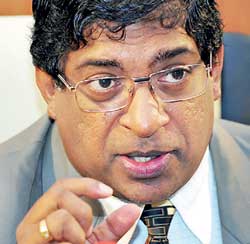
“No. We’re not privatizing. The correct word is what we use. We’re saying privatization is not there. But commercialization, yes,” Karunanayake told Mirror Business recently.
The lease of regional plantation companies that cultivate tea, rubber, coconut etc., for 50 years in 1992 is still considered privatization.
The sale of shares in Sri Lanka Telecom in 1997, as well as the sale of shares of Sri Lanka Insurance Corporation in 2003 prior to re-nationalization were also considered privatization by past governments, to name just a few.
When pressed on why the government is engaging in such semantic play, Karunanayake said that the government has no option but to sell some loss making SOEs, and that the interpretation of the move is up to each individual.
“You can interpret it however you want, that is true. But then, what else? Tell me why are we going to allow the assets to be under used?” he said.
The government had also used the word public private partnership to describe some of the deals that it has been making.
The 2016 budget, as well as the 2017 budget, had sought to list over half a dozen SOEs on the Colombo Stock Exchange, and sell their shares in order to earn over US$ 1 billion to settle high cost public debt.
Karunanayake had later said that the funds would be used to bolster foreign reserves.
Sri Lanka’s official reserve assets have fallen by US$ 850 million over the span of 2 months ending this November to US$ 5.65 billion. Sri Lanka’s public debt amounts to over 80 percent of gross domestic product, when including debt undertaken by SOEs.
Over US$ 1 billion the government is hoping to use to settle US$ 760 million in commercial debt and boost reserves this January will be coming from the sale of 80 percent of the shares of the Hambantota Port to a Chinese state-owned company.
The government is also planning to sell shares of the Mattala Airport, and enter into a public private partnership for SriLankan Airlines.
Economists have pointed out that privatization has a negative connotation in Sri Lanka, since many state-sector employees—supported political forces with vested interests—are unwilling to become productive, and are concerned with their job security, and that the anti-privatization movement has spilled onto the
general public.
Karunanayake—a member of the United National Party that heads the unity government—had last year said that privatization is a banned word under the unity government.
Moves to privatize SOEs are considered as one of the reasons for the downfall of the 2001-2004 UNP regime.
Karunanayake had instead said last year that the government would make loss-making SOEs as productive as the private sector. It is estimated that SOEs have run upwards of Rs. 600 billion in losses up to 2015.
19 Jun 2026 3 hours ago
19 Jun 2026 5 hours ago
19 Jun 2026 5 hours ago
19 Jun 2026 7 hours ago
19 Jun 2026 7 hours ago