26 May 2026 - {{hitsCtrl.values.hits}}
 |
| Group CEO Ashish Chandra |
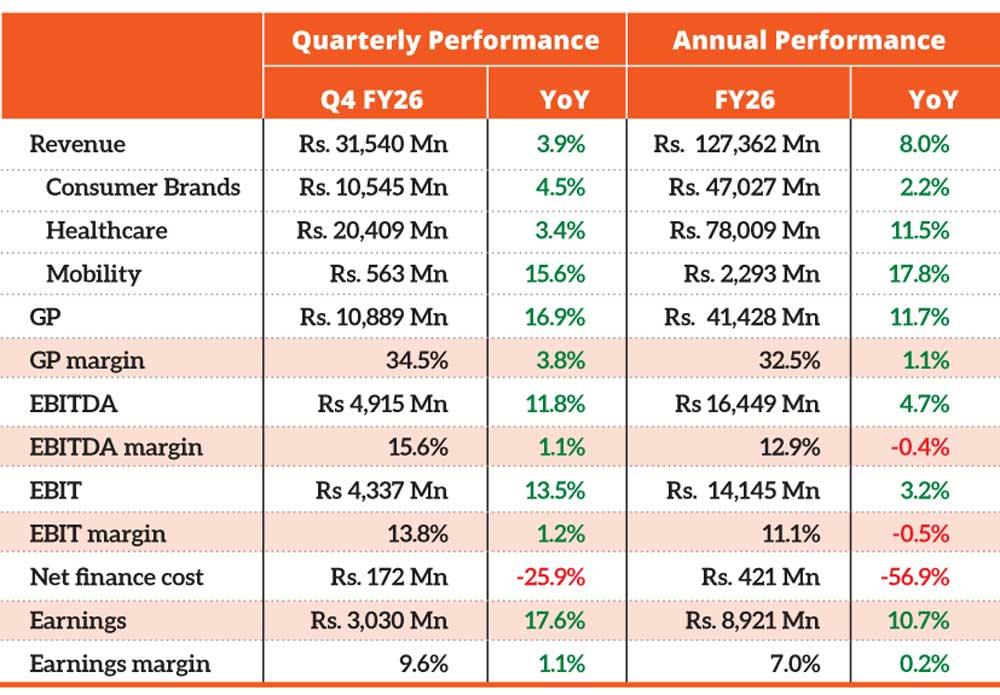
Hemas Holdings posted its strongest annual earnings on record in fiscal 2026, driven by a resilient healthcare growth, improving consumer demand and stronger maritime operations, even as the conglomerate deliberately sacrificed the margins to accelerate investments in digital infrastructure and expansion.
The Sri Lankan diversified group reported annual earnings of Rs.8.92 billion for the year ended March, up 10.7 percent from a year earlier, while the fourth-quarter profit climbed 17.6 percent to Rs.3.03 billion. Revenue rose 8 percent to Rs.127.4 billion.
The results underscore how some of Sri Lanka’s largest corporates are beginning to pivot from the post-crisis stabilisation towards longer-term expansion strategies, despite the lingering pressure on the household spending and global trade uncertainty.
Hemas expanded the gross profit margins by 110 basis points during the year, though the operating margins narrowed after the company increased spending on technology systems, workforce capabilities and healthcare expansion. The EBITDA margin slipped 40 basis points while the EBIT margin contracted 50 basis points.
The company framed the margin compression as a consequence of the front-loading investments ahead of future growth, suggesting the management is prioritising scale and capability building over the near-term earnings optimisation.
Healthcare remained the group’s dominant growth engine, with revenue climbing 11.5 percent and earnings rising 14.2 percent during the year.
The hospital operations were a standout performer, posting a 24 percent revenue growth, as the patient volumes increased across the services. Hemas also expanded into specialised healthcare segments, including liver care and cardiac services, through its Wattala hospital expansion.
The performance reflects the growing demand for private healthcare services in Sri Lanka, particularly for the specialised treatment, as capacity constraints and service gaps persist in the public health sector.
Meanwhile, pharmaceutical manufacturing arm Morison reported an 18.6 percent volume growth, with the company continuing to gain ground in Sri Lanka’s domestic pharmaceutical market.
The consumer brands business delivered a more muted revenue growth of 2.2 percent, though the company said the volume growth was recorded across all major categories, pointing to a gradual recovery in domestic consumption after years of inflation-driven weakness.
Hemas’ home and personal care business in Sri Lanka posted a 4.2 percent volume growth, despite a decline in prices, indicating that growth is increasingly being driven by higher consumer purchasing volumes rather than pricing. The beauty and personal care categories outperformed the broader consumer segments, suggesting Sri Lankan consumers are selectively returning to discretionary spending, even as broader economic conditions remain fragile.
The group’s mobility business also benefited from improving regional trade flows, with maritime operations strengthening alongside higher container throughput at the Colombo Port.
The company plans to invest more than US $ 100 million over the next four years, while also pursuing overseas expansion to reduce reliance on the Sri Lankan market. International revenue currently accounts for about 3 percent of turnover, though a planned acquisition in fiscal 2027 is expected to raise that figure to 10 percent.
Hemas is also accelerating investments into AI-enabled systems, cybersecurity, enterprise resource planning platforms and digital healthcare infrastructure, reflecting a wider trend among South Asian conglomerates seeking productivity gains through automation and data-led operations.
27 Jun 2026 20 minute ago
27 Jun 2026 53 minute ago
27 Jun 2026 2 hours ago
27 Jun 2026 2 hours ago
27 Jun 2026 3 hours ago