31 Oct 2023 - {{hitsCtrl.values.hits}}
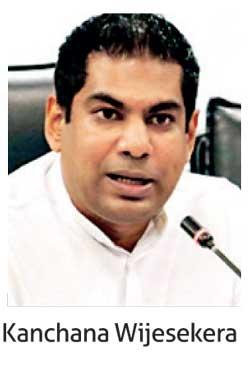 Power and Energy Minister Kanchana Wijesekera yesterday said he tabled the proposed Electricity Sector Reforms Bill for the observations and approval of the Cabinet of Ministers.
“The proposed reforms will unbundle the services of the CEB, improve efficiency, transparency, competition and allow private sector participation in the electricity industry,” Wijesekera said in a message on X, formerly Twitter.
He said the bill was prepared over the last 10 months with the assistance of energy and legal experts from development agencies and industry stakeholders. The bill received the certification of the Attorney General last week, after the proposed amendments by the Attorney General’s Department were incorporated by the Legal Draftsman.
Wijesekera said once the Cabinet of Ministers approves the bill, it would be gazetted and tabled in Parliament for approval.
Sri Lanka plans to unbundle the loss-making state-owned utility, which has a monopoly on electricity generation and transmission, under an International Monetary Fund-backed programme.
Despite the significant electricity tariff hikes, the CEB’s operating loss, as at the end of September, stood at Rs.29 billion, whereas its loss for the year 2022 was Rs.272 billion.
The accumulated losses of the CEB for the period 2014-2022 stood at Rs.565 billion and the working capital subsidy extended by the government during the same period was Rs.257 billion.
Rooftop solar users to be allowed one-time migration
The Power and Energy Ministry yesterday announced that the solar customers of the Ceylon Electricity Board (CEB) and Lanka Electricity Company (LECO) would be allowed a one-time migration to different schemes.
Power and Energy Minister Kanchana Wijesekera said the rooftop solar customers of the CEB and LECO would be allowed to opt for migration between the Net Plus, Net Metering and Net Accounting schemes, starting next week.
“The same rate at which the Power Purchasing Agreement was signed will be applied in migrating between the schemes,” said Wijesekera in an update on Twitter X.
Under the Net Plus scheme, the consumers generate electricity through solar PV connected to the national grid, with no linkage in-between the electricity consumption of the producer, whereas Net Metering allows residential and commercial customers, who generate their own electricity from solar power, to sell the electricity they aren’t using back into the grid.
The Net Accounting scheme allows the consumers to get paid in money, if their solar-generated power is greater than what is consumed from the grid. Further, Wijesekera added that rooftop financing schemes would also be introduced by the CEB and LECO for new rooftop developments from December.
Sri Lanka has an ambitious goal of achieving 70 percent renewable energy generation by 2030 and becoming carbon neutral by 2050.
In an effort to achieve Sustainable Development Goal (SDG) 7, which focuses on affordable and clean energy, Sri Lanka is implementing its Nationally Determined Contributions (NDCs) to reduce greenhouse gas emissions.
As part of its NDC plan, Sri Lanka aims to develop an additional capacity of 3,867MW of renewable energy by 2030. Given its abundant renewable energy sources such as solar, wind, hydro and biomass, Sri Lanka has the potential to meet this target.
The approved Long-Term Generation Expansion Plan (LTGEP) outlines a target of 4,705MW of solar power, 1825MW of wind power, 195MW of mini-hydro and 200MW of biomass power.
30 Jun 2026 9 minute ago
30 Jun 2026 12 minute ago
30 Jun 2026 57 minute ago
30 Jun 2026 1 hours ago
30 Jun 2026 2 hours ago