18 Nov 2016 - {{hitsCtrl.values.hits}}
By Rajitha Weerakoon
It was mismanagement and living beyond our means that caused the downfall of our economy, stated Central Bank Governor Dr. Indrajit Coomaraswamy when he addressed the 75th Annual General Meeting (AGM) of the Sri Lanka Federation of University Women last Saturday.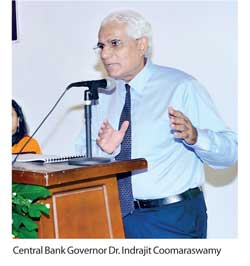
Our economy he said was next to Japan after the Second World War. Korea was behind us.
Continuing he said Sri Lanka had populist governments that indulged in classic borrowing systems to spend on a recurrent expenditure. Sri Lanka was the darling of the donors as we received aid liberally making us dependent on borrowed aid. Can we continue with the borrowing, he queried?
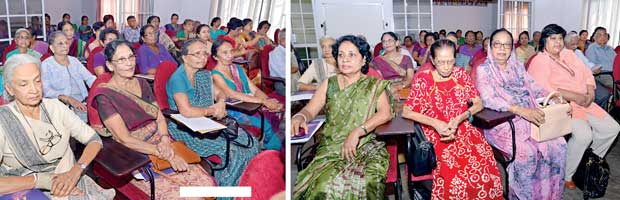
A product of Cambridge and Sussex Universities, Dr. Coomaraswamy was speaking to an almost exclusive audience of university women at the Sri Lanka Federation og University Women (SLFUW) headquarters on the invitation of SLFUW President Seela Ebert.
He spoke on the subject of ‘Sri Lankan economy – Opportunities and challenges’ when he emphasized that dramatic changes have to be made to get income-generation going.
He first traced the history of economic decline – the crash of the traditional cash crops in the 1990s and the absence of an alternative income-generating development, which also had to cater to an increasing population. The liberalized economy he said did not usher in the expected results. We had impressive social indicators. But these could not impact on the economy due to the southern insurrection and the conflict in the North.
Besides, the totally voluntary birth control practiced a few decades ago, reduced the growth of the young population. It created an ageing population, which will steadily increase to 40 percent in a few decades.
The country he said requires a growth rate of 7.8 percent and the state has to create an environment for the economy to grow. The middle class is increasing and Sri Lanka needs to pick up the baton and create jobs for them in the next two years.
A solution could be a private sector, export-oriented economy. But, he said the world economy today is low and sluggish. The next option is to exploit our strategic location between the two giants in Asia – India and China – and attract foreign investors to our markets. India is just 20 miles away and has a booming economy going at the rate of 7.8 percent.
Then, we are on China’s maritime route and we have to take note of emerging trends and look for capital markets in the Eastern spectrum. China, Japan, Singapore and Korea have the resources to invest. The government should encourage the private sector to do business with them. The state has a deficit in the nation’s savings and there are debt commitments. Giving incentives to invest in Sri Lanka to economically-emerging nations may help us to lift our economy.
He stated that our budget deficits have been high. When inflation was high, we had to borrow at high rates of interest. But when money is pumped in, that weakens the economy. Politicians attempt to stop such borrowing. But the real problem is the balancing of the budget. At present, the private sector is not capable of giving the expected support to stabilize the economy.
Focusing on state expenditure he said that the government is pumping money to the public enterprises. In 2004, there were less than 700,000 employees in the public service. It has now risen to 1.4 million. The pensions that have to be paid to them are not funded by the pensioners.
He said that 30 percent of our people are in agriculture. They live on subsidies and are trapped financially as they just make enough to cover their costs. Therefore, only 10 percent of their products are in the gross domestic product (GDP). Economists have to move them out to higher areas of productivity.
And he questioned whether we have the human resources to cater to the needs of the dynamics of economy. To have an efficiency-driven economy, right skills should be in place. Singapore is the ideal example which has developed the economy using skills.
He spoke about the three mammoth development programmes the government initiated which are expected to step up the economy and open the job market. The West Region Development Programme includes a highway up to Kandy and a light railway. Rs.40 billion has to be paid in 15 years for the project and investments have been already made toward
the project.
The Port City will be built by China and it will be a financial centre. The Hambantota Development Project includes the port and airport and has been undertaken by China under a 99-year lease. China has been promised 15000 acres to develop an industrial zone where countries could set up enterprises such as e-commerce.
Singapore, Japan and India will work together in the Trincomalee Project in the Eastern Province of which the attraction will spread to Rajarata and the Northern Province. The Kuliyapitiya Industrial Project is expected to be active in three to four years thus, giving a clear picture of the economic projections of
the government.
14 Jun 2026 8 hours ago
14 Jun 2026 14 Jun 2026
14 Jun 2026 14 Jun 2026
14 Jun 2026 14 Jun 2026
14 Jun 2026 14 Jun 2026