15 Dec 2025 - {{hitsCtrl.values.hits}}
By Nishel Fernando
Sri Lanka’s inbound tourism sector is witnessing a significant structural shift, as the international visitors increasingly bypass the traditional commercial hubs in favour of leisure destinations along the southern coast and hill country.
According to Economic Outlook 2026, released by the Mastercard Economics Institute, tourism spending is decentralising away from the capital, creating new economic frontiers for small businesses and local communities outside the Western province.
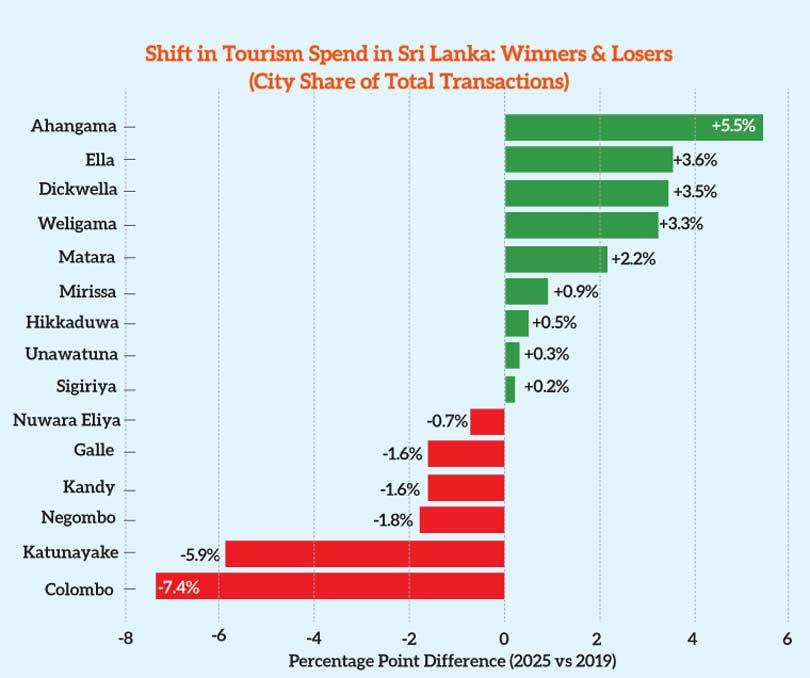
The data comparing the city shares of total card-based tourism transactions between 2019 and 2025 reveals a sharp decline in the dominance of the commercial capital. Colombo saw its share of transactions contract by 7.4 percentage points over this period—the most significant reduction among all locations tracked. Similarly, Katunayake, the primary gateway to the island, recorded a drop of 5.9 percentage points. Despite this contraction, Colombo remains the single largest location for tourism transactions but its dominance is being aggressively challenged by the rise of leisure-centric zones.
This decentralisation is being driven by a global evolution in traveller preferences toward “meaningful moments” and lifestyle-based tourism. Rather than traditional sightseeing in urban centres, the post-crisis visitors are prioritising destinations that offer distinct “vibes”—such as wellness, surfing and hiking. This “leisure-led” recovery is redirecting the capital away from the established commercial loops and toward emerging townships that offer these specific lifestyle experiences.
However, this shift comes amidst a sobering reality regarding sector value: tourism earnings have struggled to regain their pre-crisis momentum. While the visitor numbers have surged, the official data indicates that the aggregate earnings remain flat or show a decline when comparing the current performance to the pre-crisis benchmarks. This stagnation is largely attributed to a drop in the average daily expenditure per tourist. The recent industry data estimates the average daily spend has fallen to approximately US $ 148, a notable decrease from the US $ 181 range observed in the 2018/2019 period.
This contraction in daily spending points to a demographic shift in Sri Lanka’s visitor profile. The decline suggests the island may be attracting a larger volume of budget-conscious travellers—such as backpackers and regional tourists—rather than the high-spending luxury segment that drives superior yield. Consequently, while the island is attracting more feet on the ground, the economic value extracted per visitor has compressed, leaving the sector reliant on driving volume to sustain the revenue targets.
Despite the broader yield challenge, the specific experience-driven locales are defying the trend and climbing the national hierarchy. Notably, Ella has surged to become the second largest hub for tourism transactions in 2025, overtaking the traditional heavyweights like Kandy and the transit hub of Katunayake. Ahangama has also emerged as a standout performer, recording a 5.5 percentage point increase in its share of transactions to secure the fourth spot in the national rankings, signalling its rapid ascent as a preferred hotspot for the travellers seeking a unique coastal lifestyle.
The southern coastal belt continues to drive this redistribution of wealth. Dickwella and Weligama saw their shares of transactions rise by 3.5 percentage points and 3.3 percentage points, respectively. Meanwhile, Matara and Mirissa recorded gains of 2.2 percentage points and 0.9 percentage points. The Mastercard Economics Institute notes that this trend highlights the “leisure-led southern tip of the island” as a primary driver of the sector’s recovery. Conversely, the traditional tourist staples such as Kandy and Negombo have seen their market share erode slightly, dipping by 1.6 percentage points and 1.8 percentage points, respectively. This diversification is expected to enhance external stability by supporting small businesses and local economies beyond the traditional urban centres. It serves as a critical growth lever for the island as it navigates a period of broader economic moderation. The report forecasts that Sri Lanka’s GDP growth will moderate to 3.7 percent in 2026, down from an estimated 4.4 percent in 2025. However, the underlying momentum remains robust, supported by the rising tourism receipts, strong remittances and accommodative monetary policy. Inflation is projected to stabilise at 4.5 percent in 2026, providing a conducive environment for continued recovery in private consumption and investment.
20 Jun 2026 2 hours ago
19 Jun 2026 5 hours ago
19 Jun 2026 7 hours ago
19 Jun 2026 7 hours ago
19 Jun 2026 9 hours ago