23 Jan 2026 - {{hitsCtrl.values.hits}}
By Shabiya Ali Ahlam
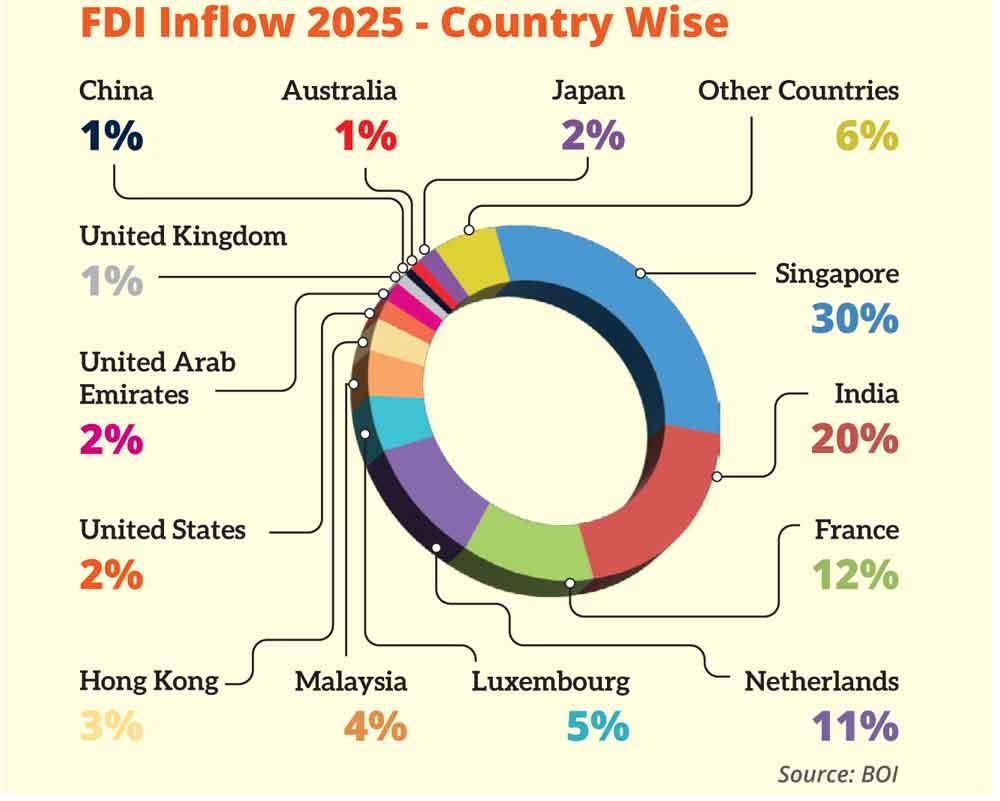
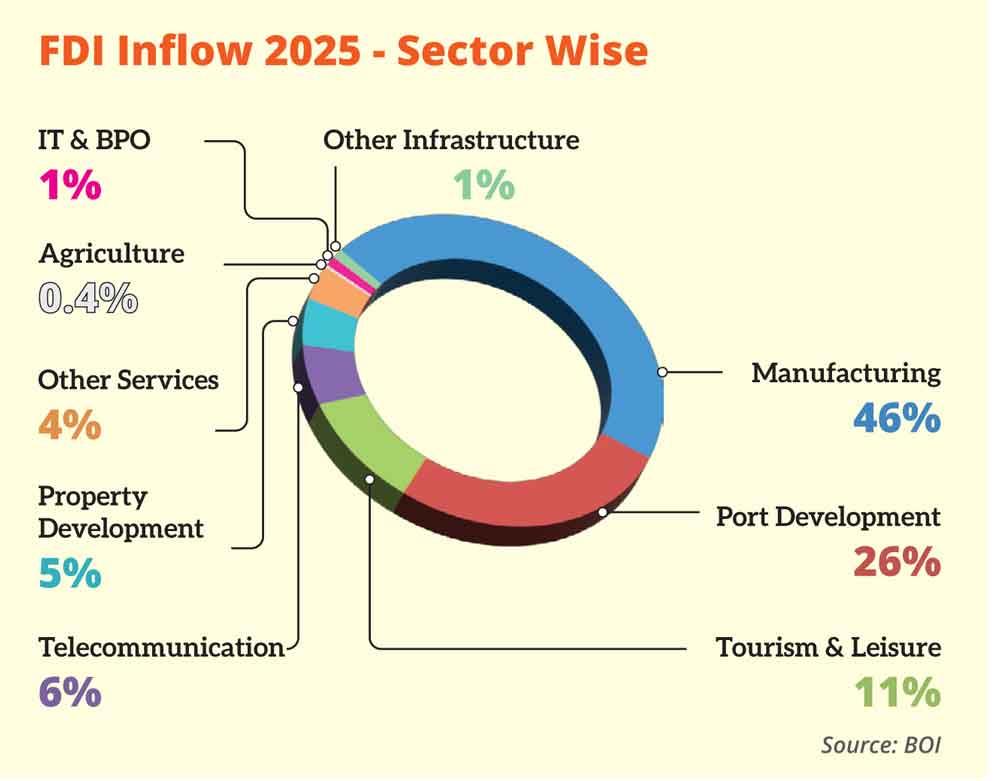
Sri Lanka crossed the US$ 1 billion mark in foreign direct investment (FDI) inflows in 2025 for the first time since the crisis. However, analysis of the data shows that the recovery remains uneven since the inflows are still dominated by debt-like instruments rather than fresh equity capital.
The Board of Investment (BOI) yesterday said FDI inflows reached US$ 1.057 billion in 2025, a 72 percent increase from 2024 and marginally above its US$ 1 billion target.
The rebound comes against the backdrop of macroeconomic stabilisation under the IMF programme, easing inflation, and a more predictable policy environment after years of volatility.
Of the total, only US$ 167 million, or about 16 percent, came in as equity capital, while US$ 567 million was recorded as intra-company borrowings and US$ 110 million as foreign commercial borrowings. Reinvested earnings accounted for US$ 213 million.
This structure indicates that much of the headline inflow was driven by balance-sheet financing within existing multinational operations rather than new risk capital entering the country.
The dominance of such flows suggests foreign investors are still cautious, preferring to support Sri Lankan operations through debt instruments until economic and policy risks ease further.
That caution is also visible in the split between new and existing investors. Of the 189 companies that infused FDI during the year, only 26 were new projects that signed agreements with the BOI in 2025. These contributed US$ 134 million, or 13 percent of total inflows.
While this is an improvement from recent years, when new projects accounted for as little as 2 to 10 percent, it still means nearly nine-tenths of inflows came from expansions and continued funding of existing projects.
For a country seeking to reposition itself as a competitive investment destination, the limited scale of greenfield investment remains a constraint. New projects typically bring stronger technology transfer, export diversification and job creation than incremental capital injections into established operations.
The BOI noted that the increase in new-project contributions signals a turnaround in investor confidence, particularly given the higher perceived risks associated with first-time investments. Yet the relatively modest dollar value suggests Sri Lanka has not yet attracted large anchor investors capable of reshaping its FDI profile.
Project approvals, meanwhile, point to a more optimistic pipeline than realised flows. The BOI approved 146 investment projects in 2025 with a total value of US$ 1.9 billion, including 70 new projects and 76 expansions. Of this, US$ 896 million is expected to come in as foreign capital over time, forming the basis for the government’s US$ 1.5 billion FDI target for 2026.
Historically, however, approved investment values have not translated one-for-one into actual inflows, often due to delays in land access, regulatory clearances, infrastructure bottlenecks and financing constraints.
Institutionally, the BOI has sought to present 2025 as a reset year, pointing to tighter project monitoring, faster approvals and closer coordination with line ministries. It has also launched a BOI Accelerator Programme with a two-year action plan aimed at improving investor facilitation and internal capacity, alongside new policy frameworks developed with Asian Development Bank (ADB) support.
Internally, the agency has moved to fill long-standing staffing gaps, recruiting management trainees and securing approval to fill 88 vacant positions, while proposing a performance-based bonus scheme from 2026, subject to Cabinet approval.
Looking ahead, the investment outlook hinges less on headline targets and more on the quality of inflows. Large-scale projects such as the proposed SINOPEC oil refinery, along with sector-specific investments in data centres, manufacturing and agri-processing, could materially lift FDI numbers if they reach financial close. It must be noted that such projects have historically faced execution risks in Sri Lanka, ranging from regulatory uncertainty to public finance constraints.
14 Jun 2026 4 hours ago
14 Jun 2026 6 hours ago
14 Jun 2026 6 hours ago
14 Jun 2026 9 hours ago
14 Jun 2026 14 Jun 2026