10 Mar 2026 - {{hitsCtrl.values.hits}}
By Nishel Fernando
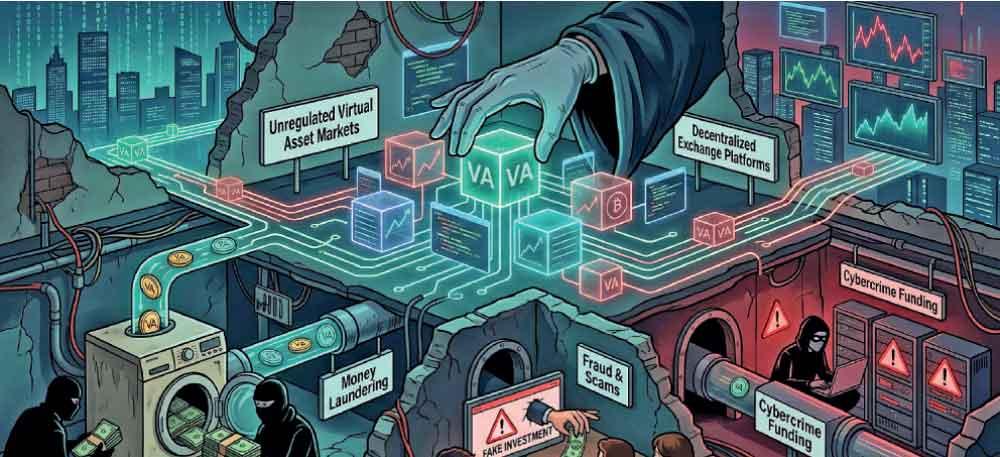
Sri Lanka’s financial landscape is facing new challenges, as an unregulated virtual asset market opens potential avenues for financial crimes.
According to the recently published National Risk Assessment on Money Laundering, Terrorist Financing and Proliferation Financing 2024/25, the country’s virtual asset ecosystem remains at an early stage, marked by increasing public interest and the use of digital assets, largely for speculative investment.
The assessment, representing a significant milestone in the ongoing commitment to strengthen the nation’s financial security framework, highlights that a comprehensive legal and regulatory framework for virtual assets and their service providers is still absent.
This lack of formal registration, licensing, supervision and enforceable anti-money laundering obligations for virtual asset service providers constitutes a major vulnerability within the sector. Consequently, peer-to-peer platforms and non-custodial wallets have been assessed as carrying a medium risk for money laundering and terrorist financing, while custodial wallets and fiat-to-virtual conversions pose a low risk.
Despite the repeated warnings from the Central Bank of Sri Lanka that cryptocurrencies are not legal tender, adoption continues to grow among the retail investors and businesses exploring alternative financial avenues.
The current regulatory void has created an environment susceptible to misuse, with digital assets increasingly being utilised to bypass the national financial controls. Because virtual currencies are not an authorised investment category under the domestic foreign exchange laws, the investors frequently leverage major international exchanges and local peer-to-peer networks to convert rupees into stablecoins, effectively circumventing the foreign exchange restrictions.
Furthermore, the quasi-anonymous nature of blockchain transactions poses significant challenges for domestic tax collection, as the lack of third-party reporting mechanisms creates substantial loopholes for potential tax evasion and illicit wealth accumulation.
Despite these significant hurdles, there are positive developments taking shape on the enforcement front. The law enforcement agencies continue to conduct investigations related to virtual assets, freezing digital funds held in foreign platforms where necessary. Crucially, international information-sharing arrangements are currently in place with major foreign virtual asset service providers operating in or providing services to Sri Lanka.
To build on this momentum, a key recommendation from the latest National Risk Assessment is to prioritise the identification of a prudential regulator and implement compliance obligations for virtual asset service providers. Establishing a balanced regulatory framework may be essential to mitigate the risks of money laundering and tax evasion while potentially harnessing blockchain technology for broader economic growth.
14 Jun 2026 27 minute ago
14 Jun 2026 3 hours ago
14 Jun 2026 5 hours ago
14 Jun 2026 7 hours ago
14 Jun 2026 8 hours ago