13 May 2026 - {{hitsCtrl.values.hits}}
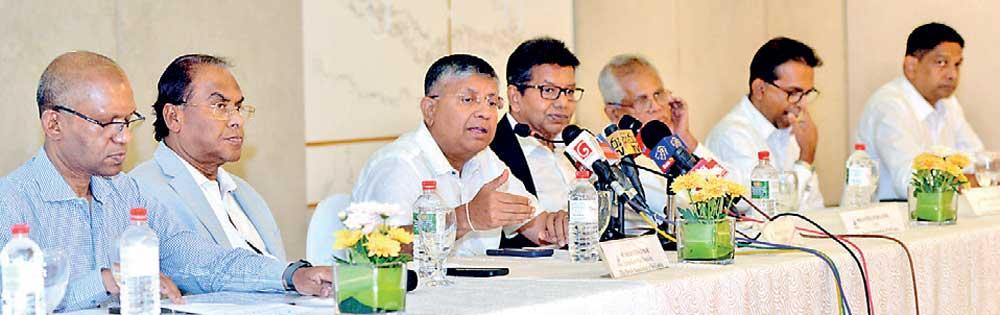
THASL President Ashoka Hettigoda addressing the media in Colombo yesterday. Committee member Sanjeewa Anthony, immediate past president Sushanthi kumar, CEO Priantha Fernando, Vice President Bandula Ekanayake, Vice President Eksath Wijerathne and committee member Ashoka Chaminda Wickremasinhe are also present.
Pix by Pradeep Pathirana
By Nishel Fernando
The Tourist Hotels Association of Sri Lanka (THASL) is calling for a consistent, minimum annual marketing investment of US$ 50million to steer the industry toward its ambitious target of 5 million arrivals and US$ 10 billion in income by 2030.
Industry leaders highlighted that the government already possesses the necessary funds for this global promotional drive, with an estimated Rs. 14 billion having been steadily collected from the formal sector through the Tourism Development Levy and the embarkation levy.
During a press briefing held in Colombo yesterday, stakeholders pointed out a concerning disconnect between recovering arrival numbers and actual fiscal growth. While tourist arrivals in 2025 returned to 2018 levels of 2.3 million—reflecting a 15.1 percent year-on-year growth—total revenue expanded by a marginal 1.6 percent to approximately US$ 3.2 billion, exposing the urgent need for a strategic shift.
The stagnant revenue is largely attributed to a saturated accommodation landscape within the formal sector.
Vice President of Resort Hotels at THASL Eksath Wijeratne emphasised that the sector is currently grappling with fierce price competition because while arrival numbers have remained static compared to pre-crisis levels, the supply of accommodations has surged.
“We, in 2018, had 2.3 million arrivals and then 2025, also 2.3 million. So imagine five years ago down the line where the arrivals to the country were and where we are today,” Wijeratne remarked.
“So if you look at the number of rooms what we had in 2018 to 2025, it has doubled. The accommodation has increased, the facilities, the providers have increased, but whether the numbers have equally increased? So there is a competition. Everything else is increasing except the price that we can get for the services that we provide.”
The industry’s recovery is being further hampered by significant bureaucratic delays in launching an interim marketing blitz. While a US$ 1.3 million budget was allocated for immediate promotions in key source markets including India, Russia, China, and Australia, execution remains stalled.
THASL President Asoka Hettigoda noted that despite requests to reduce the international procurement bidding period from 42 days to 14 days, authorities have yet to provide the green light. He pointed out that if this interim campaign can finally take off in June, Sri Lanka can still achieve its immediate target of 2.5 million arrivals and proportional revenue growth for the current year.
“We are halfway through May, we are still talking to people who can take the decision, but at this moment the decision has not come,” he said.
Looking beyond the interim measures, Hettigoda stressed the absolute necessity of finalising the broader global campaign so that it is ready to launch as soon as geopolitical tensions ease.
“Yes, we understand that right now there is a global issue based on the Gulf region, so I personally don’t think that we need to execute now. But the moment we all believe that this war cannot sustain for a longer period, that should end at some point. So the moment it’s ready, we need to have the materials to execute the campaign,” he explained, noting that competing destinations in the region began their marketing efforts decades ago and Sri Lanka cannot afford further delays once global travel conditions stabilise.
In the absence of state-driven marketing, the formal hotel sector is struggling under the weight of escalating operational costs, which Hettigoda noted are currently the highest in Asia.
With private sector investments in the industry exceeding US$ 15 billion, he pointed to the heavy regulatory burden placed exclusively on registered hotels. These establishments must navigate soaring energy tariffs, rising fuel costs, and exorbitant fees for liquor licenses. Highlighting the severe strain on profitability, Hettigoda specifically called for urgent energy tariff relief, urging the government to grant the formal hotel sector industrial electricity rates rather than subjecting them to exorbitant commercial tariffs. He also stressed the need for relief on license fees for hotel bars and other operational units to maintain commercial viability. He noted that while a mandatory 10 percent service charge is allocated directly to hotel employees to support the workforce, the hotels themselves are heavily taxed, with approximately 25 percent of a registered hotel’s revenue effectively going to the government.
To counter these challenges and increase the average tourist spend, THASL is advocating for a strategic shift in promotional focus from traditional beach holidays to high-value niches including Ayurveda, yoga, architecture, and culinary tourism.
30 Jun 2026 2 hours ago
29 Jun 2026 8 hours ago
29 Jun 2026 8 hours ago
29 Jun 2026 29 Jun 2026
29 Jun 2026 29 Jun 2026