17 Jun 2025 - {{hitsCtrl.values.hits}}
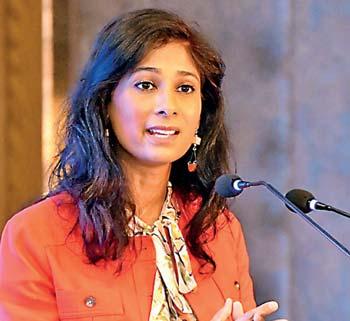 |
| Dr. Gita Gopinath |
By Shabiya Ali Ahlam
Sri Lanka received what can be called a charged address from the International Monetary Fund (IMF) yesterday, which declared that the island nation’s recovery from its worst economic crisis in decades must not be wasted.
“This time must be different!” said visiting IMF First Deputy Managing Director Dr. Gita Gopinath to Sri Lanka’s leadership, in a message that felt part warning and part vote of confidence.
“We believe this (current IMF programme being the last) is possible if Sri Lanka stays the course,” she told a room full of key decision makers of the country, including President Anura Kumara Dissanayake. It was also a stern call to break the past trends of aborted reforms.
Dr. Gita shared her views while addressing a conference themed ‘Sri Lanka’s Road to Recovery: Debt and Governance’, co-hosted by the Finance Ministry, Central Bank of Sri Lanka and IMF. The message comes as Sri Lanka is halfway through the IMF-supported programme and 75 years into the country’s engagement with the IMF. It also marked the first time in two decades that a serving First Deputy Managing Director has visited the island nation.
She commended Sri Lanka taking painful but necessary measures to pull its economy out from a free fall three years ago, when foreign reserves were depleted, inflation was spiralling and citizens queued for essentials such as fuel and medicine, amid crippling shortages. In 2022, it defaulted on its foreign debt, the first external default in its history.
Today, the situation has changed. Economic growth returned with a 5 percent expansion in 2024. Inflation has been brought under control. Imports have normalised. On the fiscal front, the government tax revenue rose by more than two-thirds of GDP, through tough but necessary reforms. The reforms included tax hikes, subsidy cuts and pricing reforms for electricity and fuel, measures that while politically unpopular, have been critical to regaining macroeconomic stability.
However, the IMF’s second-in-command cautioned that the work is far from over. “None of this will be easy. The global environment is difficult, with tariffs, geopolitical conflict and economic fragmentation posing major risks for small open economies like Sri Lanka,” said Dr. Gopinath. While praising the island nation, she also did not shy away from invoking the country’s chequered history with the IMF. Of the 16 programmes Sri Lanka has undertaken with the IMF, half were abandoned prematurely.
“Hard-earned gains were reversed. Growth faltered. The country cannot afford to repeat that cycle,” she warned.
“As the IMF Managing Director noted during our Spring Meetings in April: the choice facing countries today is between reform and regret.”
Meanwhile, she acknowledged that the restructuring of Sri Lanka’s sovereign debt, both external and domestic, has become a blueprint for emerging markets facing similar crises. The country secured US $ 3 billion in debt forgiveness and restructured a further US $ 25 billion, extending repayment periods and reducing interest rates.
Through this, the country has managed to slash its external debt service burden as a share of GDP by half. External and total debt stock will fall by 27 and 34 percentage points of GDP, respectively over the next decade.
She described the process as a complex but instructive case. Coordinating with a diverse group of bilateral creditors, among them India, Japan, France and informally China, demanded novel approaches to information-sharing and comparability of treatment. The IMF staff, she said, played a key role in facilitating dialogue and pushing the process forward.
Dr. Gopinath noted that Sri Lanka’s experience contributed to improving the global sovereign debt architecture. It directly informed the IMF’s new methodologies for evaluating “state-contingent features” in debt contracts and helped shape the restructuring playbook released during the IMF’s recent Spring Meetings. “The Sri Lankan debt restructuring experience provides several lessons that will help make the process simpler for other countries,” she said, while stressing that domestic debt, given its sensitivity to the financial system, required even more careful calibration.
Dr. Gopinath went on to stress that Sri Lanka cannot afford another crisis. For Sri Lanka, she said, the experience with the debt restructuring drives home the importance of managing the economy such that a similar situation would never arise again. She ended her remarks by echoing Dissanayake’s recent comments: “Let us ensure this is the last IMF programme Sri Lanka will need.”
21 Jul 2026 4 minute ago
21 Jul 2026 10 minute ago
21 Jul 2026 42 minute ago
21 Jul 2026 46 minute ago
21 Jul 2026 50 minute ago