27 Jun 2025 - {{hitsCtrl.values.hits}}
By Nishel Fernando
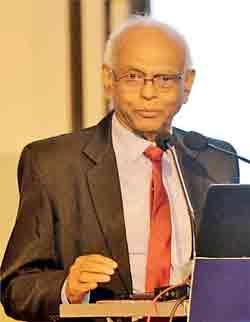 |
| Dr. W. A. Wijewardena Pic by Pradeep Pathirana |
Sri Lanka must shift its focus towards fostering innovation, empowering entrepreneurs, and moving beyond its current economic trajectory to achieve a prosperous future with a sustained growth rate of over 8 percent, according to former Deputy Governor of the Central Bank, Dr. W. A. Wijewardena.
Dr. Wijewardena cautioned that the nation should not be complacent with the current nominal economic stability, arguing that a growth rate of around 5 percent is effectively “zero growth” for a country such as Sri Lanka that needs to catch up.
“For a country like Sri Lanka to become a prosperous nation within a single generation, we must have a compound growth rate of about 8 percent year after year,” Dr. Wijewardena said.
“Anything below 4.5 percent is a negative growth rate for us. What we are planning today is to have either a zero growth rate or a negative growth recovery, which is not helpful for Sri Lanka.”
The senior economist presented his views while delivering the keynote address at the CA Sri Lanka Tax Symposium yesterday.
He emphasised that the current stability in prices and the exchange rate is nominal and that the real economy needs a significant boost. This, he argued, can only be achieved by transforming Sri Lanka into an innovation-driven economy.
Dr. Wijewardena asserted that a 4.5 percent to 5 percent growth rate is natural for an economy such as Sri Lanka and requires no significant effort. He stressed that true progress lies in consistently exceeding an 8 percent growth rate.
Drawing a distinction, he explained that invention is the creation of something new by scientists or engineers, while innovation is the commercial application of that invention by entrepreneurs. He cited the example of the smartphone, where the Gorilla Glass was an invention that Steve Jobs, the innovator, commercialised.
For Sri Lanka to prosper, Dr. Wijewardena outlined a four-step process: fostering inventions, encouraging entrepreneurs to innovate, diffusing the knowledge of these innovations across the country, and promoting imitation and adaptation of successful technologies.
He highlighted Sri Lanka’s low ranking in the Global Innovation Index, compiled by the World Intellectual Property Organization (WIPO), where the nation stands at 89th out of 123 countries. This, he argued, is indicative of the country’s low innovation status.
He went on to stress that the government is not equipped to lead this charge and that the private sector and entrepreneurs must be the driving force behind innovation. He criticised the demoralisation of research staff in universities and other institutions, which house a significant amount of human capital.
He also warned of external shocks, such as potential tariff revisions and geopolitical conflicts that could impact Sri Lanka’s recovery. He argued that a robust and growing real economy provides the necessary “space” to manage such external pressures.
Dr. Wijewardena urged policymakers and business leaders to create an environment that nurtures invention and facilitates its transformation into marketable innovations. He concluded by stating that a departure from the traditional economic mindset is imperative for Sri Lanka to break free from its cycle of low growth and achieve sustainable prosperity.
21 Jul 2026 4 minute ago
21 Jul 2026 10 minute ago
21 Jul 2026 42 minute ago
21 Jul 2026 46 minute ago
21 Jul 2026 50 minute ago