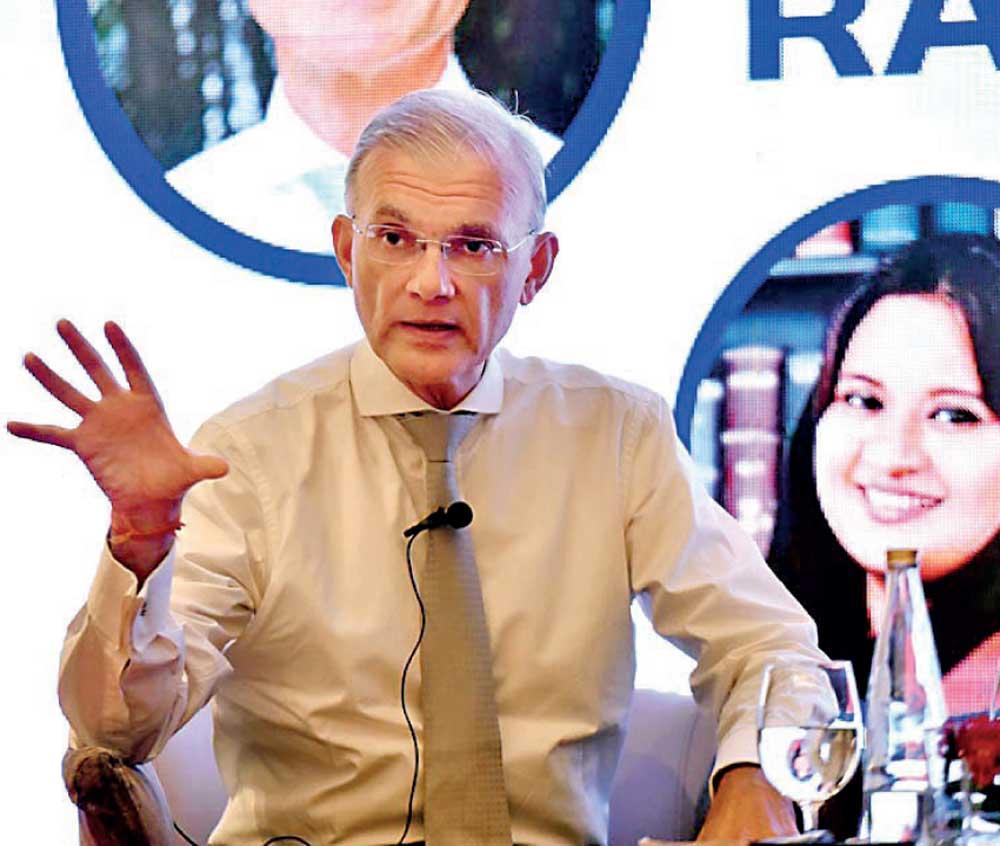
Prof. Razeen Sally
Pic by Nisal Baduge
- Says deeper trade, investment and regulatory changes are essential to shield crisis-hit economy from fresh external shocks
- Asserts it is important that Sri Lanka links itself to the value chains of southern India
Sri Lanka could miss a once-in-a-generation opportunity to plug into the fast-growing supply chains of southern India – that is unless the island nation pushes through market-opening reforms that go “well beyond” its current International Monetary Fund (IMF) programme, leading international economist Prof. Razeen Sally warned this week.
Prof. Sally, former Associate Professor at the Lee Kuan Yew School of Public Policy in Singapore and a former chair of the Institute of Policy Studies (IPS), Sri Lanka, said deeper trade, investment and regulatory changes are essential to shield the crisis-hit economy from fresh external shocks such as higher oil prices or new US tariffs.
“The danger is that the external shocks, Trump, trade wars, whatever new tariffs the United States might impose on Sri Lanka, hitting garment exports in particular, a skyrocketing oil price, as a result of an escalating Middle East war, might tip Sri Lanka pretty quickly into recession.
“...and it’s important that Sri Lanka links itself to that, particularly the south and the value chains of southern India. That’s not going to happen unless there are those structural reforms going well beyond the IMF programme,” he said.
Prof. Sally was responding to a question during a one-on-one session at the 13th Capital Market Conference in Colombo this week, moderated by Daily Mirror Business Editor Shabiya Ali Ahlam.
He traced Sri Lanka’s trajectory from the garment-led liberalisation of the late 1970s to the debt-fuelled expansion that collapsed in 2022 and mapped out three scenarios for the next five years, which are ‘drift’, ‘relapse’ and ‘sustainable growth’.
The first scenario is sticking to the IMF’s rescue but stopping short of deeper reforms, a path he deemed most likely under the current politics.
The second is a populist turn that could accelerate a slide back into recession and even a second sovereign default.
The third scenario is a reform push that dismantles import barriers, liberalises foreign direct investment and fully integrates Sri Lanka into global value chains, starting with India.
Without such a “take-off” scenario, Prof. Sally cautioned that the economy could lurch from crisis to crisis, eroding revenue, raising the risk of renewed default and fuelling public backlash.
Prof. Sally pointed out that India’s upgraded hard and digital infrastructure, especially in the southern states, offered Sri Lanka a ready platform for logistics, IT and professional-services exports that could offset any slowdown in its US $ 5 billion apparel sector.
However, according to him, the investors would only commit if Sri Lanka tackled the Customs red tape, streamlined investment rules and locked in policy continuity.
“Politically, of course, that’s unlikely, in all probability, given the domestic politics here. I’m not saying it’s impossible. But that’s the scenario that I think we need in these more adverse, malign global economic and political conditions,” said Prof. Sally.
Prof. Sally is currently focused on travel writing, journeying across Asia, as he works on his upcoming book.