12 Jun 2025 - {{hitsCtrl.values.hits}}
The Public Utilities Commission of Sri Lanka (PUCSL) yesterday approved a 15 percent increase in electricity tariffs, moderating the previously proposed hike.
According to the power sector regulator, the revision delivers a net annual relief for key sectors such as industry and hospitality.
While the revision is set to raise costs for commercial users and government institutions, the overall adjustment, which comes into effect from today, results in a lower electricity burden compared to 2024, for most large-scale operators.
The PUCSL said the tariff increase follows a comprehensive review of the Ceylon Electricity Board’s (CEB) request for an 18.3 percent hike and reflects inputs gathered through public consultations.
The PUCSL emphasised that the decision aligns with the cost-reflective pricing methodology approved by law and would be accompanied by a published account of how public suggestions were incorporated.
This marks the second tariff adjustment for 2025, following a 20 percent reduction announced in January.
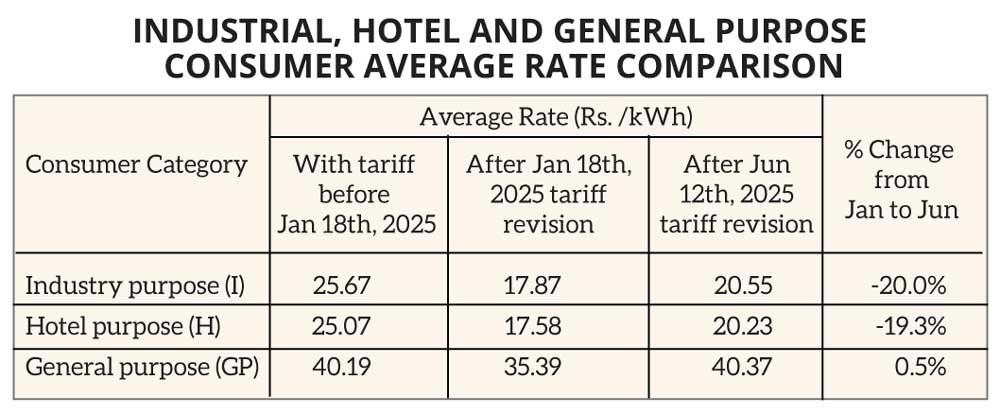
For the industrial sector, the new tariff structure translates to a 15 percent increase from the current levels but amounts to a 20 percent net decrease over the full year, when compared to 2024. The hotel sector will experience a similar trajectory, with the revision resulting in a 19 percent drop in costs year-on-year.
However, the commercial category, which covers general-purpose usage, will see a 14 percent hike under the new tariff structure. This equates to a 5 percent net increase compared to last year, raising concerns among retail, services and SME operators about mid-year cost adjustments. The government institutions, meanwhile, will absorb a 16 percent tariff increase, with no corresponding offset from January’s downward revision.
The PUCSL also announced an 8 percent increase in tariffs for the lowest consumption block of domestic users, a segment that had benefited most from the previous reductions.
The timing of the revision is significant. It precedes the visit of International Monetary Fund (IMF) First Deputy Managing Director Dr. Gita Gopinath, who is expected to arrive in Colombo next week. Electricity pricing reform has been a central condition under Sri Lanka’s ongoing programme with the IMF, which is seen as crucial for sustaining access to multilateral funding and restoring macroeconomic stability.
During the fourth staff-level agreement announced on April 29, IMF Mission Chief for Sri Lanka Evan Papageorgiou said the agreement was subject to two prior actions: restoring electricity cost-recovery pricing and ensuring the functioning of the automatic adjustment mechanism.
He described cost-reflective pricing as essential for minimising fiscal risks and enabling long-term infrastructure investments in the power sector. Papageorgiou further noted that there is a strong alignment between the government and IMF on the need to implement these reforms decisively.
“The government is committed to taking the reforms and owning those reforms,” he said, referring to the long-standing issues surrounding pricing and dependability of electricity supply in Sri Lanka.
21 Jul 2026 7 minute ago
21 Jul 2026 39 minute ago
21 Jul 2026 43 minute ago
21 Jul 2026 47 minute ago
21 Jul 2026 52 minute ago