27 Jan 2026 - {{hitsCtrl.values.hits}}
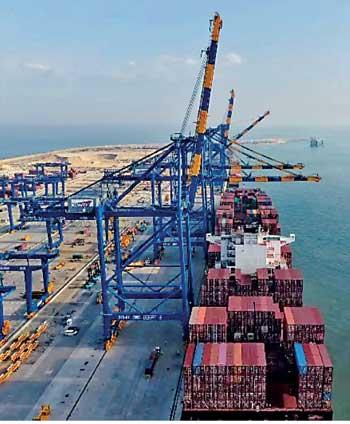 |
| Colombo West International Terminal |
By Nishel Fernando
A tale of contrasting velocities has emerged in the Port of Colombo, with the private sector-led Colombo West International Terminal (CWIT) rapidly outpacing the state-managed East Container Terminal (ECT) in 2025, prompting renewed calls from industry heavyweights to open the latter for private investment.
While the Sri Lanka Ports Authority (SLPA) celebrated the commissioning of ECT’s third berth last week, aiming to ramp up operations, the data shows the Adani-John Keells Holdings (JKH) consortium has already seized a dominant operational lead in its debut year.
According to the official data and statements, CWIT, which only commenced operations in April 2025, handled a massive 717,226 twenty-foot equivalent units (TEUs) by year-end. In contrast, the SLPA-managed ECT, operating with what the officials termed “incomplete infrastructure”, processed “in excess of 500,000 TEUs” during the same period.
The disparity is starker in capacity utilisation.
Speaking at a recent investment symposium, JKH Deputy Chairman Gihan Cooray revealed that CWIT has already reached 90 percent utilisation of its Phase 1 capacity of 1.6 million TEUs.
“At the run rate that it is going at now, we are pretty much at 90 percent utilisation of that capacity already,” Cooray said.
The state-run terminal is now racing to close the gap. Marking a pivotal milestone, the SLPA commissioned ECT’s third berth, a move attended by representatives from global giants Maersk, CMA CGM and MSC.
SLPA Managing Director Eng. Ganaka Hemachandra announced that jetty construction work is scheduled for full completion by mid-February 2026. Once the operational systems are fully integrated, the SLPA has set an ambitious throughput target of 1.5 million TEUs for ECT in 2026.
“The steady advancement of the SLPA is contributing tangible economic value,” Hemachandra stated, noting that the 1,300-meter quay length will now allow the terminal to accommodate large mainline vessels with minimal tidal constraints.
Despite the SLPA’s progress, the private sector sees unexploited value in the state asset. During the panel discussion, Cooray pointed to ECT’s lagging operational timeline as a strategic opening.
“If you look at it, ECT has not still become fully operational and that is an opportunity to even get investment in if they really want to go through that route,” Cooray remarked.
His comments reignite the longstanding debate on whether the fully state-managed model for ECT can match the agility of private operators. The data from the SLPA indicates that while CWIT added over 700,000 TEUs to the port’s volume, the SLPA’s own cluster of terminals, comprising JCT, UCT and ECT, saw volumes contract by 1.2 percent in 2025 compared to the previous year, suggesting that the state sector struggled to retain market share against the new entrant.
Both terminals are aggressively expanding. The rapid pace of development has been supported by local construction partners. Access Engineering PLC was awarded the construction work for WICT’s container platform and associated infrastructure, playing a key role in bringing the facility online ahead of schedule. Once Phase 2 is complete, the terminal’s total capacity will reach 3.2 million TEUs, potentially intensifying competition within the port further.
Meanwhile, the SLPA maintains that the addition of ECT’s third berth will ease congestion and distribute vessel calls more efficiently, positioning the facility to capture a larger slice of the transshipment pie in the Bay of Bengal and East-West shipping lanes.
As 2026 unfolds, the Port of Colombo is witnessing a direct race between state planning and private efficiency, with the numbers currently favouring the latter.
19 Jun 2026 3 hours ago
19 Jun 2026 5 hours ago
19 Jun 2026 5 hours ago
19 Jun 2026 7 hours ago
19 Jun 2026 7 hours ago