 KELUM BANDARA
Reply To:
Name - Reply Comment
 Whatever I’m saying is based on my experience in aviation—that’s number one. Number two, it’s from the video evidence I’ve seen, which is from amateur footage. So what I’m saying is just what I feel might have happened. I could be right, or I could be wrong. The black box has been recovered, and along with that, the cockpit voice recorder will also be examined
We can only speculate at this stage. The flight data recorder (FDR) and the cockpit voice recorder (CVR) will give us the real picture—whether there were any system warnings, whether the engines were delivering full thrust, flap settings, everything. Until then, we can only go by informed assumptions
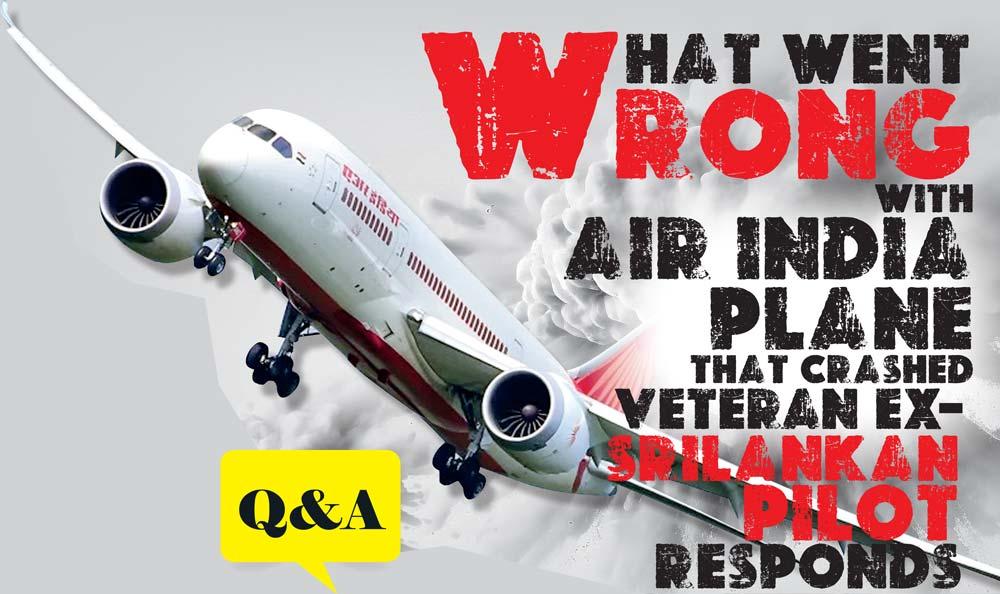
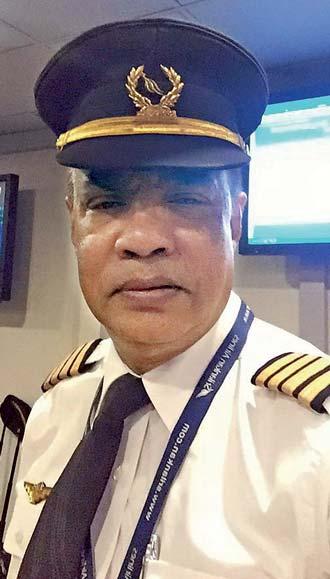
Days after the crash of an Air India flight, former SriLankan Airlines pilot captain Sri. Segaram speaks to Daily Mirror on the possible causes that might lead to an air crash. Captain Sri. Segaram has 45 years of experience with over 30,000 flying hours. Excerpts:
 QAs an experienced pilot, what do you think could have caused the Air India flight crash?
Whatever I’m saying is based on my experience in aviation—that’s number one. Number two, it’s from the video evidence I’ve seen, which is from amateur footage. So what I’m saying is just what I feel might have happened. I could be right, or I could be wrong. The black box has been recovered, and along with that, the cockpit voice recorder will also be examined.
So, they’ll come out with the actual reason for the crash quite soon—because there’s pressure from Boeing, the aircraft manufacturer; pressure from General Electric, which makes the engines; and also, Indian aviation is a very large and important industry. People are anxious to know what really happened. It’s a very sad incident. And it’s also a freak incident, because the Dreamliner, the Boeing 787, is a very reliable aircraft.
I have flown Airbus all my life—starting with the A320, then the A330, and later, the A340. They’re all very safe aircraft with modern technology. And even with all this, flying still remains the safest mode of transport in the world. Right now, while we’re speaking, there are thousands and thousands of people flying across the globe, and none of them are crashing.
But what happens is, when one aircraft goes down, and it takes many lives, it becomes a huge incident. I feel very sorry for the crew and passengers. But we’ll have to wait for the inquiry.
QBut as a captain with decades of flying experience, what do you think could trigger an air accident like this?
Yes, so again, I’m just talking about possible scenarios here. There are a few things we’ve tentatively ruled out.
For example, there was a theory that the aircraft was overloaded because it was a long-haul flight. But that was shut down, because there were empty seats onboard. Maybe it was payload-restricted, but not overloaded. So, we’ve temporarily ruled that out.
Second, there’s no indication of a single-engine failure. If one engine fails, the aircraft will yaw—that’s the technical term for when the aircraft turns or swings to one side. You’d usually see the plane veering slightly to one side due to asymmetric thrust. But that’s not visible in the footage we’ve seen—again, keeping in mind these are amateur videos. But in this case, the aircraft seems to take off smoothly and then just drops or “pancakes” straight down. Very unfortunate.
QSo, what are the main possibilities you’re considering at this stage—pending the black box analysis?
Since there was no bad weather reported, the accident would not have been due to weather.
We can only speculate at this stage. The flight data recorder (FDR) and the cockpit voice recorder (CVR) will give us the real picture—whether there were any system warnings, whether the engines were delivering full thrust, flap settings, everything.
Until then, we can only go by informed assumptions. But yes—it’s a tragic, freak event. We, in the aviation community hope that once the facts are out, we can learn from it and ensure it doesn’t happen again.
QCan you walk us through what normally happens during takeoff—and where things might have gone wrong in this incident?
Yes. So, flaps and slats—these are only used for takeoff and landing. We calculate the required settings based on weight, runway length, prevailing weather conditions, and so on. You then select that particular flap setting before takeoff.
Then, as the aircraft accelerates, it reaches a particular speed we call ‘V1’. “V” stands for velocity. In some aircraft, V1 is called out automatically; in others, the pilot monitoring will say “V1.” That’s what we call a ‘committal speed’. Above that speed, you’re committed to take off. Whatever problem occurs after that—engine failure or anything—you still continue the takeoff.
But below V1, the procedure is to reject the takeoff. The captain will say “stop” in Airbus procedures or company SOPs. In other companies, they might say “reject.” Basically, you stop the aircraft on the runway.
QAnd what happens after V1?
After V1, the next call is “rotate.” That’s when the pilot flying lifts the nose to initiate liftoff. Now remember—only one pilot flies, the other is monitoring. We still don’t know who was flying in this case—whether it was the captain or the first officer.
After liftoff, when the aircraft reaches around 25 to 45 feet—depending on weight—the pilot monitoring looks at the radio altimeter and other instruments and calls out “positive climb.” That confirms the aircraft is climbing. And that’s when you want to retract the landing gear, because it creates a lot of drag. Gear is only used on the ground, so you want to get rid of it once airborne.
Then, the pilot flying will cross-check and respond, “gear up.” But in this case, surprisingly, the gear was not up. The whole episode—from liftoff to crash—lasted about 28 to 30 seconds.
QSome theories suggest the pilot may have selected the flaps by mistake—can you elaborate?
There’s also a theory that the pilot monitoring mistakenly selected the flaps instead of the gear. I’ve seen some videos where people are trying to analyze whether the flaps were still extended or not. But it’s very hard to tell from amateur footage.
Now, hypothetically, if the flaps were retracted by mistake, that could be a serious issue. Flaps give you high lift at low speeds. If you retract them too early, the aircraft can sink—especially just after takeoff. That would be a human error—but again, we don’t know yet. Still speculative.
QThere’s also been talk about RAT deployment—what is that?
The “RAT”, or Ram Air Turbine. On any modern aircraft, if all engines fail, you will lose electrical and hydraulic power—so what happens?
The RAT drops down. It’s a small turbine located under the wing. It turns by airflow and generates emergency electric power and hydraulic power for basic aircraft control.
There’s a video going around where someone claims they saw the RAT deployed on the aircraft. I saw it too, but I’m not convinced. Still, if the RAT was deployed, it means both engines had failed—which would be an extremely rare occurrence. A freak incident. One in ten million.
All engine failures have occurred before. For example, British Airways flew through volcanic ash once and lost all four engines, but they managed to restart them. And of course, Captain Sully of US Airways lost both engines due to bird strike and ditched in the Hudson River.
But here, the aircraft was at such a low altitude that there was ‘very little choice’. At that height, you don’t have the lift to glide or time to react. You can’t turn, can’t climb—you just try to control the crash. That’s the tragic part.
QDo you think the pilots had any time to react?
Let’s say the total event lasted about 28 seconds. If it takes, say, five seconds for the crew to realize something has gone wrong—that leaves about 20 seconds before impact. That’s very little time. It’s terribly unfortunate. You can’t do much in that window.
There were reports that the pilot may have said “Mayday,” or “no thrust” as they were going down. But again—we don’t know if that’s real. These things are on social media—you have to take them with a pinch of salt. The only credible proof is that the air traffic controllers heard the Mayday call.
QCan you describe a situation where you encountered a technical failure during flight?
Engine failure happened to me while take-off at low level, departing Cochin. It is a critical one.
QWhat happened in Cochin?
In Cochin, we took off, and the engine failed. We shut down the engine, declared an emergency, and came back and landed. That’s it. But the aircraft is capable of flying with one engine. So, nothing to panic about. We are trained to handle that. It has happened to me. I’ve done it also.
QWere there any specific technical issues?
Yes, technical failures happen. Sometimes... even landing gear can fail to extend. Then we have an alternate method—landing gear extension, hydraulic pump, and all those systems. If it’s not working, we go for a gravity extension. There are alternate systems. If that’s not working, we do belly landing. I haven’t done it. But there are people who have done it. These are emergencies that can occur, but not very common. Those are the things we’re trained to handle.
-What do you think of SriLankan Airlines’ safety standards?
I’ll tell you—I’m not saying this because I’m ex-SriLankan Airlines pilot. We have one of the best safety records. People might be complaining: the flight is delayed, the schedule is all changed, the food is not good, the seat’s uncomfortable, and the TV’s not working. Those are all simple things. Definitely, those are customer-based issues.
But safety-wise, we have some of the best pilots. We have some of the best cabin crew. And we have some of the best engineers and technicians. All personnel —personnel, directly or indirectly handling the aircraft—have high standards. We are as good as, or even better than, any other.
When we go to other countries, we see their engineers or technicians work, we look at them. Our people are very, very good. The pilot standards, the training standards—excellent.
QWhen you talk about an airline’s safety, mainly the responsibility lies with the pilot. But other than that, who else is responsible?
People who are responsible for an aircraft to fly from A to B, there are many people involved directly and indirectly- ground handlers, cargo handlers, flight dispatchers, technicians, engineers, cabin crew and pilots.