Reply To:
Name - Reply Comment

The Easter Sunday Attacks of 2019 stand as a stark reminder that intelligence is only as good as the leadership’s willingness to act upon it

In the grand theatre of global geopolitics, the visible actors, presidents, prime ministers and generals often command the limelight. However, the true script of national survival is frequently written in the shadows by those whose faces remain unknown and whose successes are rarely celebrated. National intelligence is the lifeblood of a sovereign state; it is the early warning system that prevents catastrophe and the strategic compass that guides leadership through the fog of war and diplomacy.
From the legendary exploits of the CIA and Mossad to the localised, high-stakes operations of Sri Lanka’s intelligence apparatus, the mission remains constant: to know what the enemy thinks before they act.
Architecture of national security
National security is not merely the presence of a standing army at a border. It is a state of readiness predicated on information. Intelligence agencies such as India’s RAW, Britain’s MI6 (SIS), and Russia’s FSB/SVR (the successors to the KGB) serve as the “eyes and ears” of the nation. Their role is to safeguard sovereignty and territorial integrity against a spectrum of threats that are increasingly non-linear and asymmetrical.
These threats are no longer just tanks crossing a line on a map; they are cyber-attacks on power grids, the radicalization of youth via encrypted apps, and the silent infiltration of financial systems.
The Human Element: Infiltration and the Necessity of “Dirty Work”
One of the most enduring truths of intelligence is that while technology is powerful, Human Intelligence (HUMINT) remains the gold standard. To understand the “intent” of an enemy, one must go inside the room where decisions are made.
The process of infiltration is often morally complex and physically perilous. It requires intelligence officers to embed themselves within hostile organizations, often posing as sympathizers or recruits. As noted in the case of Osama bin Laden, the breakthrough that led US forces to his compound in Abbottabad was not solely a satellite image; it was the painstaking tracking of his inner circle, including his courier/driver, often facilitated by financial incentives.
The use of “secret salaries” or ransoms is a pragmatic necessity. In the world of espionage, loyalty can often be bought when it cannot be earned. Without the ability to compensate informants or flip enemy assets, an agency is effectively blind to the internal dynamics of a terrorist cell or a hostile foreign cabinet.
The Case for Infiltration: “The Enemy Within” the most accurate information comes from within the enemy’s own network. This requires deep-cover agents. The Financial Incentive: Why pay “secret salaries”? Because ideology is often fickle, but financial survival is a universal motivator. By offering a “way out” or a “ransom” to a driver, a bodyguard, or a low-level clerk, an agency like the CIA or RAW can bypass the most sophisticated encryption. The Risk of “Going Dark”: If an agency relies solely on technology, they risk being “blinded” if the enemy stops using phones or moves to a platform they cannot crack. Infiltration ensures that even if the enemy uses “code words,” the agent on the inside can translate the true meaning.
Information gathering
Intelligence is not a monolith; it is a puzzle assembled from various sources. While your focus on Infiltration and Human Intelligence (HUMINT) is historically accurate as the most effective method, modern agencies use a “Full-Spectrum” approach:
Technology vs. Tradecraft: The battle for communication
We live in an era of unprecedented digital transparency, yet the “dark spots” are growing. While agencies use sophisticated signals intelligence (SIGINT) to intercept communications, the “enemy” has adapted.
 Code Words and Nicknames: Just as in World War II, modern insurgents use linguistic decoys to mask their true intentions.
Encrypted Platforms: Applications like WhatsApp and Signal provide end-to-end encryption that presents a significant hurdle for traditional wiretapping.
The Lesson of Yamamoto: During WWII, the US successfully decrypted Japanese naval codes, allowing them to intercept and shoot down the plane carrying Admiral Isoroku Yamamoto. This single piece of intelligence changed the trajectory of the Pacific War. At present, that same level of interception requires bypassing modern encryption a feat that often necessitates “hacking” the human rather than the software.
The Sri Lankan Context: A Case Study in Intelligence Failure and Success
Sri Lanka’s history provides a poignant and painful look at the importance of intelligence. During the decades-long conflict with the LTTE, intelligence was the deciding factor in dismantling the group’s international procurement networks and internal suicide cells.
However, the Easter Sunday Attacks of 2019 stand as a stark reminder that intelligence is only as good as the leadership’s willingness to act upon it.
The tragedy of the Easter attacks was not a lack of information. Intelligence agencies in India and the United States provided specific, actionable warnings regarding the National Thowheeth Jama’ath (NTJ). They provided the dates, the targets (churches and hotels), and the names of the perpetrators.
“The failure was not in the gathering of intelligence, but in the dissemination and the political will to respond.”
When the then President and Commander-in-Chief Mr Maithripala Sirisena failed to act on these warnings, the result was the loss of over 250 innocent lives. The subsequent legal ruling ordering a fine of Rs 100 million against the former head of state underscores a vital principle: National intelligence is a sacred trust. When politics interferes with security protocols, the citizens pay the ultimate price.
Perils of political interference
For an intelligence agency to be effective, it must be apolitical. Its sole allegiance must be to the State and its people, not to the party currently in power.
When intelligence services are used as tools for political surveillance or when their personnel are targeted for political vendettas, the entire national security framework begins to crumble. Weakening these agencies whether through budget cuts, the exposure of undercover assets for political gain, or the appointment of unqualified loyalists creates a vacuum that extremists and foreign adversaries are quick to fill.
Protecting the Protectors
To maintain a robust intelligence posture, a nation must:
Ensure Secrecy: Protect the identities of officers and the methods of collection.
Provide Legal Protections: Ensure that officers acting in the interest of national security are not unfairly prosecuted for the “gray area” actions inherent in espionage.
Modernize Capabilities: Invest in AI and data analytics to sift through the mountain of metadata generated in the digital age.
Conclusion
The importance of national intelligence cannot be overstated. It is the difference between a nation that anticipates a blow and a nation that is reeling from one. Whether it is the CIA’s global reach or the localized vigilance of Sri Lankan intelligence, these men and women form the invisible wall that allows a society to sleep in peace.
To ignore their warnings is negligence; to weaken their structure is a betrayal of the national interest. Sovereignty is not a gift; it is a condition maintained by constant, quiet, and often dangerous vigilance.
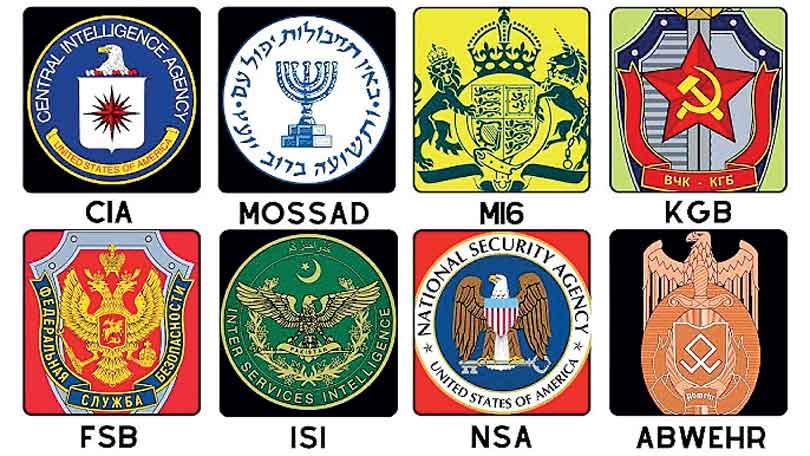
Each country has its intelligence agencies such as India’s RAW, Britain’s MI6 (SIS), and Russia’s FSB/SVR (the successors to the KGB) which serve as the “eyes and ears” of the nation
(The writer is a battle hardened Infantry Officer who served the Sri Lanka Army for over 36 years, dedicating 20 of those to active combat. In addition to his military service, Dr Perera is a respected International Researcher and Writer, having authored more than 200 research articles and 16 books. He holds a PhD in economics and is an entrepreneur and International Analyst specialising in National Security, economics and politics. He can be reached at [email protected])