Reply To:
Name - Reply Comment
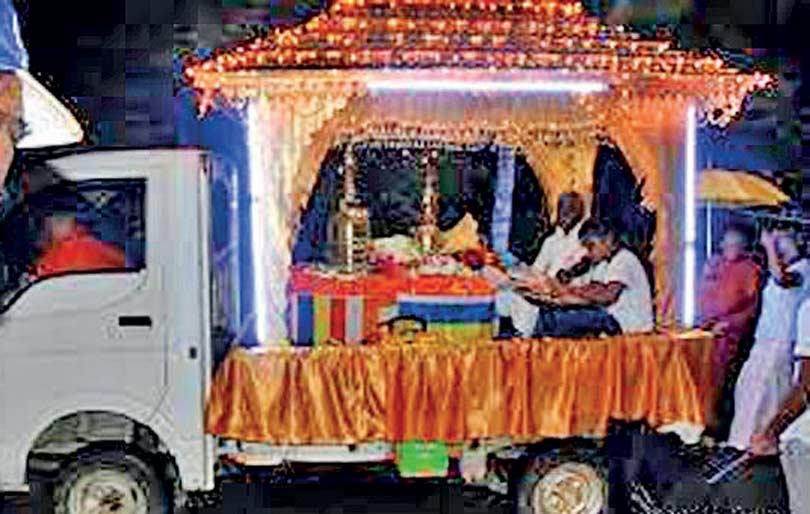
Katina is colourful but noisy
 Living in a hamlet surrounded by five Buddhist temples, a Catholic church, and a mosque creates an inescapable soundscape. Residents endure a continuous stream of amplified religious observances
 In the quiet hours before dawn, when communities should be at rest, Sri Lanka’s residential neighbourhoods are jolted awake by amplified loudspeakers from religious institutions. This relentless noise, presented as devotion, has become a serious public health concern that contradicts the fundamental principles of every tradition it claims to represent.
Living in a hamlet surrounded by five Buddhist temples, a Catholic church, and a mosque creates an inescapable soundscape. Residents endure a continuous stream of amplified religious observances: Buddhist suttas chanted in Pali, Sinhala Christian hymns, and calls to prayer in Arabic. These institutions alternate in providing non-stop amplified sound to communities who never requested such intrusion. The paradox is striking—religions that teach compassion and mindfulness have inadvertently become sources of disturbance to the very communities they serve.
The Problem with Modern Religious Celebrations
Buddhist temples conduct their Vas and Katina rituals throughout October, culminating in elaborate processions that begin in the early morning hours. These feature hundreds of devotees, elephants hired at considerable expense, dancers, fire-ball acrobats, drums, horns, whip crackers, fireworks, and loudspeaker-mounted vehicles broadcasting recorded chants. The latest development involves installing loudspeakers on every electric or telephone post in the vicinity, creating an inescapable grid of amplified sound that penetrates every home and street. Streets are draped with wasteful illuminations, elaborate lighting displays that consume enormous amounts of electricity while the nation grapples with energy shortages. These noisy, brightly-lit processions often take unnecessarily long routes through neighbourhoods to reach temples located just a short distance away.
The contrast with practices elsewhere is instructive. At a Katina ceremony in Dandenong, Melbourne, approximately 500 Lankan Buddhists and Australians walked peacefully, chanting “Sadhu, Sadhu” in quiet reverence. There were no hired drummers, acrobats, whip-crackers, or wasteful decorations. Schoolchildren on decorated bicycles added modest color. The procession started at 10:00 AM and reached the temple within thirty minutes. This simple celebration honored both Buddhist teachings and the community’s right to peace.
What the Sacred Teachings Actually Say
The venerable Piyadassi Thera of Vajiraramaya offered important guidance: “Benefit could be derived only by listening intelligently and confidently to pirith sayings because of the power of concentration that comes into being through attending whole-heartedly to the truth of the sayings. Blaring forth the sacred suttas and disturbing the stillness of the environment, forcing it on ears of persons who do not invite such chant is the anti-thesis of the Buddha’s teaching.”
Buddhist texts record that when ascetics saw the Buddha approaching, they would resolve: “Be quiet, don’t make a sound! It is the Gautama who is coming. He is a lover of appasaddá [quietness/silence].” The Buddha himself valued silence and stillness as essential conditions for spiritual practice.
St. Mother Teresa articulated a similar principle: “We cannot find God in noise and agitation. Nature, trees, flowers and grass grow in silence, the stars, sun and moon move in silence. Silence our eyes, silence our ears, silence our mouths, and silence our minds, in the silence of hearts God will speak.” Prophet Muhammad instructed his companion Omar to lower his voice when reciting the Quran in congregational prayer.
Every major religion values contemplation and inner peace. Yet contemporary practice has increasingly substituted amplified noise and ostentatious displays for genuine spiritual engagement.
The Health and Social Impact
Medical professionals report significant health consequences from prolonged noise exposure. ENT consultants note that victims commonly display signs of hypertension, irritability, stress, sleep deprivation, and tinnitus. These represent serious threats to public health, particularly for vulnerable populations.
Schoolchildren attempting to study, elderly citizens requiring rest, patients recovering from illness, and individuals with mental health conditions all suffer disproportionately. In any civilized society, events that deprive children, students, the elderly, or sick persons of sleep, especially during early morning hours, raise serious ethical concerns.
The Sri Lankan legal system has addressed this issue. In FR case 38/2005 (Ashik vs. Bandula and others), Chief Justice Sarath N. Silva established strict conditions for noise amplification permits under Section 80(1) of the Police Ordinance, stating clearly: “No religion recommends that prayers should be performed by troubling the peace of others, nor does it speak that they should be through amplifiers or beating of drums.”
However, enforcement remains inadequate. The Central Environment Authority developed draft standards for permitted noise levels that require urgent implementation. In developed countries, loud music in public parks after 10:00 PM is prohibited. Buddhist discipline fundamentally emphasises observing one’s behaviour to ensure no harm comes to others. The practice of “Shabda Puja”, worship through amplified sound, was introduced long after the Buddha’s time and represents a departure from his original teachings.
A Path Forward
The Buddha established Vas (Rains Retreat) as a practical response to monsoon conditions that made travel difficult and could harm crops and insects. The Katina tradition originated when monks delayed by floods arrived in mud-splattered robes and were given cloth to create garments for those most in need. These were practices rooted in genuine necessity and compassion, not opportunities for ostentatious display.
The circumstances have fundamentally changed. The Buddha taught that intent matters above all else. We must ask: what is the true intent behind amplified noise and extravagant peraharas? Is it spiritual elevation, or has it become about visibility and competition among temples?
The practice of draping streets with elaborate lighting displays during Katina celebrations consumes enormous amounts of electricity, a particularly troubling extravagance when the nation faces energy challenges and many citizens struggle with high electricity costs. The Buddha lived simply, walked barefoot, and owned three modest robes. How do wasteful illuminations and expensive processions honour his teachings on simplicity and mindfulness?
The Need for Reform
Meaningful reform should emphasise substance over spectacle. For the genuine survival and relevance of religion, the focus must shift toward deeper training in spiritual principles rather than external displays.
Religious institutions should embrace their own foundational teachings. Buddhism, Christianity, and Islam all emphasise compassion, consideration for others, and the importance of inner peace over outward show. Communities deserve protection from excessive noise that harms health and disrupts daily life. Children need environments conducive to learning. The elderly and sick require peaceful conditions.
True spirituality flourishes not in amplified sound or wasteful displays, but in the silence where genuine reflection occurs. Religious institutions have an opportunity, and indeed an obligation, to lead by example, demonstrating that authentic devotion respects both the sacred and the community. Only through such reformation can these traditions maintain their relevance and genuinely serve the spiritual needs of modern society while honoring the peace and wellbeing of all citizens.
A “system change” reducing rituals and poojas has become an essential feature. Rituals, one can argue, are cultural requirements, but for ensuring survival of the sasana, the gradual shrinking of religion should be substituted by increased training in the pure Dhamma. The choice is clear: religious institutions must return to their foundational teachings of compassion and mindfulness, respecting the peace of their communities. Only then can the true anisansa, the spiritual merit and blessings, of Katina Pooja and other sacred observances be genuinely experienced.