Reply To:
Name - Reply Comment
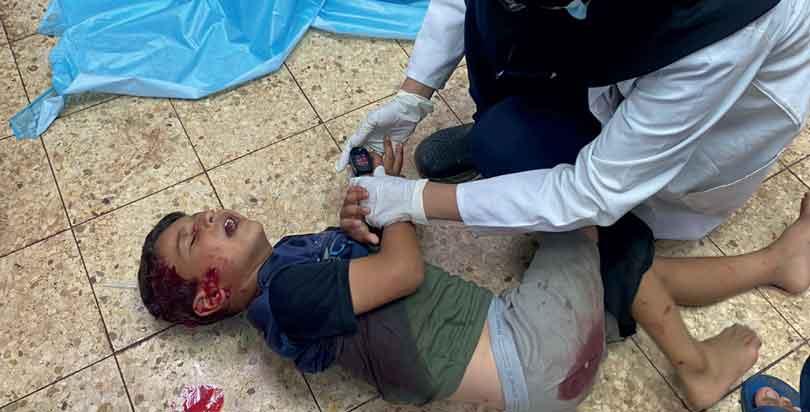
A wounded Palestinian child receives medical attention at the Nasser Medical Complex in Khan Yunis in the southern Gaza Strip yesterday, following Israeli bombardment. AFP
 In one of his celebrated poems, the famous Tamil poet Subramania Bharathi said, “Let’s destroy the world, if a single person cannot find food.” Reflecting moral urgency and responsibility, he also wrote, “If the young go hungry without food, let the world be destroyed!”
His radical and resonant words, rooted in Asian ethical traditions, stand in stark contrast to the so-called Western values which are being corrupted by imperial powers that continue to shield Israel despite the Zionist entity’s morally reprehensible use of starvation as a weapon against the Palestinian people, including children.
Humanitarianism is neither Western nor Oriental. If we have a modicum of humanity left in us, the basic working-class meal we partake of should appear to us as vulgar luxury when children in Gaza die of hunger.
Yet feeding the hungry has become conditional. There is no altruism. Only politics.
The condition is that Hamas must hand over the hostages and surrender its weapons for the war to end and the siege to be lifted. As much as these are Israel’s demands, they are now also the Arab rulers’ demands. They are part of a surrender document euphemistically called the New York Declaration, adopted at the end of an international conference two weeks ago—a white paper of sorts, envisioning Gaza as an occupied territory stripped of resistance.
Keep Hamas aside and focus solely on resistance. International law defines resistance as the collective or individual actions taken by a people to oppose, challenge, or overthrow a foreign occupying power that exercises control over their territory without consent. This definition fully legitimises the Palestinian struggle from 1947. At that time, world powers manipulated the newly formed United Nations to pass an unjust resolution. This resolution gave native Arabs, who constituted about 70 percent of Palestine’s population, only 45 percent of the territory, while granting Jews, many of whom were European with little or no connection to the land, 55 percent of Palestine.”
The legitimacy of the Palestinian armed struggle resonates in the United Nations Charter and numerous United Nations resolutions and treaties. Additional Protocol I to the Geneva Conventions of 1949 recognises resistance as a protected and essential right of occupied people everywhere.
In 1974, UN General Assembly resolution 3314 affirmed the right “to self-determination, freedom and independence of peoples forcibly deprived of that right, particularly peoples under colonial and racist regimes or other forms of alien domination”. It also noted the right of the occupied to “struggle … and to seek and receive support” in that effort.
UNGA resolution 37/43 (1982) explicitly affirmed the lawful right of occupied peoples to resist occupying forces by all lawful means, including armed struggle. In light of this legitimacy, those who describe resistance as terrorism are arguably bigger terrorists.
While international law is crystal clear about the right to resist by “all means, including armed struggle”, the Western-Zionist cabal’s declaration of resistance as terrorism is nothing but a calculated effort to delegitimise resistance and enable Israel to grab more Palestinian and Arab lands. Such anti-resistance narratives also serve the imperial West’s project of keeping Arab leadership subjugated—a process rooted in the 1916 Sykes-Picot (between Britain and France) Agreement, designed to prevent the Arabs from uniting and posing a challenge to Western imperialism.
In a recent article published on the Middle East Eye website, History Professor Ussama Makdisi, who is also the Chancellors Chair at the University of California, Berkeley, called this project aimed at Arab enslavement Arab Façade, which he says now serves the US imperial interests.
According to the erudite Middle Eastern expert, who is the nephew of world-renowned scholar Edward Said, the so-called sovereignty of Arab nations is a façade. The essence of this façade lay in unelected native rulers fulfilling certain conditions to obtain nominal independence. These included accepting subordination to British imperial dictates; acknowledging that their personal fortunes and dynasties were tied to imperial favour; not resisting British hegemony in the region; not opposing British support for Zionist colonisation of Palestine, regardless of its injustice and unpopularity; and either mollifying their people s demands to liberate Palestine or, failing that, cracking down on those very demands.
Arab rulers who tried to defy the rules of the Façade were done away with. Among them was King Ghazi, grandson of Sharif Husayn, the Ottoman governor of Makkah who betrayed the Ottoman caliphate for thirty pieces of silver. The British rewarded this treachery by making his two sons kings in the Balkanised Middle East: Faisal became king of Iraq, and Abdullah, king of Jordan. King Ghazi ascended the throne of Iraq after Faisal s death. He defied the British-imposed Arab façade and sought to assert Iraq s sovereignty. In 1939, he was killed in a car crash though many Iraqis believe he was killed by British agents.
In 1975, a nephew shot dead Saudi King Faisal, who had defied Western imperialist dictates and spearheaded the 1973 oil boycott in support of the Palestinian cause. The incident remains a mystery to this day. Others who defied imperial interests and paid with their lives include Saddam Hussein of Iraq and Libya’s Muammar Gaddafi. Bashar al-Assad, by contrast, survived—fleeing to Russia to save his life. But the Syria he once ruled is now run by Zionist puppets who permit Israel to seize Syrian territory at will.
In these deaths and ousters, there is a warning to Arab rulers: if they go against the West, they will face a similar fate. One wonders whether in their hearts, the fear of the imperialists is more intense than the fear of their God, who commands them to stand up for justice and resist oppression, even if it means the loss of their kingdoms and all the worldly pleasures they cherish.
Given that the imperialists who reap the benefits of the Arab Façade project are firmly in control of Arab regimes, it is sheer wishful thinking for Palestinians to hope that their cries would shake the corridors of power in the Arab capitals. For the past 22 months, the Arabs have been holding conferences, waxing eloquent in meeting after meeting at the UN Security Council, and holding talks with the very world leaders who arm and finance Israel’s genocide—but all their actions add up to zero in terms of relief for Palestine.
With the Palestinians left to their own fate, and with only nominal support coming from Arab capitals, it is no surprise that the New York declaration from the recent international conference, hosted by France and Saudi Arabia, has turned out to be yet another attempt—or even a charade—that favours Israel.
Backed by the Arab League, the European Union, and 17 other countries, the declaration—seeking to appease genocide-committing Israel—condemned the October 7, 2023, attacks by Hamas and insisted on Hamas’s disarmament.
In other words, the declaration is calling for the death of resistance—the last hope of the Palestinians—as Israel’s hardline Prime Minister Benjamin Netanyahu and his government move ahead with plans to annex Gaza after expelling or decimating its population.
What does the day after look like, following a Hamas surrender of weapons to the Palestinian Authority as demanded by the New York declaration? An occupied Palestine without resistance—a freehold for Israel.