Reply To:
Name - Reply Comment
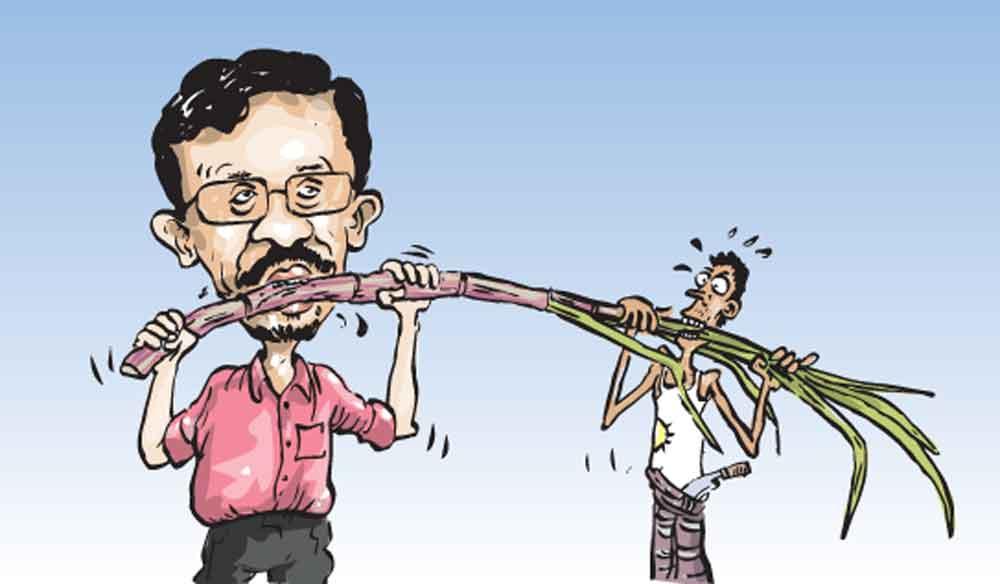
Sri Lanka has experienced the best and the worst when it comes to privatisation attempts. Privatisation affected many industries including the sugar industry which eventually led governments to import sugar, impose taxes and pushed farmers towards a crisis.
The privatisation of Hingurana and Kantale sugar factories, which had been state-owned, is seen as a significant turning point. These factories experienced initial disruption under private management, which contributed to the decline of the domestic sugar industry. The Kantale Sugar Factory for instance was once a thriving venture and a lifeline for people living in its surrounds. But this highly profitable venture was gulped down by the darker shadows of privatization attempts. At present, this massive factory complex which was initially built on a 44,000 acre complex, now remains abandoned on a 21,000 acre expanse of land.
However, between 2011/2012 the government took over the Pelwatte and Sevanagala sugar factories under the Revival of Underperforming Enterprises and Underutilized Assets Act, creating Lanka Sugar Company Ltd. (LSCL) with the goal of increasing local production and reducing import dependency. Policies, including a significant VAT on ethanol and the withdrawal of custom duties on imported sugar, were implemented, partly due to IMF recommendations. These actions severely impacted the profitability of the state-owned factories, leading to losses.
In order to address this crisis with a vision to strengthen and sustain the country’s domestic sugar industry, the government has taken steps to promote the use of locally produced brown sugar among the general public. As such, Cabinet approval was granted to make it mandatory for all state institutions to use brown sugar in food production. The decision is expected to boost demand for the product and support the livelihoods of factory workers, sugarcane farmers, and service providers linked to the local industry.
But recently, Minister of Industry and Entrepreneurship Development Sunil Handunneththi came under scrutiny following the opening of a sugar sales outlet in Nugegoda to promote brown sugar consumption among the public. Speaking in Parliament, he said that Sri Lanka has imported 2,502 million metric tonnes of sugar during the last five years at a cost of Rs. 350 billion (more than USD 1500 million).
However, critics point out that opening exclusive state-run stores to sell sugar may not generate sustainable profits and could, in fact, impose an additional strain on public finances. They point out that sugar prices in the open market remain lower than those offered at government-run outlets, undermining the project’s competitiveness.
In one of the episodes, a popular YouTuber recently pointed out the price disparities of products sold at this sales outlet and the price of sugar sold at local shops. As such, the price of one kilo of premium brown sugar at this sales outlet is Rs. 350 while a kilo of normal brown sugar is Rs. 275 at the same outlet. But elsewhere, prices vary from Rs. 261.30 to Rs. 248 raising concerns on affordability.
Economic experts claim that the project duplicates private-sector operations and lacks a viable financial model. According to them, without an effective pricing strategy and transparent supply chain management, the network could fail to generate sufficient revenue to offset operational costs.
In response, Ministry officials insist that the network’s long-term focus is not merely profit but also economic empowerment of rural sugarcane farmers. By promoting locally produced sugar over imported varieties, they hope to strengthen domestic industries and reduce dependency on foreign imports. Earlier this year, sugarcane farmers complained about government’s failure to distribute thousands of metric tonnes of sugar stored at warehouses. Lanka Sugar Company Limited came under scrutiny due to lack of storage space to store sugar, mounting financial pressure, delayed salaries for employees and non-payment of dues to nearly 15,000 farmers.
The government needs to address existing issues in the sugar industry without diverting from reality.
New projects are welcome but they shouldn’t be done at the expense of people’s trust or be an eyewash in the long run – because people have had enough of such political drama in the past.
‘Your Thought’ is a space, a right of the readers to support or contradict and discuss the issues highlighted in the editorial and other articles in the editorial and op-ed pages. Designed as the reader’s editorial; our readers can send in their writings, with a word count not exceeding 200, to ‘Your Thought’, Daily Mirror Political Features Desk, No 8, Hunupitiya Cross Road, Colombo 2 or email to [email protected]