Reply To:
Name - Reply Comment
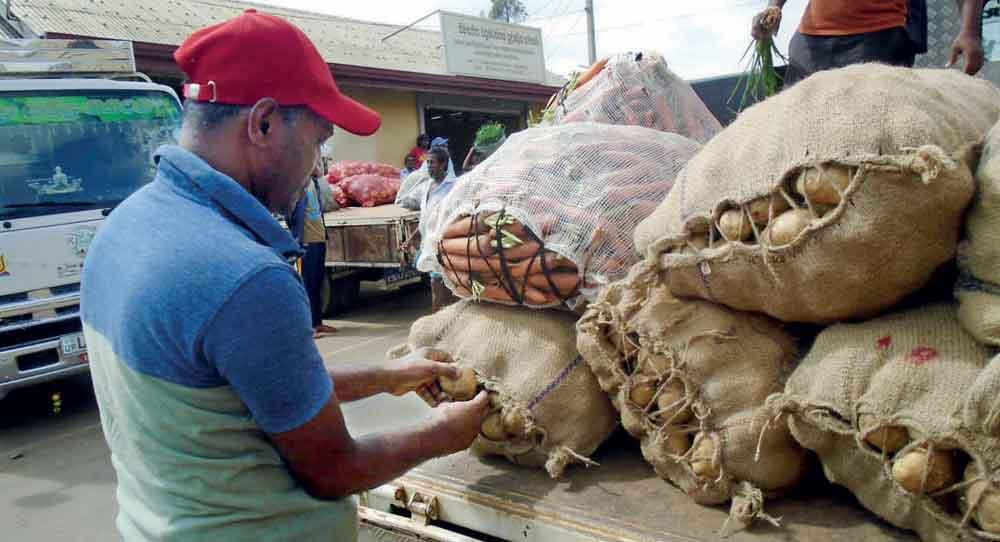
Potatoes brought to the Keppetipola Economic Centre is left unsold
By K. R. Rajamanthri
Farmers in the Welimada plateau maintain that cultivating potatoes requires a very high investment, and when the harvest they produce reaches the market, imported potatoes are sold at lower prices during the same period. As a result, the prices of the harvest obtained from the 2025/26 Maha Season have already dropped, causing severe economic as well as mental distress to farmers, making those in the Welimada plateau fear that potato cultivation may disappear from the area in the near future.
They also point out that as farmers gradually shift from potato cultivation to other vegetable crops, there is a risk that overall vegetable prices will decline significantly in the future, placing the entire farming community under severe economic pressure. Therefore, potato farmers in the Welimada plateau requested the government to prevent farmers from abandoning potato cultivation by allocating a portion of the import taxes collected on imported potatoes to provide them with seed potatoes and chemical fertilizers.
Although Minister Lal Kantha stated in Parliament that in 2026 the government would purchase local potatoes at Rs. 250 per kilogramme through Lanka Sathosa, the harvest from the 2026 Maha season has already begun to enter the market -- the minister’s promise has still not been fulfilled. Farmers therefore urged the government to resolve this issue, noting that the fall in potato prices will inevitably lead to a decline in the prices of other vegetables as well.
T. M. Muthubanda (67), an active member of the Kumburuyaya Farmers’ Organisation in Sapugolla, Uva Paranagama, stated: “We spend a very large amount of money cultivating vegetables, including potatoes. We are unable to obtain a fair price for the potatoes we cultivate during the Yala Season because imported potatoes permitted by the government enter the market during the same period when our harvest is released to the market.
“As a reasonable solution, we have requested successive governments, including the current one, to stop importing potatoes before our harvest season begins. In 1994, when former President Chandrika Kumaratunga came to power, she set a guaranteed price of Rs. 35 per kilogramme of potatoes during the election. Within about a year after she came to power, the market price fell to Rs. 25. At that time, she took steps to compensate farmers for the Rs. 10 difference. She fulfilled the promise she made to farmers. However, the programme collapsed because of corrupt officials.
“Previous governments provided fertilizer subsidies to farmers. However, farmers protest every year when local potato prices fall. In response, governments increase import taxes on imported potatoes. Yet the problems faced by farmers have never been properly resolved. Like previous governments, the present government has also deceived farmers”.
Imported potatoes cheaper
“In previous years, I cultivated about 1000 to 1200 kilogrammes of seed potatoes during the Maha season. But due to high cultivation costs and the poor prices received for potatoes grown in the previous Yala Season, this time I cultivated only 50 kilogrammes. Now potatoes grown by our local farmers are entering the market. Because imported potatoes are available in the market at lower prices, we cannot even recover the money spent on cultivation. Therefore, we are forced to shift from potato cultivation to other vegetables that require lower costs to grow.
“As vegetable cultivation increases, the prices of those vegetables also fall, which ultimately affects the entire farming community. A clear example that farmers are abandoning potato cultivation is that for the 2025/26 Maha season, even the newly developed seed potato variety (G-01) produced by the Department of Agriculture was purchased by farmers in smaller quantities, according to officials at Agrarian Service Centres. Under these circumstances, there may also be a shortage of seed potatoes for cultivation in the coming Yala Season, which will create serious difficulties in continuing potato cultivation,” he added.
R. M. Rohana Ramanayake (61), convener of the Welimada Uva Paranagama Vegetable Farmers’ Association, stated: “We are proud potato farmers. If we are in a better position today, it is because of potato cultivation. Compared with the past, the cost of cultivation has now increased rapidly.
“Our cultivation costs rise to approximately 120,000–130,000 rupees because we have to purchase imported seed potatoes for 35,000–40,000 rupees per 50kg bag, and chemical fertilizers at a high price; of around 12,000 rupees per 50kg bag for our rain-fed mountain farming during the Maha Season. Some of the harvest from these crops is set aside to be used as seeds for cultivation in paddy fields during the Yala Season, while other farmers purchase seed potatoes from external producers, and invest large sums of money to grow them in the fields during the Yala Season. Farmers cultivate potatoes during the Yala season with great hopes. The harvest can usually be sold towards the end of September to November. However, when the potatoes grown in the Welimada plateau enter the market, imported potatoes have already flooded the market. As a result, both the demand and the price for our potatoes have decreased.
“At present, our potatoes should be sold at around Rs. 300 per kilogramme, but at economic centres, the price has fallen below Rs. 200. Traders offer only around Rs. 180 to Rs. 190 per kilogramme. This price is not sufficient for us. Since we invest such large sums of money into potato farming, we often have to pawn our jewelry to fund the cultivation; however, with the current low market prices, we are unable to recover even the costs we invested,” Ramanayake elaborated.
“The politicians who are now in government joined farmers in protests in Welimada demanding fair prices for potato cultivation from previous governments. After coming to power they continued making promises that farmers’ problems would be solved. Minister Lal Kantha stated that potatoes would be purchased from farmers at Rs. 250 per kilogramme through Lanka Sathosa. However, during the 2025 Yala season, Lanka Sathosa bought potatoes only for a few days and then stopped.
“The ministers currently in power are well aware of the crisis faced by vegetable farmers, including potato farmers. Yet they seem to have forgotten these problems. What we request is that seed potatoes, other seed varieties, chemical fertilizers, and cultivation inputs be provided to farmers at reasonable prices. We also request that the importation of potatoes be halted several months before the local harvest reaches the market,” Ramanayake emphasised.
“Because a programme to protect local potato farmers was not implemented, the high cultivation costs forced them to reduce the extent of their crops for the 25/26 Maha season by approximately 40% compared to the 24/25 season. As a result, there may be a shortage of seed potatoes in the coming Yala season, and the extent of cultivation will decrease further. This could eventually lead to a shortage of local potatoes in the market.
At the same time, many farmers who have abandoned potato cultivation due to high costs and low income are turning to other vegetable crops. As vegetable cultivation increases, prices of all vegetables may decline, placing the entire vegetable farming community in difficulty. From practical experience, we know that when potato prices rise, the prices of other vegetables also increase accordingly. Therefore, we request the government to implement a programme to reduce the cost of potato cultivation and protect all vegetable farmers.
“The government states that import taxes are imposed on imported potatoes in order to protect local potato farmers. If that is the case, a portion of that revenue should be used to provide farmers with seed potatoes and chemical fertilizers to help them overcome the economic difficulties they are currently facing. If that is not possible, then part of that money should at least be used to provide vegetable seeds, fertilizers, and agrochemicals to farmers at reasonable prices.
“Otherwise, farmers in the Badulla District may eventually abandon vegetable cultivation including potatoes,” concluded Ramanayake.