Reply To:
Name - Reply Comment
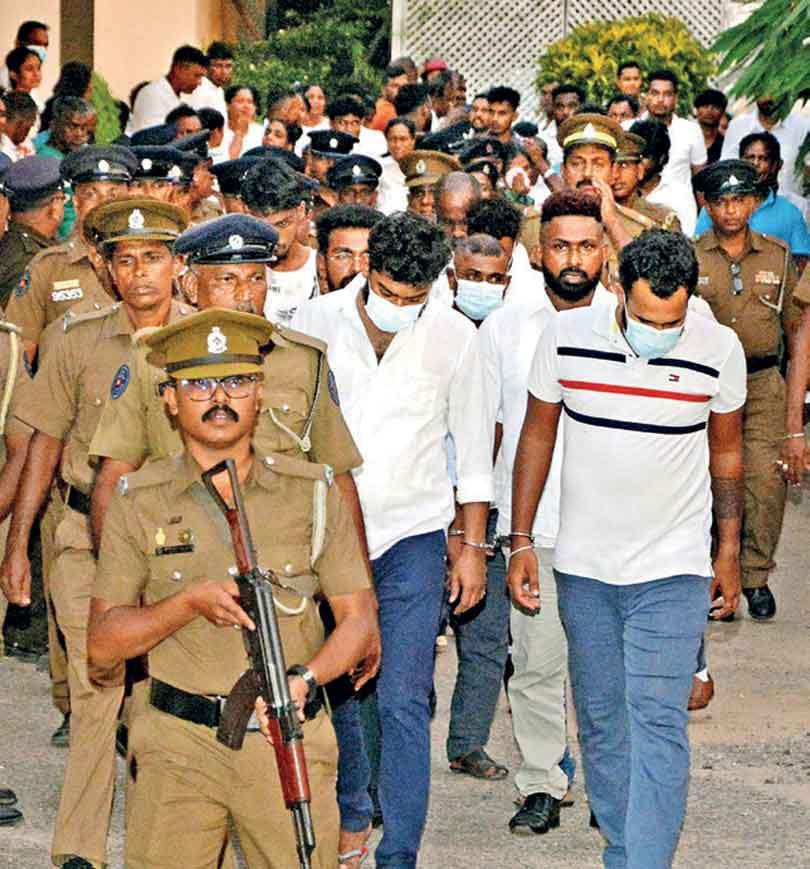
The accused brought to court
 If the tragedy of May 9 teaches anything, it is that violence, once unleashed, rarely confines itself to its intended targets.
 Nearly four years after the violence that scarred Sri Lanka on 9 May 2022, the Gampaha High Court has delivered one of the most consequential verdicts arising from the ‘Aragalaya’ period. Twelve individuals have been sentenced to death by hanging for the murder of former Polonnaruwa District Sri Lanka Podujana Peramuna (SLPP) MP Amarakeerthi Athukorala and his police bodyguard in Nittambuwa.
The judgement marks a dramatic legal response to a day that spiralled from political provocation into nationwide anarchy. Yet it also reopens deeper questions about accountability, proportionality, and the uneven arc of justice in Sri Lanka’s troubled history.
The Spark at Galle Face
|
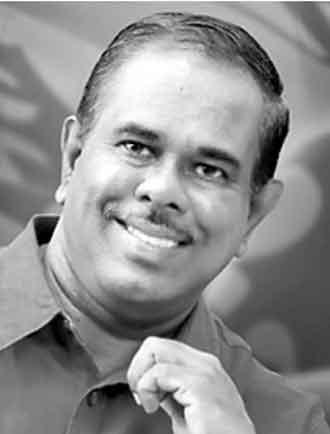
Slain MP Amarakeerthi Athukorala |
The chain of events began in Colombo. For weeks, anti-government protesters had been peacefully occupying sites at Galle Face Green (“Gota-Go-Gama”) and near Temple Trees (“Maina-Go-Gama”), demanding the resignation of President Gotabaya Rajapaksa and Prime Minister Mahinda Rajapaksa amid the country’s worst economic crisis since independence.
On the morning of 9 May 2022, several hundred supporters of then Prime Minister Mahinda Rajapaksa arrived by bus in Colombo to meet him at Temple Trees. Witness accounts, video footage, and subsequent investigations indicate that they advanced toward the protest sites armed with clubs and other weapons. Tents were torn down and set ablaze; protesters were assaulted; temporary structures including a library were destroyed.
Human Rights Watch described the attacks as a dangerous escalation and called upon the government to uphold the right to peaceful protest, ensure proportionate security responses, and prosecute those responsible. Protesters on the ground reported that police units, including a water cannon truck, retreated as the violence unfolded. President Gotabaya Rajapaksa’s direct instructions to the police to prevent hooligans from marching toward Galle Face were not carried out. Over 150 people were reported injured in the clashes that day, with at least five deaths initially confirmed in related incidents. A nationwide curfew followed.
Hours after the violence erupted, Mahinda Rajapaksa resigned as prime minister in an attempt to pave the way for a unity government. But the damage had been done. What began as an assault on protest camps triggered retaliatory violence across the country. A certain political group appeared to be waiting in readiness to strike back, targeting buses returning from Temple Trees and destroying properties belonging to SLPP MPs and their supporters.
From Retaliation to Lynching
As news of the attacks spread, anger surged. Buses and vehicles used by SLPP supporters were smashed and set on fire. Homes and properties of ruling-party lawmakers were targeted in what became a wave of retributive destruction. In Nittambuwa, the unrest took a particularly tragic turn.
MP Amarakeerthi Athukorala, a first-time parliamentarian, was travelling back to Polonnaruwa with his police bodyguard when their vehicle was intercepted by a mob. CCTV footage later showed the MP fleeing with his armed security officer. They sought refuge inside a garment store. There, both were killed by the mob in broad daylight.
The brutality of the lynching shocked the nation. Dozens were arrested over time. The case became controversial when the Gampaha High Court Trial-at-Bar initially granted bail to all suspects, prompting the Attorney General to appeal to the Supreme Court, arguing that bail would jeopardise a fair trial. Ultimately, the trial proceeded, culminating in the death sentences announced last week.
Widespread Destruction
The violence of 9 May did not end with Nittambuwa. Across the country, homes of SLPP MPs and political figures were attacked, looted, and in many cases set ablaze. One of the most symbolic incidents was the burning of the Rajapaksas’ ancestral home in Medamulana, Hambantota.
A Right to Information request later revealed that 437 houses were damaged on that day. The Government Valuation Department estimated total losses at Rs. 1,744,919,541. Even institutions such as municipal councils, divisional secretariats, and railway stations were affected.
Compensation efforts have been uneven. While some MPs received payments or temporary housing at Viyathpura under Cabinet decisions, others have complained that the compensation is insufficient. The issue remains politically sensitive, especially in a country still grappling with economic hardship.
Law, Order, and Lapses
The Police and military, despite having troops stationed near Nittambuwa, failed to intervene swiftly enough to prevent the lynching.
It has been questioned why no inquiry was conducted into possible lapses in maintaining law and order. Such criticisms highlight a broader concern: the state’s responsibility to prevent mob justice, regardless of political sympathies.
The Criminal Investigation Department’s efforts, including forensic steps such as sending blood samples from Temple Trees to the Government Analyst, reflect a procedural attempt to restore legal order.
Yet public reactions remain polarised. Some voices, bitter toward the ‘Aragalaya,’ have mocked the “rebellious comrades” who once encouraged confrontations but are now absent. Others argue that while violence must be punished, the context of state-sponsored provocation cannot be ignored.
Justice and Its Uneven Memory—83’ Black July
The sentencing of twelve individuals to death underscores the judiciary’s assertion that mob killing is unequivocally criminal. “Bad is bad,” as one observer bluntly put it. The courts have identified wrongdoing and imposed punishment. But the verdict also invites uncomfortable comparison. In July 1983, thousands of Tamils were slaughtered during anti-Tamil pogroms. Decades later, not a single perpetrator has been meaningfully held accountable for those atrocities. The contrast is stark. Why has justice moved decisively in one instance of communal and political violence, yet remained elusive in another far greater tragedy?
This question lingers over the May 9 judgement. It does not diminish the gravity of the Nittambuwa murders, nor the necessity of accountability. Rather, it challenges Sri Lanka to confront a broader principle: justice must be consistent if it is to command moral authority.
The events of 9 May 2022 altered the trajectory of the ‘Aragalaya’ and the nation. What began as a largely peaceful civic uprising against economic mismanagement descended into cycles of provocation, retaliation, and bloodshed. The resignation of a prime minister, the burning of homes, the lynching of a parliamentarian, and now death sentences handed down by a Trial-at-Bar; all are chapters of the same turbulent story.
The High Court’s judgement closes one legal chapter, but leaves open deeper societal questions.Some members of the current Cabinet were reportedly seen encouraging and inciting mobs to set fire to the Parliament building that night. Should they not also face legal repercussions under the President’s principle that the law applies equally to every citizen, regardless of status? How can political leaders avoid inflaming tensions in moments of crisis? How should security forces balance restraint with responsibility? And can Sri Lanka ensure that justice is not selective, but steadfast; whether the victims are a parliamentarian in Nittambuwa or thousands of Tamil civilians in 1983?
If the tragedy of May 9 teaches anything, it is that violence, once unleashed, rarely confines itself to its intended targets. The rule of law must not only punish after the fact but prevent the conditions that make such days possible. Only then can the country hope to move from retribution toward reconciliation.