Reply To:
Name - Reply Comment

By Dr Malathy Knight and Dr Sumith Pilapitiya
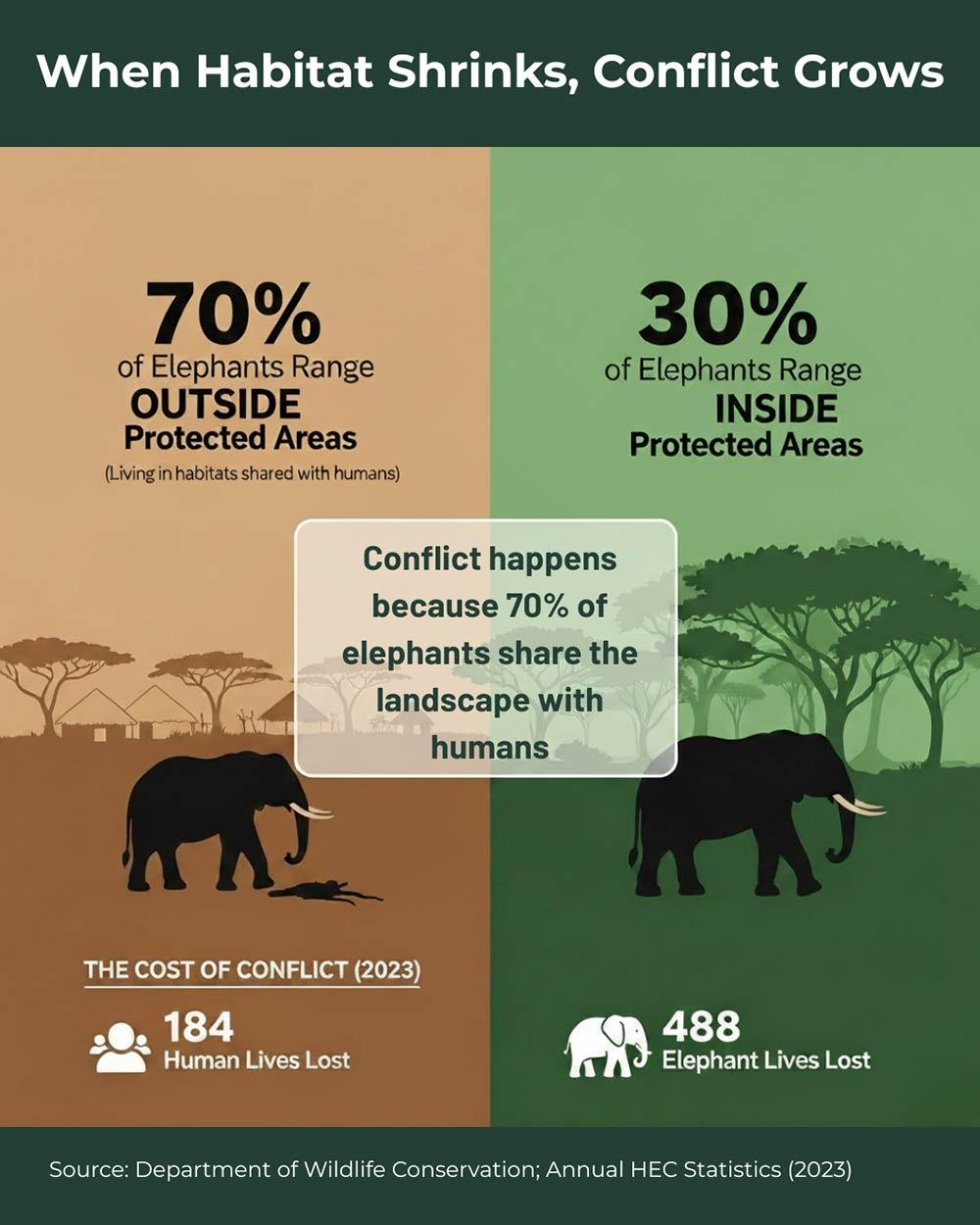
Sri Lanka’s human-elephant conflict (HEC) has reached a breaking point. In 2023, Sri Lanka became the deadliest country for Asian elephants, with 488 killed a 115% increase since 2010. HEC-related human deaths also increased by 127% in this period. From January to October this year there were 366 elephant deaths and 131 human fatalities.
Sri Lanka’s HEC policy, largely unchanged for more than 65 years, has exacerbated the issue. The key flaw is the focus on confining elephants to “inside” Department of Wildlife Conservation (DWC) Protected Areas (PAs). This approach does not address the central problem of insufficient carrying capacity within PAs and managing “outside” elephants that continue to raid crops and break into houses for grain.
The tragedy of this continued policy myopia is that there is an official plan based on scientific research that provides a better solution. In 2020, a Presidential Committee prepared a National Action Plan for the Mitigation of HEC (NAP) with wide stakeholder participation. NAP concluded that any strategy must include the management of elephants inside and outside DWC PAs. Successive governments have largely ignored these recommendations except for in 2023/2024. Yet, the 2026 Budget doubles down on this failure, allocating substantial amounts of funding to strategies proven to be futile.
It is time to rethink the current approach. Effective HEC mitigation is crucial for rural livelihoods. Elephants are a keystone species, vital for ecosystems and biodiversity and an important source of revenue through eco-tourism. This Op-Ed argues that NAP’s research-based and pilot-tested solutions must be implemented now.
Science-based solutions must be implemented now
HEC is inevitable: humans are increasingly encroaching into elephant habitat, mostly for agricultural activities. Elephants and people share 44% of the country’s landscape, and 70% of the elephant population range outside PAs. Ecosystems have limited carrying capacity, and PAs are already at or close to this threshold. Consequently, attempts to restrict elephants within DWC protected areas do not just fail; they actively intensify the conflict. There is a solution to this problem: NAP’s science-based approach must be implemented immediately.
Current HEC management in Sri Lanka includes two ineffective strategies: 1) translocation of “problem” elephants into DWC PAs or elephant holding grounds and 2) large-scale elephant drives into DWC PAs. Drives are ineffective for two primary reasons. First, elephants tend to remain within their home range. If driven out, the problem-causing males return more aggressive, intensifying HEC. As described in NAP, elephants that lose access to their home range are forced to raid crops to survive, endangering the lives of both humans and elephants.
Second, approximately 65% of electric fences have been erected on administrative rather than ecological boundaries. Although electric fences are considered one of the best options for HEC management, this strategy has failed in Sri Lanka because they are not constructed on the boundaries that the elephant relates to. A key recommendation in NAP is that all electric fences must be relocated to elephant habitat boundaries. The DWC needs political support for relocating existing fences to the boundaries of elephant habitat, which is lacking at present. Ignoring these research-based solutions is a recipe for failure.
NAP’s approach has had limited traction
NAP has never fully launched to date. A second Presidential Committee oversaw limited measures in 2024, contributing to a decline in HEC that year. However, the 2024 elections resulted in the dissolution of the Committee, a halt to NAP implementation and reverting to attempts at confining elephants to DWC PAs. The recent elephant drives are a case in point. Building support and restarting implementation will require tackling three issues: agency fragmentation, community information gaps, and accountability lapses
Agency fragmentation: Responsibility is fractured across a labyrinth of agencies, including wildlife, forestry, agrarian and development authorities, which often work at cross-purposes. Coordinating the actions of agencies is essential. NAP recommends forming a Presidential Task Force, appointed by the Presidential Secretariat, to issue top-level directives and coordinate agencies’ actions. Establishing a Presidential Task Force will also demonstrate the government’s commitment to resolving HEC.
Community information gaps: HEC communities are not sufficiently aware of science-based solutions, such as those in NAP, leading to ad hoc measures that worsen the problem. Access to better information will empower communities to make informed decisions. NAP’s empirical approach bridges crucial knowledge gaps required for successful demand-driven solutions (such as community fences).
Accountability lapses: Agency fragmentation and community information gaps dilute responsibility, leading to insufficient accountability. This contributes to political apathy and murky decision-making by HEC agencies. For instance, local officials often parcel out forest land without transparent criteria, converting elephant habitats into potential conflict zones. The Auditor General’s office audits DWC spending but does not evaluate the outcomes of HEC programmes. Politicians respond to the interests of their constituents. Increasing community awareness and buy-in on NAP and its research-based solutions will encourage politicians to support an effective mitigation approach.
In short, disregarding NAP’s science-based approach will worsen HEC with disastrous consequences for both humans and elephants. NAP’s recommendations demonstrate that this is not a zero-sum game but a potential win-win for all. Evidence-based findings in NAP must be widely disseminated to protect public interest. The stakes of not resolving HEC immediately are high.