Reply To:
Name - Reply Comment
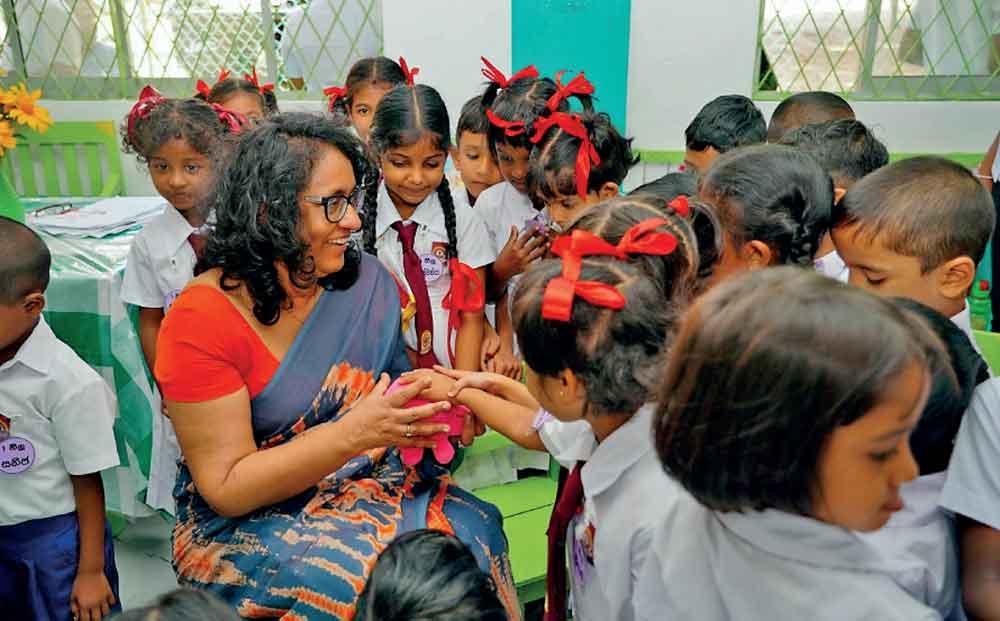
PM Dr. Harini Amarasuriya with students of Gunasekara Vidyalaya, Athurugiriya last week
Source: PM media unit
 Sri Lanka stands at a critical juncture in its educational history. The NPP Government has embarked on what it calls a ‘transformational’ reform of the country’s education system, scheduled for implementation starting in 2026 with Grades 1 and 6. The vision is ambitious: shift from the traditional exam-oriented system to a student-centered, practical learning model emphasising holistic development, digital literacy, and vocational training. The budgetary allocation to education has increased to 2% of GDP, and the Government has pledged to build infrastructure, recruit more teachers, and expand school facilities.
On paper, these reforms address long-standing concerns about Sri Lanka’s rigid, exam-focused education system that has stifled creativity and critical thinking for generations. The new curriculum promises to promote “critical thinking,” “multiple intelligences,” and embed “values of equity, inclusivity and social justice.” However, beneath this progressive rhetoric lies a deeply problematic reality that demands urgent attention.
Minister of Education, Prime Minister Dr. Harini Amarasuriya, who once commanded over 600,000 votes, now finds herself at the center of a growing storm, not because of her gender, but because of the substance, or lack thereof, in her educational reforms. Let us be clear: criticism of these policies is not rooted in prejudice. Sri Lanka, the first country to elect a female Prime Minister and twice to elect a female Executive President, has demonstrated its willingness to support women in the highest offices. This is about policy, not gender.
The reform process itself contradicts the democratic principles the NPP Government claims to champion. Announcements were made in July 2025 for reforms planned for January 2026. An official policy document wasn’t released until November 2025, just three months before implementation. By the time the Ministry of Education held public meetings, modules had already been written, published, and teacher training had commenced. This is not consultation; it is theater.
A statement signed by 94 university teachers highlights this fundamental flaw: reforms of this magnitude require genuine public engagement, not hasty top-down directives. Those who have worked alongside Prime Minister Amarasuriya on education matters over the years expected better - they expected someone who would ask difficult questions, someone who would draw on deep conceptual understanding rather than parrot empty words borrowed from international development agencies.
The emptiness of buzzwords
The statement says, the current educational reforms suffer from a fundamental problem: they mistake terminology for transformation. “Learner-centered education” has become a mantra repeated without understanding its origins or implications. This concept, drawn from the revolutionary insights was meant to empower students and democratise knowledge. Instead, they see is a hollowed-out version, stripped of its transformative potential and reduced to neoliberal platitudes. Learner-centered education, as currently implemented, has devolved into superficial team exercises, meaningless assignments, and something vaguely called “independent learning.” Rather than liberating teachers and students, this approach has reduced educators to mere cogs in a machine, following directives created elsewhere, often by World Bank consultants with little understanding of Sri Lankan realities; the statement emphasises.
If education is truly to be learner-centered, certain foundational elements are non-negotiable: well-trained, empowered teachers who are independent thinkers, not robotic implementers of foreign guidelines, and quality textbooks, particularly crucial given the proliferation of poor-quality digital material flooding our schools.
Gap between rhetoric
and reality
Perhaps most concerning is the stark discrepancy between the policy’s stated objectives and its actual content. The curriculum claims to promote critical thinking and emphasise the “social and political value of the humanities and social sciences,” yet it systematically marginalises these very subjects. At the primary level, environment, history, and civics have been eliminated entirely. At the junior secondary level, civics receives only 10 hours per term, and history just 20 hours. Meanwhile, mathematics and the mother tongue, fundamental subjects, are allocated merely 30 hours per term at junior secondary level. At the senior secondary level, social sciences and humanities are relegated to electives.
Textbooks riddled
with problems
They say, the textbooks available on the National Institute of Education (NIE) website reveal alarming quality issues. The Global Studies textbook associates specific facial features, hair color, and skin color with particular countries, essentialising race in ways long discredited. It refers to indigenous people using offensive terms like “Pygmies” and “Eskimos,” terms these communities themselves reject. Nigerians are portrayed stereotypically as poor agriculturalists without electricity. The Entrepreneurship textbook introduces “world famous entrepreneurs”, mostly men, equating success solely with business acumen.
This content directly contradicts the policy’s commitment to “equity, inclusivity and social justice.” If these are the materials we’re providing our children, we’re not fostering critical thinking, we’re perpetuating harmful stereotypes. The National Institute of Education, which should be a powerhouse of innovation and research, has instead become an empty vessel executing directives from international organisations. It has been given tasks of enormous importance but stripped of real power, no meaningful research, no substantive teacher training, nothing truly innovative. The quality of the textbooks makes clear that the NIE’s structure and mandate require urgent review and reinvigoration.
Consider the stark contrast in approaches to child protection globally. Australia has enacted laws banning certain websites for children under 16, recognising the need to protect young minds from inappropriate content. Meanwhile, according to information that has emerged, Sri Lankan 11-year-olds are being directed to government-endorsed websites with deeply questionable content. The ‘Samarisi’ [gay] website controversy exemplifies this problem, rather than engaging with substantive criticism, defenders have attempted to reframe legitimate policy concerns as attacks on the minister’s gender or personal life.
The proposed “career interest test” at the end of Grade 9 is deeply problematic. Directing fourteen-year-olds toward career paths when vocational pathways beyond secondary education remain underdeveloped risks entrenching inequality, a prominent educationist observed. Channelling children from certain backgrounds into predetermined paths based on parental vocations rather than genuine aptitude.
While digital literacy sounds progressive, many schools lack basic infrastructure. The burden of providing digital devices will fall on parents, widening the gap between well-resourced and under-resourced schools, deepening educational inequality rather than bridging it.
Prime Minister Amarasuriya is implementing a system that undermines free education’s core objectives and sets disadvantaged children up for failure. Parents who can afford it are looking abroad to universities in the United States, Australia, or Canada. Meanwhile, government school students are being prepared for limited opportunities, a two-tier outcome that is the antithesis of what free education was meant to achieve.
The Cabinet’s decision to postpone Grade 6 implementation to 2027 is appreciated but insufficient. What’s needed is a complete pause, genuine consultation through public sittings nationwide, holistic curriculum review, strengthening of the NIE with external scholarly input, and honest acknowledgment that these reforms currently fail Sri Lanka’s children.
We need reforms grounded in evidence, developed through genuine consultation, and focused on outcomes serving all children. Vision without competent execution, democratic process, and institutional capacity is merely empty rhetoric, and our children deserve far better.
(The writer can be reached via [email protected])