Reply To:
Name - Reply Comment
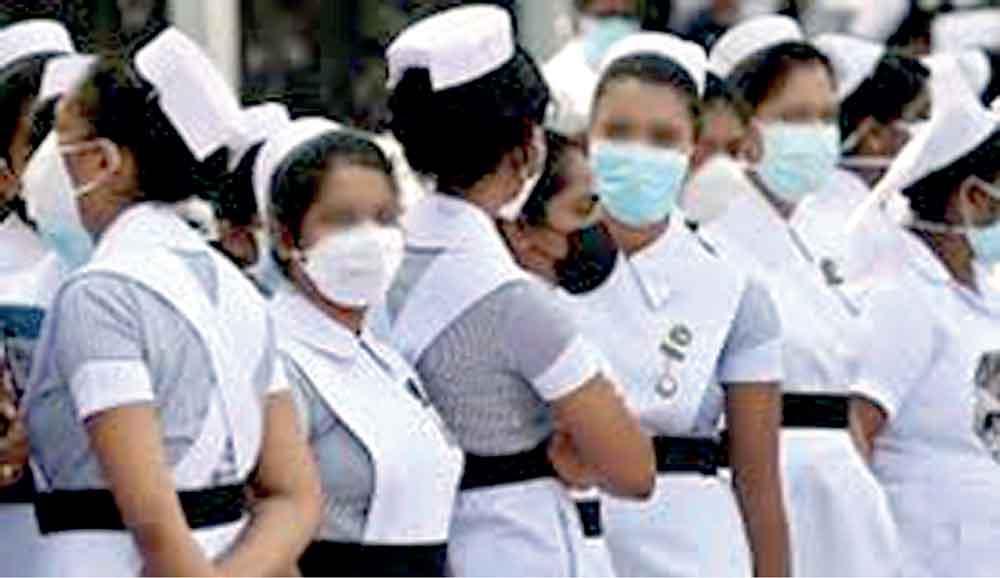
Nurses uniforms have a secular basis and should not create divisions
 How far can a country go in accommodating its multicultural, multi-faith, and multi-racial character without amplifying the fault lines and developing parallel societies? This is not a question unique to Sri Lanka, but a global one. That, however, is the question one should ask about the recent government proposal, now seems to have been aborted, to accommodate long dresses and head coverings for Muslim health care workers.
The government proposal stemmed from a discussion chaired by Minister of Foreign Affairs, Foreign Employment, and Tourism Vijitha Herath, between a group of government officials and politicians and a delegation of Islamic clerics and community members.
Minister Herath had opined that there were “no legal barriers” preventing healthcare workers from wearing religious attire and urged those facing discrimination to report it to higher authorities.
His remark drew strong opposition from major professional associations and trade unions in the sector.
The president of the United Nurses’ Union of Government Service, Muruththettuwe Ananda Thera, in a letter to the health ministry, said that it ‘strongly disagrees’ with the government proposal to change the internationally accepted standard nursing uniform, and warned of industrial action if the proposal is not revoked. Earlier, the Sri Lanka Nurses’ Association (SLNA) opposed the government proposal. Saman Ratnapriya, president of the Government Nurses’ Association, had observed, “Uniforms are about professionalism, not nationality or faith.”
In the face of growing opposition, the health ministry backtracked. Minister of Public Administration, Prof. A.H.M.H. Abayarathna, was on record as saying the standard nursing uniform remains the same and that the ministry has not received any formal recommendation for a revision.
There are a few lessons, some innocuous and some potentially dangerous, that the government could draw from this episode. Some of which may also apply to the Muslim community associations themselves, some of which, like All Ceylon Jamayathul Ulama, have a chequered recent past.
In the first place, Minister Herath’s remarks, though may be in good faith, had only amplified the ethnic faultlines, rather than bridging them. The uniforms, as self-explanatory, are intended to bring a sense of uniformity to a particular profession and an extension of its professionalism, though it is not necessarily discouraged to accommodate religious sensitivities -- Indian army uniforms are a mirror of its cultural diversity. The exception is when the relevant institution or the State is defined by a strict sense of secularism (e.g., France).
Integration or fragmentation
Therefore, the more pertinent question would be whether such religious and cultural accommodations lead to social integration or fragmentation. In any case, a request for accommodation of a hijab or headscarf would appear innocuous. Yet, the professional nursing unions in the country thinks otherwise. An interesting scenario would also be if other religious and cultural groups demand the choice to wear their own cultural and religious garments. No religious or cultural sensitivity is greater than the other, and a government that accommodates one group is bound to do so with all others.That would turn nurses into a fancy dress parade in Osaries, Kandyan Sarees, and Lama Sarees. That fragmentation of professional integrity and uniformity in the profession seemed to be the primary concern of the professional unions. Irrespective of these concerns, it is hard to avoid the debate taking an ethnic and religious line. The appropriate course of action for Minister Herath could have been to recommend that the Islamic groups submit the proposal to the relevant line ministry or the regulatory authority, rather than attempting to arbitrate it himself.
Secondly, one might ponder why now? This is a rather tricky question to answer, without referring to a ground swell of Islamism-tinted religiosity in the global Muslim community. The changing dress code of the Muslim community is a marker of these social changes, which have not necessarily helped social cohesion. Second-generation migrants are more religious than their parents. ( One in every hundred Muslims in the UK is on the terrorist watchlist, and nearly 10 per cent identify themselves with Islamism). Often, what teams up as community associations foster religiosity, rather than support assimilation. In the local context, during the run-up to the Easter Sunday attack, and growing Arabisation and Wahabism within the local Muslim community, Jamayathul Ulama issued a fatwa encouraging Muslim women to wear Burka and Niqqab. (The edict was removed from its website after public pushback following the Easter Sunday attack.) Several other Muslim community associations lobbied in favour of Female Genital Mutilation. The presidential commission to probe the Easter Sunday attack found that the Islamic textbooks in public schools justified the killing of those who leave the religion.
Islamisation is a gradual process, and at one point, it becomes irreversible, leading to parallel societies and often violent manifestations of Islamism.
When Sri Lanka considers the recent proposal for an Islamic dress code for nurses, which appears innocuous and poses no harm, it should also draw lessons from its recent past and global experience. Any government measures should be designed to foster integration, rather than creating parallel societies. Muslim associations should also know where to draw the line between Arabisation and Wahabisation, and cater to the genuine concerns of the local Muslim community to aspire and prosper within Sri Lankan society under Sri Lankan identity. That is not a hard choice to make!
Follow @Ranga Jayasuriya on X