Reply To:
Name - Reply Comment
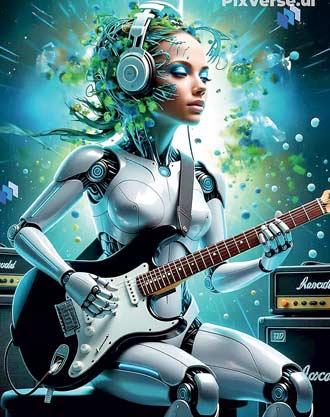
 AI apps that allow music generation has taken the world by storm. It creates music which sounds similar to an original creator. While the users may be happy using AI to make the song they want, a pertinent question has been raised as to what would happen to the performer (that is the singer), the composer and the lyricist and for that matter the Record Labels and the Music recording industry itself. The other side of the equation is the query that if in any event these songs created by AI apps are legal, then who owns the rights to a song created by an AI App.
At the time of writing this article here is how the law stands. The legal status of intellectual property (IP) for AI-generated music is primarily determined by the level of human involvement. While global laws are rapidly evolving, a general international consensus is yet to be determined as who owns the fully autonomous AI-generated music and can it be copyrighted.
Legal status
|
While global laws are rapidly evolving, a general international consensus is yet to be determined as who owns the fully autonomous AI-generated music and can it be copyrighted |
The Human Authorship Requirement: In major jurisdictions including the United States, European Union, and Australia and even Sri Lanka, copyright protection is granted only to “original works of authorship” created by natural persons.
The “Prompt” Rule, that is entering a text prompt into an AI app to generate a song is generally considered insufficient for a copyright claim. Courts and copyright offices view prompts (text inputs to AI music generators) as “unprotectable ideas” rather than creative control over the final expression. The reason for this is these generative AI apps copies from existing material which it learnt at the training session and actually doesn’t create an original with the ingenuity as that of a human. Hence the public domain status applies. That is to say creations where music or song is generated entirely by AI without meaningful human intervention is typically considered part of the public domain, meaning it can be freely copied or used by others.
Conditions for Protection (Hybrid Works)
On the other hand songs created with AI assistance can receive partial copyright protection if the human user contribution is “substantial” and “demonstrable” as creative elements. This means there has to be a sufficient creative input. For example protection may be granted for original lyrics, human-recorded vocals, or a specific “creative arrangement” of AI-generated stems. In these cases, copyright typically only covers the human-authored portions (e.g., the arrangement or the lyrics), while the individual AI-generated sounds remain unprotected. In other words Copyright can be granted for songs that use AI as a tool, provided there is meaningful human authorship. In countries like United States where there is a copyright registration regime, you can register copyright for specific elements you personally created, such as your own lyrics, a human-composed melody, or original human-recorded vocals which you used to fuse with the AI app to generate a song. Also if you take AI-generated “stems” (individual sounds or parts) and arrange or modify them in a “sufficiently creative” way, you may be able to copyright the arrangement of the song as a whole.
Copyright and Contractual Ownership
There is a critical distinction between legal copyright and contractual ownership. For example in terms of service in AI apps like Suno or Udio often grant “ownership” and commercial rights to users on paid plans through their Terms of Service. While you may “own” the song via a private contract like this with the app provider, you may still lack the legal standing to sue third parties for copyright infringement if a court deems the work lacks human authorship
In Sri Lanka
In this country, the legal status of AI-generated music is still governed by the Intellectual Property Act No. 36 of 2003. As of now, the law doesn’t explicitly recognise AI-generated content, which leads to a legal environment that favors human creators over autonomous software. The core hurdle for AI music in Sri Lanka like in many countries is the definition of an ‘author’. Under Section 5 of the IP Act, an ‘author’ is defined as the ‘physical person who has created the work’. Since AI is not a natural person, it cannot be recognised as an author. Current Sri Lankan jurisprudence does not have a provision for “computer-generated works” (unlike the UK), meaning fully autonomous AI output lacks copyright protection entirely. Hence in Sri Lanka to receive protection the originality threshold has to be passed. That is, a work must be an ‘original intellectual creation’. The Sri Lankan law also follow the international standard tests requiring ‘skill, labour, and judgment’ from a human author. Therefore mere user prompts are generally viewed as ‘ideas’ rather than creative expressions and hence does not meet the ‘originality’ requirement under existing Sri Lankan law.
However, partial protection can still be found for ‘Hybrid’ Works in the same manner explained above. Songs that use AI as a tool rather than a sole creator may receive partial protection i.e. if a human user meaningfully shapes the output such as by writing original lyrics, recording their own vocals, or extensively rearranging AI-generated stems those specific human-authored elements are copyrightable. Furthermore a sound recordings made from an AI generated song under section 18 of the IP Act protects sound recordings as “entrepreneurial works” while the underlying composition of an AI song might not be copyrighted if it lacks, the substantive human user contributions. The specific recording may receive limited protection for the person who made the arrangements for it.
Can the Commissioned Work rule apply for protection?
As of now, the legal premise of ‘commissioned work’ (or ‘work made for hire’) generally cannot be used to claim copyright ownership of a song generated purely by an AI app. Under both Sri Lankan law (Intellectual Property Act No. 36 of 2003) and most international jurisdictions (such as the U.S.), the ‘commissioned work’ doctrine requires a contract between two legal ‘persons’. AI is not a legal person as an AI app is a tool and not a natural or legal person, it cannot enter into a binding contract or an employer-employee relationship. For a work to be ‘commissioned’, there must first be an author who creates it. Current law in Sri Lanka defines an author strictly as a ‘physical person’. Hence if the AI is the sole creator, there is no ‘author’ from whom the rights can be transferred.
Prompts which are given by humans are viewed as ‘Instructions’, not Commissioning legal authorities. The U.S. Copyright Office, has specifically addressed this argument by comparing an AI user to a client hiring an artiste. Providing a prompt is like giving ‘general directions’ to a commissioned artist. In the recognised commission, the human artiste uses their own creative expression to fulfill the idea or general instructions given. In AI, the machine determines the ‘expressive elements’. These elements lack human authors/designers to communicate a specific message or experience and thus the machine cannot hold copyright and hence the work often falls into the public domain rather than being owned by the person who gave the prompt.
Can UK Law be an exceptional solution?
The ‘Computer-Generated Works’ seems to be the only notable exception which exists in the United Kingdom (and countries with similar laws like New Zealand). Section 9(3) of the CDPA: UK law allows for copyright in ‘computer-generated works’ where there is no human author. In these cases, the author is deemed to be the person who made the ‘arrangements necessary’ for the creation of the work.
However there is more to it than meets the eye. Although the UK copyright law provides this framework through Section 9(3) of the Copyright, Designs and Patents Act 1988 (CDPA) that can potentially grant copyright to songs generated by AI apps, significant legal uncertainties remain regarding its practical application. For example the section 9(3) specifically addresses works generated by a computer ‘in circumstances such that there is no human author’. In such cases, the ‘author’ is deemed to be the person who undertook the arrangements necessary for the creation of the work. Hence depending on the specific circumstances, this author could be the developer of the AI tool or the user who provided the instructions or prompts.
Furthermore to qualify for copyright, a work must be ‘original’. The current UK courts often apply the test of being the ‘author’s own intellectual creation’, which historically implies a human’s personal touch. In practice, courts often seek to identify a human author first. If a human uses AI as a creative tool and adds substantial ‘intellectual investment’, they may be considered the traditional author. Section 9(3) only acts as a ‘fallback
when no human author can be identified. Ongoing reforms are still evaluating the future of Section 9(3). Proposals range from clarifying its scope (such as removing the originality requirement for these works) to abolishing it entirely to ensure copyright only protects human creators. The debate over whether an AI output created from a simple text prompt can meet this standard is still on going.
Sri Lanka currently, does not have this specific provision similar to the UK provision in its IP Act and hence without it, you cannot use the ‘arrangements necessary’ or ‘commissioning” logic to claim copyright over purely AI-generated music.
Recent court rulings in China suggest AI-generated content may be protected if a person was significantly involved, though the threshold remains lower than in the U.S.
Voice Clones and Publicity Rights
A major shift and focus has been made in US since 2024 on ‘digital replicas’ or AI-cloned voices (e.g., ‘Fake Drake’). Copyright law generally protects the composition and recording and not the actual sound of a specific person’s voice. While federal copyright may not apply, many states (like California and Tennessee) have enacted and updated Right of Publicity laws to protect individuals from unauthorized AI voice or likeness simulations.
Meanwhile record labels considering transitioning from pure litigation to pursuing large-scale licensing deals with AI music platforms to manage rights and royalties. Moreover many other ongoing Court battles in major lawsuits (e.g., music publishers vs. AI companies) are pivotal for deciding if training AI on copyrighted songs is ‘fair use’ or requires compensation to original artistes. I n the absence of a comprehensive federal AI law, states like Texas and Utah have enacted their own AI governance frameworks that implemented laws that are comprehensive artificial intelligence (AI) governance frameworks that prioritise transparency and responsible development.