Reply To:
Name - Reply Comment
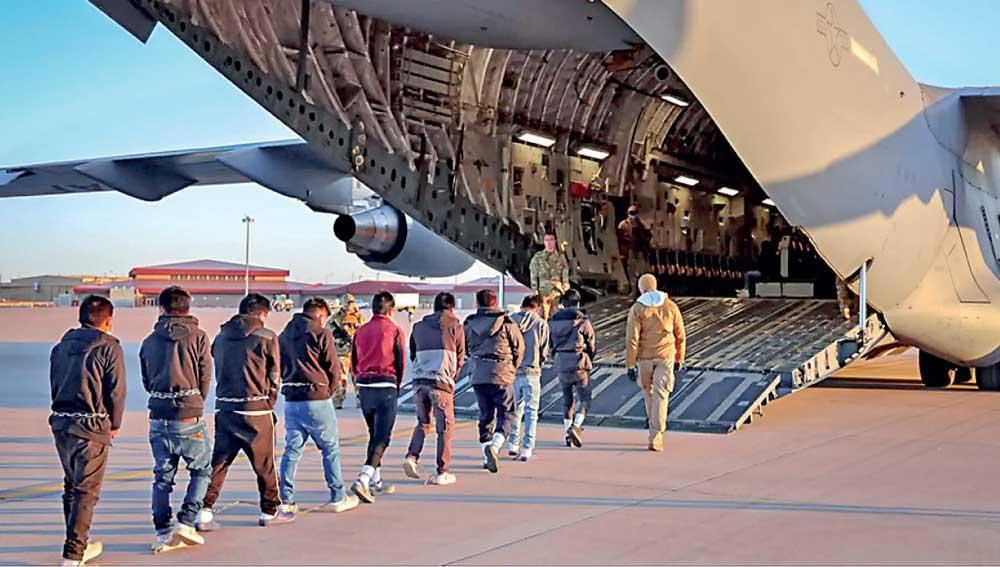
Deported immigrants escorted by the US military personnel
 West Side Story, the film adaptation of a Broadway musical by that name, was first released in 1961.
This is how one of its most famous songs go:
“I like to be in America; OK by me in America
Ev’rything free in America; for a small fee in America
I like the city of San Juan; I know a boat you can get on
Hundreds of flowers in full bloom; Hundreds of people in each room
Automobile in America; Chromium steel in America
Wire-spoke wheel in America; I’ll drive a Buick through San Juan
If there’s a road you can drive on; I’ll give my cousins a free ride
How you get all of them inside?; Immigrant goes to America
Many hellos in America; Nobody knows in America
Puerto Rico’s in America; I’ll bring a TV to San Juan
If there’s a current to turn on? I’ll give them new washing machine
What have they got there to keep clean?
I like the shores of America; Comfort is yours in America
Knobs on the doors in America
Wall-to-wall floors in America; Buying on credit is so nice
One look at us and they charge twice
Skycrapers bloom in America; Cadillacs zoom in America
Industry boom in America; Twelve in a room in America…”
The story is set in Manhattan where youth gangs of Puerto Rican and white American boys clash. But the song sums up a common immigrant dream, no matter where they come from.
That was six decades ago. The immigrant flow to the United States went on unabated. Not all were poor immigrants – those with good educations focused on Silicon Valley, and other lucrative professions. But the majority of those who came in their millions from troubled states in Latin America and Africa over the past several decades were poor or working class. In the 1990s alone, 11.2 million immigrants arrived in the US in 2000, nearly 850,000 were granted legal permanent resident status. The Venezuelan crisis in the post-Hugo Chavez era saw millions more entering the US, mostly illegally.
Over the past two decades, every American administration has worked to stem the flow of illegal immigrants. But none acted with the vehemence of President Donald Trump and his far right followers. What we are seeing is a declaration of war against immigrants, and even those settled down in the US with proper documentation are being rounded up.
Since the time of West Side Story, Sri Lankan youth too, have dreamed of ‘I like to be in America.’ But most of them settled for Western Europe. It was possible to travel overland to Europe via Afghanistan even in the early 1980s, while the US was inaccessible to Asians without valid visas, and France, Germany and the UK were the favourite destinations of many. But the old ‘I like to be in America’ dream persists, even though contemporary reality vis-à-vis immigration to the US is now totally different (and to Europe, for that matter).
I like to do my own surveys by sounding out people. Speaking to several white-collar, low-income professionals about the current American anti-immigrant drive and backlash, I told them about President Donald Trump’s thuggish ICE (Immigration and Customs Enforcement) Police and their harsh attacks on immigrants in major American cities.
“Never mind. Don’t mind getting roughed up if I can get there,” was a common answer. Hearing this was a shock, giving me an insight into the average Lankan’s psyche today, and how people judge their country according to their experiences and views. Some people, when I told them that after Trump’s attack on Venezuela and his plans to annexe Canada and Greenland, India or China could annexe Sri Lanka on some pretext, replied in all seriousness they don’t mind, as long as things are managed properly.
This is a complete negation of Mahatma Gandhi’s ‘We prefer our own bad government to someone else’s good government.’ ‘Just how bad?’ would be the instant reaction.
They represent those born around 1990 or thereafter – too young to remember the civil war, no memories of the two southern rebellions at all, and swept forward from childhood to adulthood by a strong nationalist wave that bordered on xenophobia. They were adults working at jobs when the Rajapaksa family had a strong grip on Sri Lankan society – seemingly forever. Whatever their political persuasions, many of them were influenced by that ethos – nationalism first, country and patriotism first, and respect for minorities and international opinion was discarded. Strong government was hailed over weak democracy.
All that collapsed in 2022, which left them bewildered, shattering their core beliefs. But the admiration for a strongman lingers on. Upon reflection, that’s the only explanation one can think for ‘don’t mind even getting kicked in America’ mentality. In other words, only a strongman can bring order into chaos, and rough methods should be excused. It doesn’t matter if Sri Lanka’s strongmen of recent memory failed to deliver in America, there’s an authoritarian president kicking out the rabble.
Is it any wonder that people who have undergone so much trauma would lose touch with reality? This is also a generation weaned on social media. Videos showing US ICE outrages – shooting civilians, dragging immigrants out of homes, workplaces and cars, hitting and kicking people – are impossible to miss, but those interviewed for this column are focused on a fantasy – the America of West Side Story or ‘Comfort is yours in America.’ It’s an America which has vanished.
2026 is a zero-immigration year, and up to 60,000 immigrants are being held in detention centres across the country. They are shown handcuffed and with leg irons at airports, awaiting deportation.
But the people I spoke to are blind to this bleak reality. Their hopes have been crushed by blundering, plundering politicians. These are people who need to raise families, build homes, buy a car. Their salary scales date from the pre-Covid days, ridiculously low now in face of rupee devaluation and astronomical cost of living. People with higher incomes have little left after taxation (except the very rich) because they are living on credit and must pay loans. In the early 1960s, card-based credit was unknown in the third world. Bank-issued credit cards were first introduced in 1958 in the US, with Bank of America (BankAmericard or Visa) and American Express leading the way – hence, the song’s ‘Buying on credit is so nice.’ The not-so-nice side is that total US credit card debt reached 1.23 trillion US dollars in 2025.
This generation feels used and discarded. They realise that the patriotic diet they were fed was just a cover up for unbelievable levels of corruption and mismanagement. They feel bereft of a future. No wonder they have no faith in any Sri Lankan government.