Reply To:
Name - Reply Comment
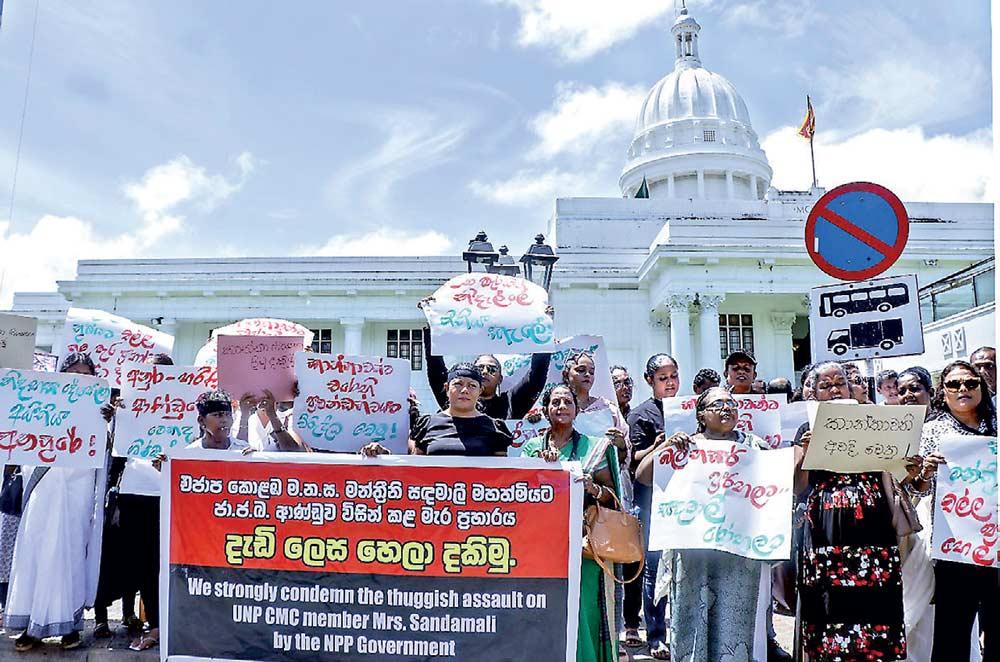
Citizens have also sometimes critiqued the present government for underperforming in its roles economically, socially and politically
 The fourth is a small, but highly influential and evocative group of Sinhala Buddhist nationalists who lament that the Sinhala Buddhist heritage, protected over millennia, is now under threat
Each Northern political faction competed to be more Tamil nationalist than the other, effectively leading to a race to the bottom, finally breeding a generation of terrorists
 As Sri Lanka celebrates the 78th anniversary of independence today (February 4), you might already have read a full complement of post-mortem reports on what has happened since then.
In general, they might fit into one of the following categories.
The first school of thought would critique Sri Lanka’s failure, economically, socially and politically. By ‘failure,’ they mean the outright, near-universal failure, not the challenges and setbacks that every new state would have confronted in its ascent.
The second group frets how Sri Lanka failed to build an inclusive society, mainly owing to Sinhala Buddhist nationalism. They have a receptive audience of NGO captains, diaspora, Western embassies, the discarded political left, and the Northern electorate.
Unlike the first two, the third group is novel and, until recently, somewhat marginal. They include the usual acolytes of the JVP, who say that the first 76 years of independence were a curse, and that during the next one and a half years, the country was overflowing with honey and curd, after the JVP rode to power, capitalising on the wave of a protest vote.
You might treat them with a playful diffidence, as you would do towards a bunch of court jesters, except that they have a history of morbid violence, though unlike their Northern peers, they had repented for their past.
The fourth is a small, but highly influential and evocative group of Sinhala Buddhist nationalists who lament that the Sinhala Buddhist heritage, protected over millennia, is now under threat. They often hit their own goal, and their outbursts are often used to justify the terrorism of the LTTE or lately, Islamist terrorism, though unlike the latter two, the loudmouth Sinhala Buddhist nationalists are not known to blow up public transport buses, churches, massacre civilians in cold blood, and constantly undermine the state.
Fifth, there are always analysts with well-thought-out, common sense scrutiny of independent history, its achievements and failures, and a succession of flawed economic policies of statism and populism that held back the country. But the interlocutors of this school of thought are often crowded out in a field dominated by everyday charlatans and imbeciles. Their solutions are politically unpalatable in a political culture that has constantly shied away from decisive reformist policies. Therefore, we continue to celebrate banal garbage as received wisdom and continue to make the same mistakes that had festered throughout independence.
In a nuanced take on post-independence performance, one might notice that Sri Lanka had not necessarily failed, but rather underperformed. Leave out a handful of high-performing outliers in East and Southeast Asia (Singapore, South Korea, and Taiwan, and, to some degree, the Mahathir-era Malaysia and Post-Mao China), and Sri Lanka’s performance is a global average or even slightly better. Its economy grew at 4 per cent during the first 30 years, which were also the lost decades of economic growth, and around 4.5 per cent during the turbulent years of J.R. Jayawardene, and around 5 per cent during Kumaratunga and 6.5 per cent during the Rajapaksa, driven by state-led construction.
The modest economic performance does not tell the full story of Sri Lanka’s achievements in social welfare, education, and health, which were consistently above its relative economic status. However, none of these achievements were fully appreciated by its own constituency, who had developed an oversized sense of entitlement. In response, the successive governments designed state policies to cater to this insatiable appetite, while uniformly shying away from decisive economic reform measures to generate growth.
The state’s failure in economic reforms was also owing to another fallacy of the British model of premature political empowerment.
Universal suffrage and free elections heralded an era of political empowerment of the masses, but the state apparatus and institutions were not equally empowered to withstand this populist onslaught. This effectively placed the state at the receiving end of mass political empowerment, with no guardrails to moderate excesses. For a comparative analogy of what happened then, one could see the mayhem in the post- Sheik Hasina Bangladesh nowadays.
The ethnic crisis was a by-product of that mass populist upheaval. When Sinhalese mainstream politics resorted to the welfare cheque book as the route to political power, the Northern political elites, who had disassociated themselves from the central government, opted to hype up Dravidian ethno-nationalism, modelled after the language riots in the 1960s in Tamil Nadu. Each Northern political faction competed to be more Tamil nationalist than the other, effectively leading to a race to the bottom, finally breeding a generation of terrorists.
The Tamil resistance was not about equal rights; in fact, the first native commanders of the Sri Lankan military force were either Tamils or Burghers, and Tamils held a disproportionate share of high posts in the judiciary and bureaucracy until the LTTE detonated its first bombs. The Tamil struggle was for ethnic parity with the Sinhalese, which is not feasible owing to the realities of the demographic composition of the country.
Sri Lanka could have been spared most of its post-independence problems had it not been a democracy. The continuous advocacy of propped-up grievances and the continuous economic policy instability owing to political change every five years in elections were only possible within a democracy. None of the successful East and Southeast Asian states during their high growth years were democracies. Each secured social peace by cracking down on the opposition. Sri Lankan democracy did not insulate the government from violence; instead, it forced the government into knee-jerk reactions whenever it was confronted with full-blown anti-state violence, as it was in 1971, 1988-89, and the three decades of violence in the North. And every time, when the threat subsided, the state pulled back into its old status quo, rather than making the necessary reforms to its approach.
That is in contrast to the heavy-handed approach of successful pro-growth authoritarian states, such as South Korea, Suharto’s Indonesia, or Pinochet’s Chile, whose unremitting state violence was preceded by a prolonged period of political stability that propelled long-term growth. In retrospect, they appeared to be Act utilitarianism, irrespective of the human cost. Whereas successive governments in Sri Lanka lacked direction either in violence or the economy.
Today, as Sri Lanka marks its 78th Independence Day, it confronts the same old problems that festered for decades.
However, the unexpected silver lining of the economic crisis is that the old economic model pursued for generations had been delegitimised. The tragedy, though, is that the current government, with its residue of Marxism, is refusing to make use of this grand economic opening. It admits the economic unviability of SEOs, but refuses to reform or offers, at best, piecemeal reforms that serve no purpose. It acknowledges that the economic policy is outdated and that the state machinery is anti-growth, yet it hesitates to cut red tape for investment and liberalise the economy.
The danger is not that Sri Lanka regresses into another economic crisis, but rather squandering a golden opportunity to leapfrog the economic growth.
On the second count, i.e., ethnic harmony, the country is trapped in the past. For once, the state had prevailed over a nihilistic terrorist campaign, yet the divisive rhetoric that gave birth to terrorism is alive. Sri Lankans should ask themselves, out of all the diverse communities in the country, why is it only a Northern Tamil gripe? Why is it not Muslims, who have an equal share of the population? The answer is probably that Northern Tamil politics has failed to rise above race. The ethnocentrism adopted in the fifties has pervaded it.
Sri Lanka should aspire to accommodate the aspirations of its communities, but some aspirations might not be able to be accommodated without breaking up the country beyond repair. In the meantime, Sri Lanka can look beyond its shores to the ethnic management policies of Israel, Singapore, or Paul Kagame’s Rwanda. Some of them might offer a template to emulate. In the meantime, on this 78th anniversary of independence, the greatest responsibility of this government would be to ensure that these peripheral grievances would not explode into the next claymore mine or bus bomb.
Follow @RangaJayasuriya on X