 Kamanthi Wickramasinghe
 Reply To:
Name - Reply Comment
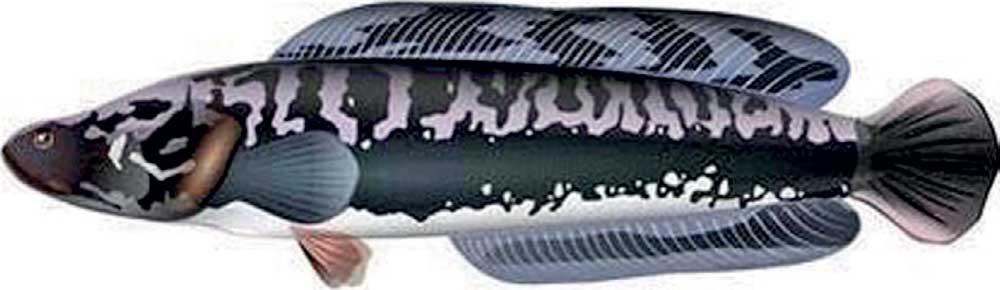 Channa micropeltes Illustration source: FISH and LINES @fish_lines


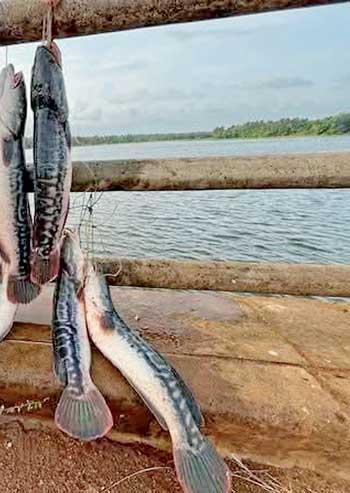 |
| Giant snakehead fish caught near Deduru Oya recently |
Fishermen in Deduru Oya are seeking support from volunteers to help them fight an ecological disaster in the form of an invasive alien species. The Giant snakehead fish (Channa micropeltes), commonly known as the Channa fish had become a threat to the livelihood of fishermen due to its predatory nature. While their daily catch is rapidly declining, fishermen are now in a race against time to reduce numbers of this new species before it spreads to other parts of the country and infest more water bodies.
Local fishermen in dismay
The Giant snakehead fish was spotted at the Deduru Oya basin back in 2024. When fishermen foresaw a disaster in the offing, they had immediately informed relevant authorities. The authorities, including the Provincial Fisheries Department, National Aquaculture Development Authority (NAQDA), Disaster Management Centre and several media channels began to provide publicity on this matter. After conducting a workshop for fishermen in the area, the authorities concluded that this fish species is suitable for consumption. But according to fishermen, people are already reluctant to purchase this fish when being sold on the recommendations of the authorities.
A growing threat has been observed due to its ability to breed and produce large numbers of offspring much to the dismay of fishermen who have been thriving off fisheries harvests in Deduru Oya for years.
“Most native freshwater fish including theppiliya, lula, magura, hunga and kanaya are faced with a threat of extinction due to this fish species,” explained Manoj Sanjaya Kumara, President, Samagi Fisheries Association, Kekulawala.
This Association has a membership of 51 fishermen while over 200 families live along the Deduru Oya basin. Many families thrive on the fisheries sector and today their livelihoods have been threatened due to this invasive fish species. “Our port (referred to as thotupola in Sinhala) usually collected a harvest of 1000-2000 kilos of fish prior to this disaster, but now we don’t even get 25-30 kilos of fish. The issue is that nobody takes this matter seriously. Their only conclusion is that this fish is suitable for consumption. What we assume is that someone has deliberately added this fish to a waterway. It is a banned species of fish in Sri Lanka. They are native to Thailand and Malaysia. It has already infested the waters in Deduru Oya and we speculate whether it would spread across other parts of the country as well,” he added. When asked about their suggestions to eliminate this fish species or reduce its numbers, Kumara said that one way to eliminate this fish is perhaps to reduce water levels in the reservoir and destroy its breeding grounds.
“But those who initiated the Deduru Oya project opine that they didn’t build a reservoir for fishing activities. So they would never agree to our suggestions and solutions in the first place. Water from the Deduru Oya is used in farming, to generate hydroelectricity and other commercial purposes and there’s no chance of reducing its water levels to eliminate this fish species.
“Therefore the state has to intervene to bring about an alternative solution. The provincial fisheries department provided us with some fishing nets. Following our social media post, some people have volunteered to catch this fish using fishing baits but that is only a temporary solution,” he further said.
A fisherman’s daily income is around Rs. 3000-5000 but Kumara is worried about the fact that they are unable to earn even Rs. 500 due to this situation. The new type of fish is known to tear fishing nets apart and feed on other types of fish, aggravating the situation further. Kumara questioned as to how a fisherman could look after his family and put food on the table if this situation continues. “It is the responsibility of the government to initiate action in this regard,” he underscored.
Urgent call to restrict import of large predatory fishes
Even though local fishermen have observed a spike in the number of giant snakehead fish in 2024, senior environmental lawyer Dr. Jagath Gunawardena has made his first observation in 2019 when the fish still hadn’t reached the lower areas of Deduru Oya. “At that time it was mainly found in a small canal linked to Deduru Oya in the Kurunegala District. I went there to see the adults and the young. The young have a red stripe along their body and it’s easy to identify them because no endemic snakehead has that red color stripe. Later on I realised they were breeding in the canal as well. After the pandemic, around 2022 we found that it had reached the lower areas of Deduru Oya. Initially the fishermen didn’t know about it and they referred to it as a ‘Loola (Channa striata) with a yellow colour’. When I asked my informants to send me a photograph of the fish I realised that it’s not a Loola but a giant snakehead that had been introduced to the waters. Last year around this time we brought this to the attention of the public and authorities. But when we raised concerns about this fish species in 2019 no one took any notice,” he added.
Dr. Gunawardena further said that it is an apex predator in that ecosystem and them breeding and spreading would be a dangerous situation as it might reach other parts of the country. “Some of the larger Channidaeare also being imported into the country without any restriction or monitoring as a monster fish. I have always asked relevant authorities to have some restrictions on these large predatory fishes. The moment they escape we will be unable to detect them. The family Channidae have air breathing apparatus and they can survive in polluted waters,” he explained further.
When asked about a scientific solution to control the population, Dr. Gunawardena said that catching and eating these fish is not a scientific solution, but a desperate measure to reduce numbers. “No one has done an evaluation of its spread from the side streams of Deduru Oya and we don’t know the extent of damage. The institutions should focus on the extent of damage and how they could potentially minimize the impact,” he said while cautioning about several Channa hybrids that have been identified in the country and that their behavior and lifecycles remain unknown.
Channa micropeltes, the most predacious of all snakeheads
According to Sampath Goonatilake, Senior Programme Officer at International Union of Conservation for Nature (IUCN) Sri Lanka, Channa micropeltes, commonly known as the giant snakehead, is a non-native (introduced) species to Sri Lanka and Native to Southeast Asian countries (Thailand; Mekong basin of Laos; Vietnam; Malaysia; southeastern Sumatra; Kalimantan, particularly the Kapuas basin; Bangka and Belitung (Billiton) islands; northern Java). “It now known to be an Invasive alien species in many countries outside its range (even in USA). It is one of the largest snakehead species globally, growing up to 1 m and weight of over 20 kg and this snakehead is known to reach a length of 1.5 metres,” he described.
Goonatilake further said that Channa micropeltes has a reputation of being the most predacious of all snakeheads, known to kill more fishes than it consumes. “Its aggressive nature, high predatory behavior, and fast growth makes it a serious threat if introduced into local ecosystems, where it could prey on and outcompete native fish species,” he warned.
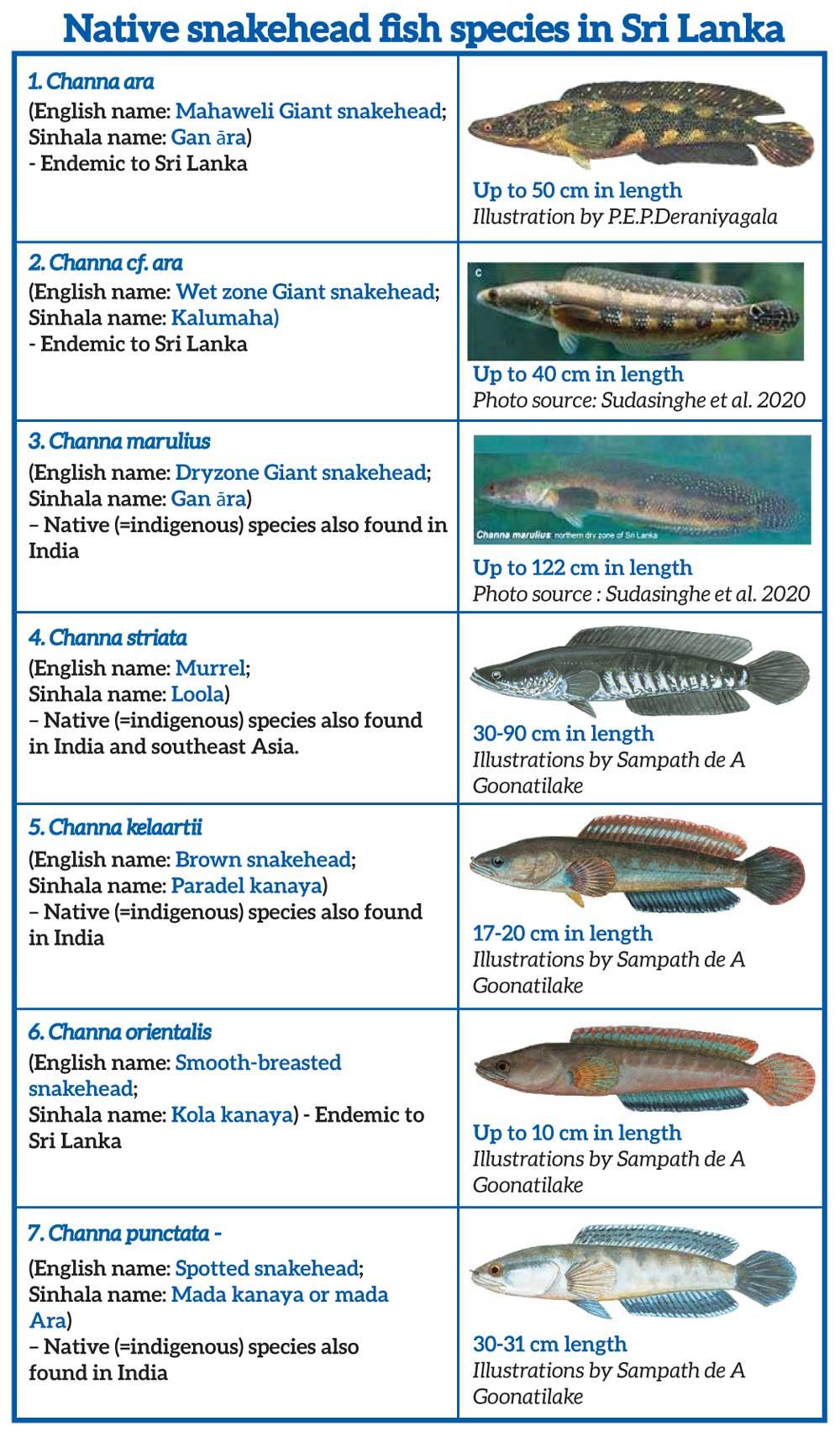
Speaking about native snakehead species, Goonatilake further said that Sri Lanka is home to seven native snakehead species and among them three species are endemic to Sri Lanka, while the rest (4) of them can also be found in India as well.
He said that Channa ara, found in the Mahaweli basin, is morphologically very similar to a lowland wet zone Channa species, which is phylogenetically distinct. “However, due to the morphological similarity, it has not yet been given a separate scientific name and is currently referred to as Channa cf. ara (cf. = ‘confer’, meaning ‘compare with’) but both are considered to endemic to Sri Lanka,” he added.
Apart from that Channa orientalis is also endemic to Sri Lanka while Channa marulius, Channa striata,Channa kelartii and Channa punctataare are native species that can also be found in India.
Responding to a query on repercussions of introducing invasive species into local ecosystems, Goonatilake said that it could lead to a wide range of ecological consequences. “While some species fail to adapt to local environmental conditions—such as unsuitable water quality, habitat limitations, or high predation pressure—and die off within a short period, others manage to survive and thrive. Those that successfully adapt can become invasive, causing significant ecological disruptions. These well-adapted, problematic species are classified as Invasive Alien Species (IAS),” he explained. According to Goonatilake, invasive alien fish species can negatively impact native biodiversity and ecosystems in the following ways:
Predation on native species, particularly small, endemic, or threatened fish, leading to rapid population declines or even local or national extinctions.
Competition for food and habitat, which disrupts the ecological balance and reduces survival and reproduction rates of native species.
Transmission of new diseases and parasites to which native species have no natural resistance, increasing mortality and stress in native populations.
Alteration of aquatic ecosystems, including changes in nutrient cycling, water clarity, and vegetation cover due to different feeding, breeding, or burrowing behaviors.
Genetic pollution, where invasive species interbreed with closely related native species, leading to loss of genetic purity and adaptive traits of the native species.
High adaptability and ecological plasticity, allowing these species to tolerate a range of environmental conditions, spread rapidly across various ecosystems, and colonise new habitats.
Economic impacts on inland fisheries, such as damage to fishing gear and reduced catch rates. For instance, the widespread presence of “tank cleaners” (Pterygoplichthysspp.) can cause gear entanglement and operational difficulties for local fishers.
Displacement of ecologically important species, which can affect the overall food web and lead to long-term degradation of aquatic biodiversity.
Goonatilake has recorded over 40 freshwater fish species in the Deduru Oya basin over a period of 10-15 years. These species have been identified with varying conservation statuses from Least Concern to National Status, Global Status, Exotic, Vulnerable and Near Threatened.
When asked how natural ecosystems and water bodies could be protected, Goonatilake underscored the need to strengthen and enforce national regulations governing the import, breeding, sale, and release of ornamental fish. “This includes screening species before importing and updating invasive species blacklists based on risk assessments. There is a protocol developed by “National Invasive Species Specialist Group (NISSG)” at the Ministry of Environment. Strict controls should be implemented on the pet trade and private aquariums, including mandatory labelling and information about the ecological risks associated with releasing non-native fish into the wild,” he said, while adding that aquariums, sustained public awareness campaigns, capture and utilisation of invasive species such as edible ones from the wild as a control measure are some other actions that could be taken to control the spread of IAS.
Several attempts to contact Rathna Gamage, Deputy Minister of Fisheries and Aquatic Resources, Ramani Shirantha, senior scientist at National Aquatic Resources Research and Development Agency (NARA) provided futile.