
Reply To:
Name - Reply Comment
By Anik Jayasekara
|
|
|
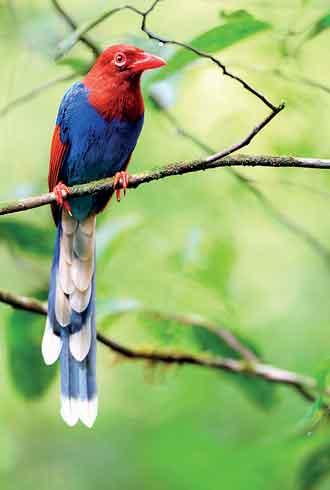
The Sri Lankan Blue Magpie is endemic |
Picture this. You are on a forest trail in Sinharaja, early enough that the light still feels undecided. Mist hangs low. Raindrops cling to leaves like they are reluctant to fall. The air smells of wet bark and leaf litter.
Protected forests look timeless. They are not.
You check your pockets. Phone. Keys. Snacks. Casually. As if no one is watching.
A flash of blue appears near the edge of the path.
It stops. It watches. Not you exactly. Your snack bag.
For a species found almost entirely within Sri Lanka’s wet-zone forests, this moment is not trivial. It is a small negotiation between visitor culture and wildlife behaviour.
You suddenly become aware of every crinkle your body is capable of producing, and of the possibility that the trail is teaching lessons neither you nor the bird intended.
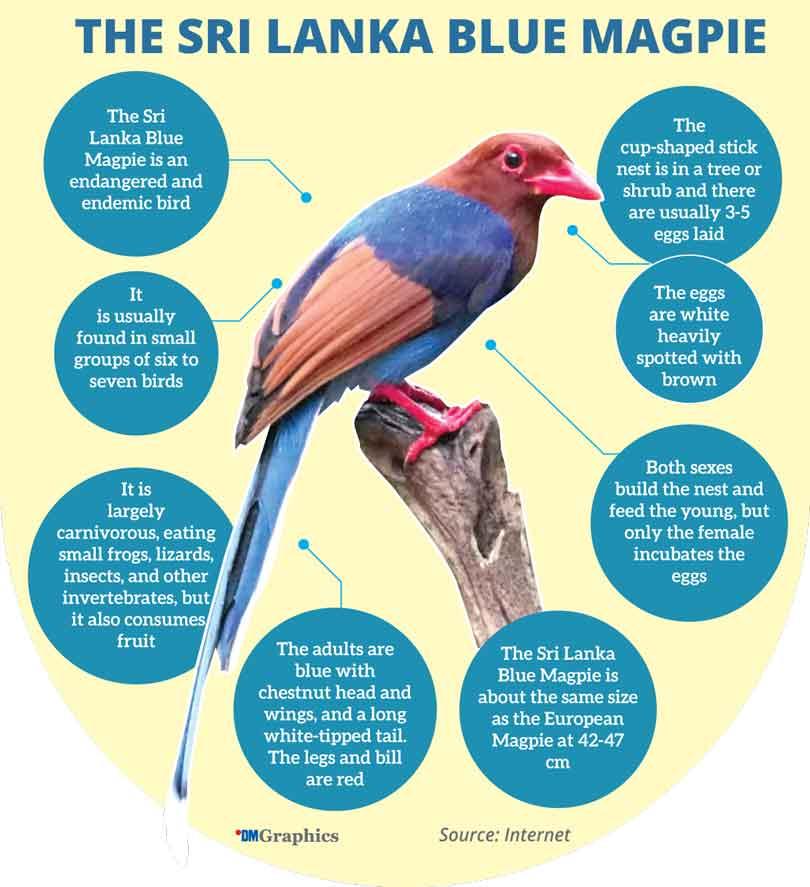
The Sri Lankan Blue Magpie is endemic. It lives largely within the lowland and mid-elevation rainforests of the southwest wet zone and parts of the hill forests. It is not a species that ranges casually across the island. That limited range is part of why it carries a vulnerable conservation status currently in global assessments, with a declining population trend widely linked to habitat loss and fragmentation. That vulnerability is shaped not only by what happens inside protected forests, but also by how surrounding private lands, buffer zones and restoration corridors are managed across the wet zone. The Blue Magpie is not a generalist that drifts comfortably across altered landscapes. It is a bird of layered rainforest. Of tall canopy, shaded understory and the quiet choreography of mixed-species flocks moving through continuous forest. When that continuity breaks, it is not just the area that changes, but also the ecological fabric that allows such forest specialists to operate.
That is the big picture. What is unusual is the smaller picture, the one most visitors actually experience. In Sinharaja, this bird can appear inside a very ordinary human system: trails, visitors, noise and food.
Not a management framework. Not a planning document. A snack bag.
Public understanding often begins with the wrong kind of confidence. When people hear “Vulnerable”, they may assume the main story is forest loss somewhere far away, handled by someone with a clipboard. When people see a Blue Magpie near a trail, they may assume it is “used to humans”, and that this is harmless, even charming. Both frames can be incomplete.
Habitat loss is a long-term structural pressure that shrinks the bird’s world over years and decades. Trail behaviour is a near-term pressure that can shape daily interactions, especially where people and wildlife repeatedly meet.
Blend the two into one neat narrative and complexity flattens. Small choices feel harmless. Repetition does the rest.
Field staff and regular visitors to protected forests often notice the same pattern. Most disturbance is not dramatic. It is ordinary. Groups get louder without meaning to. Food comes out briefly. A child drops crumbs. Someone offers a bird a snack because the moment feels special. On popular routes, these small acts can repeat day after day, and repetition is how wildlife learns.
A peer-reviewed study from the Kudawa nature trail in Sinharaja examined how recreational disturbance relates to bird occurrence near trails and recorded visitor presence and behaviour. In that setting, Sri Lanka Blue Magpies were recorded more frequently near trails under low- and moderate-disturbance conditions. That sounds reassuring.
Then comes the detail that changes the mood.
Observers also noted Blue Magpies perching near trails in anticipation of food when visitor groups were present. Under high disturbance, however, overall bird abundance near the trail fell, while abundance deeper inside the forest increased, consistent with displacement rather than calm.
This is where visibility begins to complicate public judgement. When birds appear frequently along accessible trails, photographs circulate. Sightings increase. The species can feel stable.
But trail presence is not the same as ecological security.
Visibility is not resilience.
What is easiest to see is not always what is most secure.
Tensions follow for those who work close to these systems:
If “tolerance” is read as “no problem”, what forms of conditioning are being normalised without anyone intending to?
If trail-centred sightings dominate records and images, how should that data be weighed against behaviour deeper in the forest, where monitoring logistics differ?
If feeding is framed as kindness, what is the most effective way to shift visitor norms without turning the forest into a lecture hall?
Permit systems regulate entry, but they do not automatically regulate behaviour. In peak seasons, balancing access, tourism livelihoods and ecological discipline is not an abstract debate. It is a daily operational decision. When a species appears tolerant near trails, public perception can drift towards “stable”, even if underlying habitat pressures remain unchanged.
That creates a subtle governance tension. Should visitor culture be treated as a wildlife management issue or as etiquette? And when monitoring focuses on trail presence, how do managers guard against mistaking visibility for resilience?
These questions are raised not to assign fault, but to reflect the complexity practitioners encounter when ecological systems intersect with human planning.
Many of these challenges are managed within Sri Lanka’s protected area system. The question is not whether they are recognised, but how public perception keeps pace with operational reality. If the general reader needs a handrail here, it is this: the bird does not have to be harmed for a system to shift. Repeated small interactions can be enough to change what becomes normal near trails, across forest edges, in buffer landscapes and throughout the fragmented wet-zone habitats on which the species depends. And once a behaviour becomes normal, reversing it is far harder than preventing it.
A Blue Magpie is not just a bird. It is a measure of how a country learns to treat its most valuable places.
A snack wrapper feels costless in the moment. The convenience is immediate and individual. The ecological cost, if it accumulates, is delayed and shared. Economists call this an externality. No single act appears decisive. But repeated across seasons and landscapes, patterns take hold.
The snack bag is a useful metaphor. Yet anyone responsible for a forest knows the pressures are rarely that small. A ten-acre tea patch edging closer to a boundary can be a larger wrapper to navigate. A corridor that narrows through incremental clearing. A restoration effort that stalls. Tourism infrastructure designed without ecological limits in mind. A watershed project assessed too narrowly. Each decision may be lawful, practical, even economically rational on its own. Ecosystems, however, respond to cumulative patterns, not isolated intentions.
A trail is also an education system. It teaches what is acceptable through what it permits repeatedly. If “no feeding” becomes a quiet norm, it scales without drama. If habitat continuity becomes a shared priority across private and public lands, resilience strengthens quietly. If small erosions are overlooked, they scale as well.
The Blue Magpie’s presence near a trail is, therefore, more than a wildlife moment. It is a question of how Sri Lanka shapes visitor culture, land use and stewardship in places protected precisely because they are not built for us.
SriLankasEndangered.com uses a reflection symbol called the Unity Icon. It begins with a triangle. The triangle represents a person. Each corner reflects what they bring. Research, field experience, management authority, land stewardship, restoration practice, data, images, planning decisions, even habits on a forest trail.
At the centre sits a dot. It represents conscience, the quiet calibration that guides judgement long before it becomes policy, a rule, a photograph or a published paper. These triangles often point in different operational directions. Managers balance protection and access. Boundary communities balance livelihood and land pressure. Infrastructure planners balance water, energy and ecological integrity. Researchers pursue evidence. Guides protect visitor experience. Photographers create visibility. Media shapes public memory. Landowners and restoration organisations working beyond park boundaries shape habitat continuity across the wider landscape.
Each role is rational. Each is necessary. The risk is the gap between them. Visibility can be mistaken for resilience. Policy can drift from practice. Behaviour can shift before systems notice.
The Unity Icon does not suggest uniformity. It suggests alignment. When even one corner of each stakeholder’s work turns towards the same ecological signal, misreadings correct earlier, norms form faster and knowledge crosses boundaries with less friction.
For a species like the Sri Lanka Blue Magpie, whose future depends not only on trail behaviour but also on habitat integrity across fragmented wet-zone forests, alignment matters as much as intention.
What appears in public articles today often becomes the reference point for students, journalists and policymakers tomorrow.
For this reason, this article remains open to refinement.
If you spot an oversimplification, the public record can be corrected quickly and transparently.
If the interpretation of Blue Magpie sightings, trail behaviour, habitat continuity, visitor culture, monitoring approaches or related landscape dynamics requires clarification, practitioners are invited to help refine the public record. This reflection is not an attempt to reopen past disputes, but to strengthen how cumulative impact is understood across scales.
Refining the public record
If this article raises a question, nuance, correction or perspective shaped by research, ornithology, birdwatching, fieldwork, wildlife photography, planning, management or lived experience, you are welcome to help refine the public record here:
www.srilankasendangered.com/respond
Contributions help refine how this issue is understood over time.
Researchers, practitioners, educators, planners and others working close to Sri Lanka’s environments who wish to share their journey, experience or perspective, and enable responsible connection with journalists, educators and communities are welcome here:
www.srilankasendangered.com/experts
This space prioritises clarity and credibility.
For educators and families looking for fun, age-appropriate material that supports classroom discussion and home conversations, without alarmism or fear:
www.srilankasendangered.com/kids
Designed for reading aloud, shared learning and curiosity-led discussion.
Photographers interested in contributing images that support accurate public understanding, with care for ecological context and timing, can explore ways to participate here:
www.srilankasendangered.com/click
Images are treated as context, not decoration.
For organisations, researchers and initiatives working across Sri Lanka’s landscapes, waters and communities:
www.srilankasendangered.com/orgs
A shared ecosystem is easier to navigate when good work is visible.
For readers who simply want to learn, explore and share at their own pace:
www.srilankasendangered.com
No donation requests. No pressure. No doom. No guilt. Just understanding.
This article is part of a public interest initiative, SriLankasEndangered.com, which works with scientists, educators, photographers and communities to improve public understanding of Sri Lanka’s ecosystems, one story at a time. The project publishes open, evolving features designed to invite expert input rather than close debate, and operates independently of political parties and electoral agendas, focusing instead on long-term public understanding and evidence-informed discussion.
In Sinharaja, you can stand in one of the most extraordinary forests on Earth and still be reminded that the smallest human habits travel loudly. Sometimes the rarest skill is not spotting wildlife, but learning how to pass through without altering the lesson the forest is trying to teach.
(The writer is the current platform steward for www.SriLankasEndangered.com)