Reply To:
Name - Reply Comment
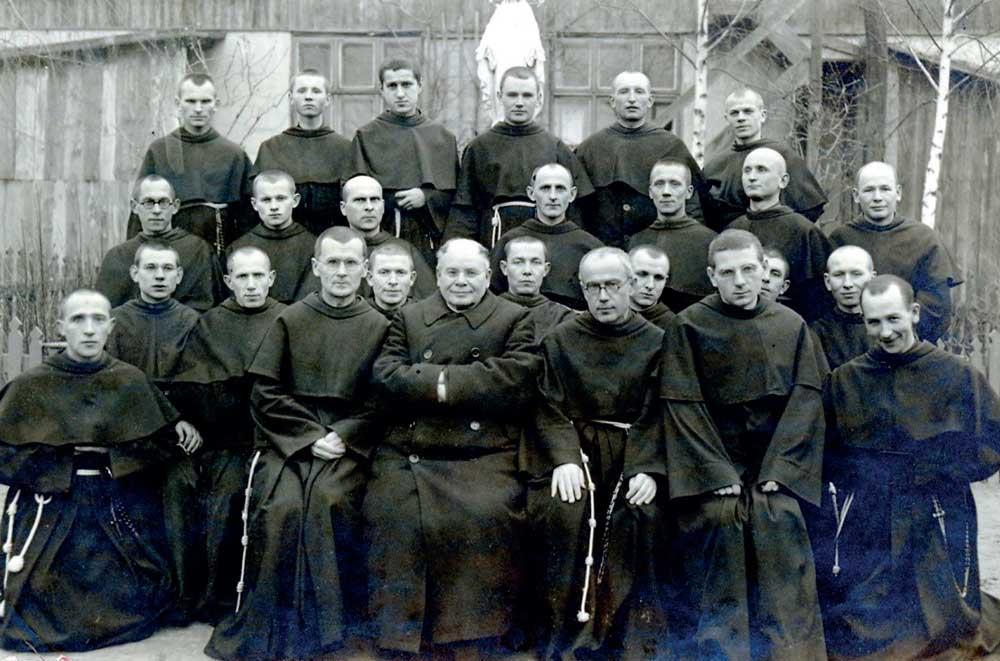
St. Maximilian Kolbe with his fellow friars at Niepokalanów (Photo courtesy: reproduced with the permission of The Archives of MI Niepokalanów (Archiwum MI Niepokalanów) , Teresin, Poland)
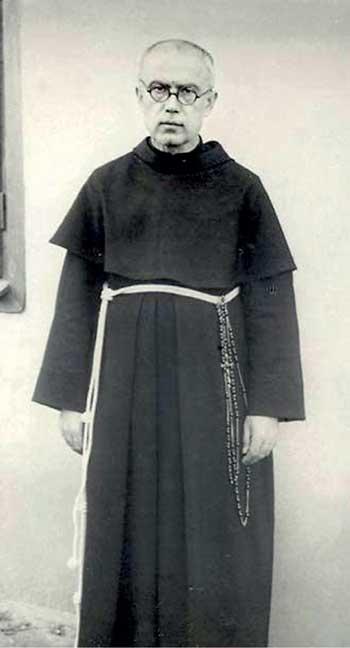 |
| St. Maximilian Kolbe |
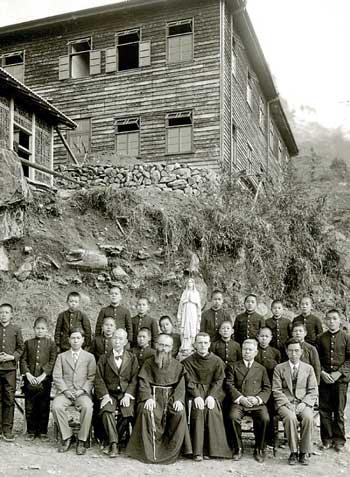 |
| St. Maximilian Kolbe in Nagasaki, Japan (1934) [St. Maximilian Kolbe [with his long beard] is seated in the middle |
By Prabhath de Silva
This is the second in a series of articles written about St. Maximilian Kolbe—The Saint and Hero at Auschwitz in view of his 84th death anniversary.
Visits to Japan and India
As St. Maximilian Kolbe’s vision for the Militia of the Immaculata was global and missionary in its scope, naturally he began to extend its work to foreign lands. In 1930, he travelled to Japan with four Franciscan brothers. There, he launched a Japanese version of his periodical Rycerz Niepokalanej entitled Seibo no Kishi, and founded a Franciscan monastery of the Order of the Friars Conventual Minor called Mugenzai no Sono (The Garden of Mary Immaculate) on a hill near Nagasaki. Although this monastery did not grow into a large institution like its parent Niepokalanów near Warsaw, it nevertheless developed into an active Catholic publishing house.
St. Maximilian Kolbe travelled to India in 1932 and during his visits there, he met with Kerala’s Archbishop of the Syrian Rite and the Archbishop of the Latin Rite. He had lengthy discussions with them on the possibilities of establishing a friary on the lines of Niepokalanów and starting publishing an Indian version of The Knight of the Immaculate. Although both Archbishops had initially expressed their willingness to gift pieces of land for his project, his vision of starting a Franciscan monastery named Amalam on lines of Niepokalanów in India did not materialise during his lifetime due to some obstacles and delays that intervened.
St. Maximilian Kolbe’s Visits to Ceylon (Sri Lanka) and His Impressions
St. Maximilian Kolbe, during his missionary travels to and from Japan, China and India, visited Sri Lanka (then known as Ceylon) in 1930, 1932 and 1933. The impressions he formed during these visits as recorded in his contemporary writings – letters, diaries, notes and article, provide a fascinating read.
March 1930
Whilst in transit and staying aboard a ship anchored in the port of Colombo for two days in March 1930 (March 24-25), St. Maximilian Kolbe and his fellow missionaries, Br. Zygmunt and Br. Seweryn visited several notable locations in the city of Colombo. These included the Colombo Catholic Press, described by him as ‘the print shop of the Oblate Fathers of Mary Immaculate (OMI)’ which published “The Messenger of the Heart of Jesus” in English and Sinhalese; a leading Catholic school; St. Anthony’s Church, Kochchikade; and the Post Office to buy postcards. He also distributed the Miraculous Medals at the places he visited. In his notes, he also makes mention of the tropical ‘summer heat’, ‘palm trees’ (a likely reference to the coconut trees), the sight of ‘a Buddhist monk’, ‘street cars’ (tram cars) and ‘cab drivers’ in Colombo. He attentively observed the devotional gestures of the faithful - ‘bowing’, ‘partly removing turbans’, ‘ joining hands’, ‘kneeling’, and placing ‘hands on the glass’ of the vitrine encasing the statue of St. Anthony whilst praying to him. He calls them ‘such good souls!’. His notes of Tuesday, March 25, 1930 (Feast of the Annunciation of Most Holy Virgin Mary) record celebrating the ‘Mass and Communion according to the intentions of the Immaculate, and speaks of a late afternoon ‘typhoon’, ‘storm’ and rain, and of ‘jumping fish’ being ‘tossed here and there’. In a parting remark, he also recorded that he had got into the boat to return to the ship, leaving the city of Colombo, ‘taking along pleasant impressions.’
[Source: March 24,25 1930 Monday Tuesday - Ceylon, port [Colombo]: The Writings of St Maximilian Maria Kolbe, Volume II Various writings, nr 991 A, Daily Notes, Notebook IV (1930-1933)page 1713-1714 Nerbini International 2016]
Summer (June- July) 1932
In the summer of 1932, St. Maximilian Kolbe visited Sri Lanka twice on his travels to and from India, en route from Japan and Hong Kong. In a letter to his superior in Warsaw, he recorded:
‘On our way there we stopped in Hong Kong, where Fr. Wieczorek, a famous Salesian missionary, asked me why we were not establishing a Niepokalanów in China (in Hong Kong). We also stopped in Singapore, where the Fathers of the Congregation of the Immaculate Conception of the Blessed Virgin Mary pointed out a site in China where a Niepokalanów could be nestled, about an 8-hour train journey from Peking (which is not far, considering average distances in Asia).
‘From there, we then crossed the Indian Ocean up to Colombo, on the island of Ceylon, which had belonged to India in the past. The crossing was rather miserable, though. The winds, called “monsoon,” blew day and night, and the ship, apparently forgetful of its thousand-ton weight, listed horribly forward, backward, or sideways. Eventually, with a one day delay due to our struggle against the winds, we landed in Colombo, where I stayed a few days over at the Oblate Fathers of the Immaculata, who are involved in missionary work there. I intended to rest and re-gain my balance, to be ready to face the sweltering heat of train cars in the rays of the tropical sun.’
[ Source: Searching for a New Niepokalanow July 1932: The Writings of St Maximilian Maria Kolbe, Volume II Various Writings, No: 991 H, Daily Notes, Notebook IV (1930-1933)page 1737,1738, Nerbini International 2016
He rested for a few days at the House of the Oblate Fathers of the Immaculate in Colombo to regain his composure, before he travelled to Ernakulam in India by train. Commenting on the train journeys from Colombo to and from India, St. Maximilian wrote to Fr. Kornel Czupryk, his superior from Colombo on July 04, 1932:
‘The journey here and back by train I did in second class. For the outward leg, in fact, at the Cook agency, where I had bought the ticket, I was told that the third class is prohibited (for a European), although later I became convinced that it was possible; but not for the return, because otherwise, before leaving India to go onward to Ceylon, I would have had to spend a five-day quarantine period in a field in countryside, in the midst of other indigenous people who might be infected with infectious diseases (malaria, cholera, and the like). Just spending any time in a situation like that, in a warm, foreign climate would be more than enough to bring down some kind of illness on me. In addition, the cost of spending that time there. Instead, I could sleep during the night and was not quite so hot, because there were electric fans. I think even our own, at least at the beginning, must travel the great distances across India in second class.’ ….
‘Nevertheless the Immaculata, who had very lovingly assisted me all through my journey, helped me in this journey as well, so that my health was not made overly feeble over the day and two nights I spent on the train. The one thing I could not do was eat.’
‘A notice had been posted on train car doors warning against infectious diseas-es: malaria, cholera, etc. Also, I was beginning to ache here and there. What to do? At a station, I clung to hot coffee and drank: I swallowed quite a bit. It did me good. Then I threw out the “molangon”” (Indian fruit) to the monkeys that were roaming along the pavement, because I realized that that type of fruit did not agree with me. I trundled on, trying somehow to get to the end of the journey, to the town of Ernakulam, located in the Indian principality of Cochin, on the Malabar Coast.’
[Source: St. Maximilian Kolbe’ s Letter to Fr. Kornel Czupryk July 1, 1932 from Colombo: The Writings of St Maximilian Maria Kolbe, Volume I, Letters, nr 443, page 948, Nerbini International 2016]
Visit in September 1933
In 1933, he visited Sri Lanka for the third time, whilst in transit and staying aboard the ship, the Conte Rosso, anchored in the port of Colombo for about six hours. He gives a fascinating and vivid account of this brief visit in his article ‘ Colombo: Impressions of a Trip to the Mission of Japan’ published in Rycerz Niepokalanej, September, 1934, as follows: ‘Toward midday’ our ship Conte Rosso was nearing the port of Colombo, and at midday we could disembark. It was announced onboard that there would be meet for lunch, even though it was Friday. Moreover, until the time of departure, at six, there was not much time; so, having eaten some bread, cheese, and two green Indian oranges each, we went on land by motorboat, paying half a Ceylonese rupee, and headed toward the city.’
‘First of all, we went, on the Borella tram, toward the episcopal palace. The conductor and the driver, thankful for the two medals of the Immaculata that we gave them, decided to drop us in front of the bishop’s palace. What good Hindus! The Immaculata will reward them for this. After visiting the small humble church situated beside the bishop’s house, we walked on foot along the paved road-full of spat-out gobs of red gum, which the inhabitants chew untiringly-toward the house of the Missionary Sisters of Mary, to procure some hosts and candles. Along the way, we walked in the cooling shade of the trees, since it was really hot. In front of us, a lot of shops with bananas of different colors and thickness, coconuts, and other tropical fruits.’
‘The small church of the sisters is very sweet, more so since Jesus, exposed all day long in the Blessed Sacrament, welcomes people all day long. Coming out of the church we found a girl who kindly invited us to go into the parlor. It was clear that our Franciscan habits, somewhat foreign to Ceylon, had already been noticed. On the principal wall of the parlor, Jesus looked down from the cross, whilst at his feet there was a big and beautiful picture of the Immaculata crushing the infernal serpent’s head with her immaculate foot. Evidently in the spirit of Niepokalanów.’
‘Soon after, two nuns dressed in white greeted us. They were the Franciscan Missionaries of Mary. The superior explained thoroughly that the aim of their in-stitute is to go on mission in order to lead souls to Jesus, always through Mary, and that they belong to Mary, Mary is their Patroness and they are the property of Mary. She spoke to us about the numerous blessings bestowed by Mary,….’
‘We gladly accepted some soda water with ice: only he who travels in such tropical countries could appreciate its utility and value.’
‘In addition, we received both the hosts and candles; the sisters even wanted to take us to the ship, all this without our making any payment, for the sake of the Immaculata.’
‘Then, we again took the Fort tram to the last stop, at the harbor. Both the conductor and the driver accepted medals of the Immaculata. The tram driver explained to us that his conductor was Buddhist; however, his dark face, shining with joy, showed us that the medal would not go to waste.’
‘Here and there, the street was blocked by two-wheeled carts covered with a roof of palm leaves and drawn by small oxen with large humps. A large group of Hindu [in some places in his writings, St. Maximilian Kolbe refers to the native inhabitants of the Indian Subcontinent as’ Hindus’ not necessarily meaning their adherence to Hinduism] workers, dressed in a cloth that covered half of their bodies or in just a loincloth, was repairing a section of the tramline. Their dark bodies moved heavy picks. [Along the way we saw] the streets, always larger, the train station (from which we had left last year in search of the Indian Niepokalanów), and the harbor.’
[Acknowledgement: The writer expresses his sincere gratitude to Fr. Krzys Flis, Director of MI Niepokalanów in Teresin, Poland and Sister Annamaria Mix, Archivist, Archiwum MI Niepokalanów in Teresin, Poland for providing him with access to the writings of St. Maximilian Kolbe relating to his visits to Sri Lanka and the photographs with permission for reproduction]