 Kamanthi Wickramasinghe
 Reply To:
Name - Reply Comment
Sustainability is no longer optional for the tea industry
 Despite Ceylon Tea being cherished the world over, the tea industry is undergoing several challenges at present. From low yields to high cost of production, challenges in retaining labour, climate change risks to social issues faced by the plantation community, each one of these issues may have a compound impact on the industry. This is why industry stakeholders are looking for a holistic approach to resolve these issues and establish a sustainable tea production going forward.
Protecting the community
Persisting challenges faced by the tea industry and certain practical solutions were discussed at a recent event organised by the Institute for Social Development (ISD) in view of International Tea Day. Periyasamy Muthulingam, ISD’s Executive Director is a labour rights activists who championed the global establishment of International Tea Day. Back in 2003, he raised issues faced by Sri Lankan tea plantation workers at the Asian Social Forum in Chennai. After subsequent discussions, the ISD together with India’s Centre for Education and Communication (CEC) held a two-day workshop in Lonavala to discuss rights violations and the welfare of tea plantation workers globally. At this workshop Muthulingam proposed establishing an International Tea Day to create a global platform to advocate for the rights of plantation workers. Even though December 15 was initially proposed in 2005, the United Nations officially recognised International Tea Day in 2019 and declared May 21 as International Tea Day.
Speaking at a recent event to commemorate International Tea Day, Muthulingam said that tea is not only related to the working class, but all sectors. “The industry includes exporters, tea brokers, regional plantation companies and so on. The industry is facing a crisis and we need to look at resolving these issues through a multi-sectoral approach. If the industry falls, the plantation community will also face a crisis. So we need to focus on the upward mobility of the estate sector and ensure that the community is protected,” he added.
Focus on tea smallholder sector
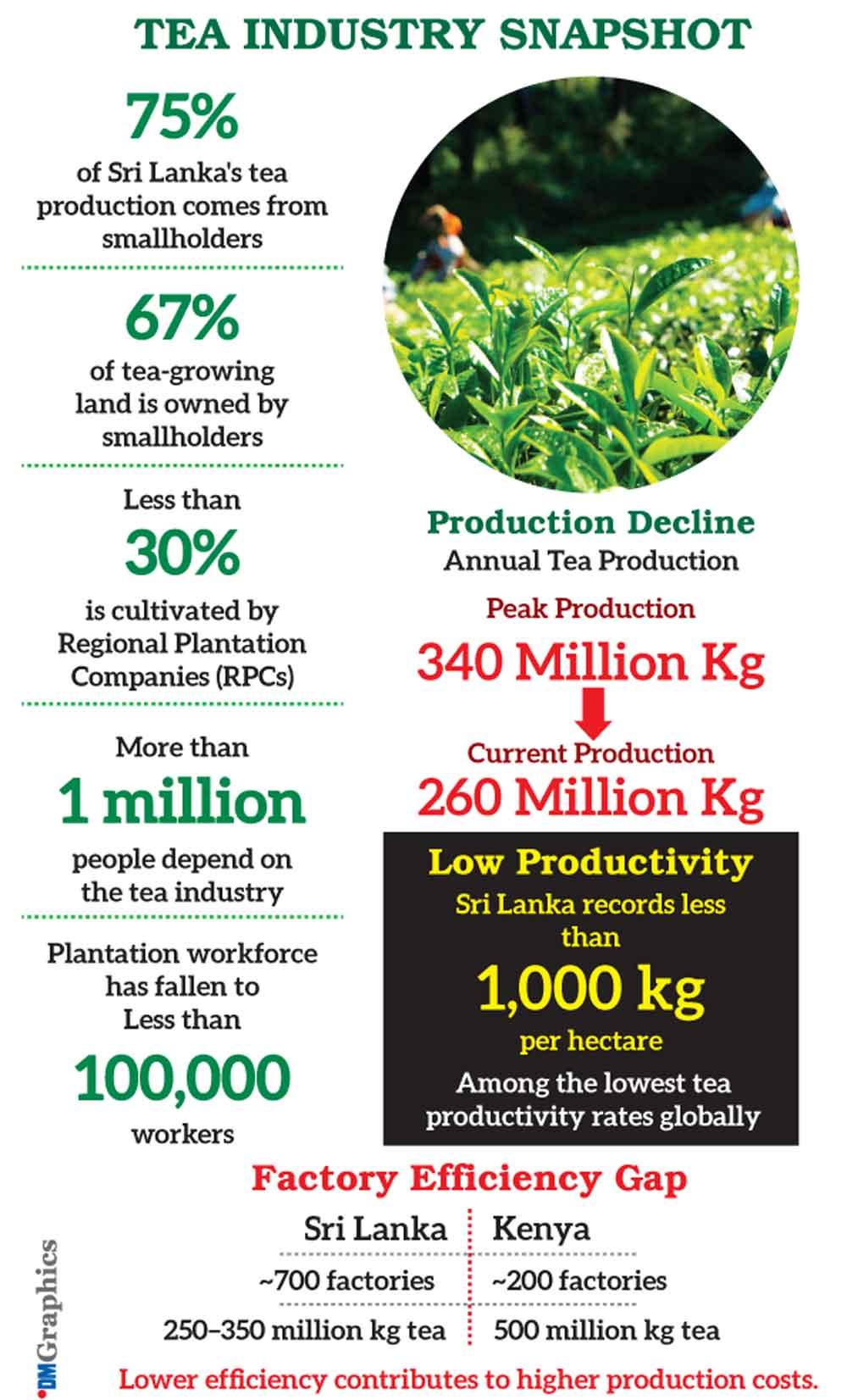
Today, the smallholder sector is the backbone of Sri Lanka’s tea industry, accounting for about 75% of the country’s total tea production. According to Dr. Roshan Rajadurai Managing Director at Hayleys Plantations said that of the cultivated extent, tea smallholders cultivate 67%, while Regional Plantation Companies (RPCs) cultivate less than 30%. He noted that the tea industry is basically a smallholder driven industry today.
Sri Lanka once had a record peak yield of about 340 million kilos of tea annually. “But irrational decisions to ban glyphosate and the ad hoc decision to ban all agrochemicals when we were just recovering, impacted annual tea production. Now we are struggling at about 260 million kilos depending on the weather and other vagaries. Tea smallholders contributed about 35% to the national tea production, but today they have doubled their production capacity,” he said.
Explaining issues faced by producers, Dr. Rajadurai said that people who do 99% of the work to grow tea, gets less than 1% of value. He said that people who buy at a high price, buy only 4% of our production and people who buy huge quantities, spare less than US$ 3. “On the other hand there are over one million people in the workforce. When I started as an assistant manager in 1983 we were finding work for the workers. Today, it has come a full circle and we are searching for workers to do the work. This is the only industry in Sri Lanka where employees work and live in the same place. Today there are less than 100,000 plantation workers, but they are given many facilities and benefits,” he added.
The plantation community has demanded for their rights. Today, they want to work independently with flexible working hours. They are demanding for dignified labour. To address these demands, tea industry officials have come up with a dynamic revenue share model and they claim that it has been “practiced successfully across plantations despite certain shortcomings.”
“We have to rely on a productivity-based wage system rather than an attendance-based wage system. Unfortunately the government hasn’t allowed us to improve productivity. Workers want to be independent, flexible and we have to break away from the shackles of colonial systems and that is the only way forward,” Dr. Rajadurai underscored.
 “The industry is facing a crisis and we need to look at resolving these issues through a multi-sectoral approach. If the industry falls, the plantation community will also face a crisis. So we need to focus on the upward mobility of the estate sector and ensure that the community is protected”
Periyasamy Muthulingam, Executive Director Institute for Social Development
 “We have to rely on a productivity-based wage system rather than an attendance-based wage system. Unfortunately the government hasn’t allowed us to improve productivity. Workers want to be independent, flexible and we have to break away from the shackles of colonial systems and that is the only way forward”
Dr. Roshan Rajadurai, Managing Director at Hayleys Plantations
 “Kenya produces 500 million kilos of tea with just 200 factories. Due to low productivity we have the highest cost of production. Soils have eroded especially in mid country, worker shortage and lack of qualified staff is a big issue. Even if we increase our productivity the question will be whether we have workers to harvest that tea”
Dr. Ziyad Mohamed, former Director at Tea Research Institute
Strategies to improve productivity
Apart from climate change, the Sri Lankan tea industry is facing a gamut of issues which it needs to overcome in order to maintain its global rankings. One of the negative aspects is that productivity is less than 1000 kilogramms per hectare. We have the lowest productivity in the world, compared to any tea-growing country, said Dr. Ziyad Mohamed, former director at Tea Research Institute highlighting issues in field productivity, factory productivity and worker productivity.
He said that in terms of factory productivity they are offering around 700 factories to produce almost 250-350 million kilos. “Kenya produces 500 million kilos of tea with just 200 factories. Due to low productivity we have the highest cost of production. Soils have eroded especially in mid country, worker shortage and lack of qualified staff is a big issue. Even if we increase our productivity the question will be whether we have workers to harvest that tea. Global warming is another factor threatening the industry. Back in the 1980s we were able to predict monsoonal months. It was a beautiful pattern. But now we get excessive rains and prolonged droughts. Tea is a rain fed crop so we have problems with that kind of weather. We also need to satisfy compliance requirements from buyers if we have to remain in business,” he explained.
Dr. Mohamed pointed out that corporate sector productivity has dropped by 500 kilos per hectare over the past 20 years while productivity in the smallholder sector has reduced by about 760 kilos per hectare. “There are no shortcuts in agriculture, but we opted for many shortcuts. We have to return to basics, see where we have gone wrong and introduce regenerative agriculture to make sure that we are getting the best option. Regenerative agriculture is the way forward and it would bring about a sustainable tea production, climate resilience, improved profitability and better market acceptance. Sustainability is no longer optional for the tea industry,” he said.
Social transformation and
emerging issues
After many struggles, the plantation community is on a slow path towards progress. Dr. Ramesh Ramasamy, Senior Lecturer, Department of Political Science, University of Peradeniya observes certain positive developments in the community. These include the community’s active participation in national level policy reforms; the strengthening civil society presence in the community despite ideological and policy differences and the growing consensus among political parties about pressing issues faced by the community.
However, there also seems to be several emerging issues that may have a negative impact on this community. Referring to a recent census report, Dr. Ramasamy said that the plantation sector has recorded the lowest birth rate while there is an increasing population of elderly persons. He noted that it would impose an economic burden on society. “The community has also become vulnerable to climate risks and climate change. Unplanned land use, poor maintenance of tea gardens, abandoned lands, unplanned infrastructure have contributed to these issues. We witnessed how the community was affected during cyclone Ditwah. Youth unemployment has increased significantly due to variety of reasons. The current generation doesn’t want to engage in plantation sector jobs. They are expecting dignified jobs with acceptable wages. So they are moving to Colombo and urban areas,” he added.
According to statistics many of them do not want to accept their Indian or Malaiyaha Tamil identity due to the stigma and discrimination that their elderly generation endured. Dr. Ramasamy also noted an alarming decrease in the labor force. On the other hand, this community is also challenged with food insecurity, malnutrition and endless cycles of debt. “They also encounter certain incidents of violence and suppression at the hands of estate managements. If these incidents continue there will be social unrest in the plantation sector which would impact the industry as a whole,” he said while adding that their demands need to be framed around the idea of social justice and that the community should continuously engage with the policy and governance process.