Reply To:
Name - Reply Comment
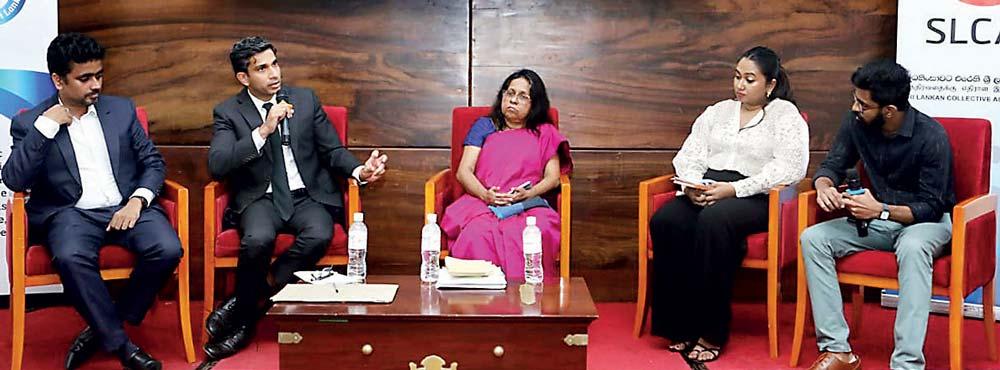
To coincide with ‘International Day in Support of Victims of Torture’, which fell on June 26, human rights activists, torture victims and close associates of torture victims attended a press conference organised by the R2L Centre and held recently. From left: Attorney at law Dulan Dasanayake, Dr. Gehan Gunatilleke, Commissioner at HRCSL and Attorney at Law S.S.K. Kasturiarachchi Director (Legal and Law Enforcement) at the National Authority for the Protection of Victims of Crime and Witnesses, Project Manager at R2L, Rashmika Wijesinghe and Project Coordinator at R2L, Suneth Gajanayake
(Pictures by Pradeep Dilruckshana)
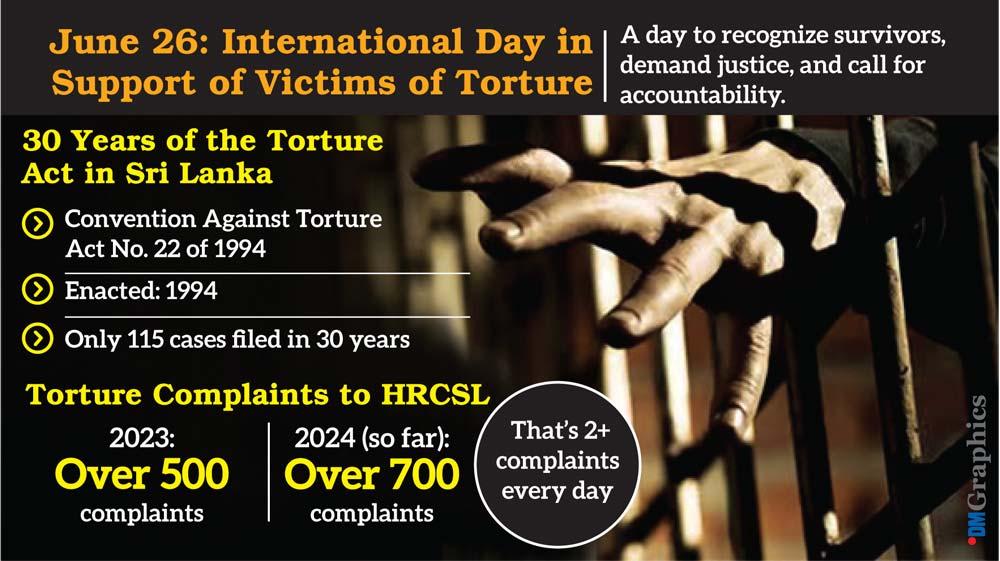
 Only 115 cases have been filed against torture and other cruel, inhuman or degrading punishment under this law in the High Courts over the past three decades
There are enough incidents associated with stays at the police which highlighting the lack of accountability and disciplinary action
The Human Rights Commission Sri Lanka received over 500 torture complaints in 2023, and more than 700 in 2024
 June 26 marked the International Day in Support of Victims of Torture. It is a day dedicated to recognising and supporting those who have endured acts of torture and also calls for accountability and justice. On this occasion, the Right to Life Human Rights Centre (R2L), a civil society organization committed to promoting and defending fundamental human rights through legal and financial support, reaffirmed its commitment to standing with survivors and advocating for justice.
This year also marks a significant milestone for Sri Lanka—30 years since the enactment of the Convention Against Torture and Other Cruel, Inhuman or Degrading Treatment or Punishment Act, No. 22 of 1994. However, progress in implementation remains deeply inadequate. According to data obtained by R2L from the Attorney General’s Department under the Right to Information Act, only 115 cases have been filed under this law in the High Courts over the past three decades.
These insights were brought to light at a press conference organised by the R2L Centre, where survivors and advocates spoke out about the realities of torture in Sri Lanka.
A harrowing experience
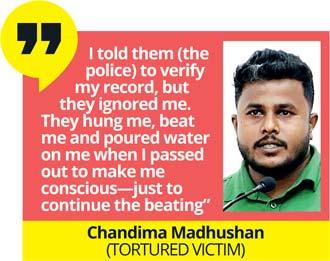 One of the survivors, Chandima Madhushan, shared his harrowing experience. “It has been six years since I was tortured by the police,” he said. The injuries limit the movement in his arms. In 2019, following a complaint for robbery, involving a driver from Munchee Biscuit Company Pvt Ltd, Madhushan was summoned by the police to give a statement. Despite having no disputes with the driver and maintaining a clean record, he was abducted and brutally tortured under the direct supervision of the station’s police chief.
“I told them (the police) to verify my record, but they ignored me. They hung me, beat me and poured water on me when I passed out to make me conscious—just to continue the beating,” he said. Madhushan also claimed that the police demanded LKR 300,000 before his release on bail. Refusing to comply, he admitted himself to a hospital for treatment. During his hospital stay, senior police officers have urged him to transfer to a private hospital, offering financial assistance, an offer which Madhushan firmly rejected. His mother subsequently lodged a complaint with the Human Rights Commission of Sri Lanka (HRCSL).
 Despite the trauma he endured, Madhushan believes that justice is still possible. However, he pointed out that the police officer implicated in his case has merely been transferred to another division—highlighting the lack of accountability and disciplinary action.
Also present was Amitha Priyanthi, who has been tirelessly pursuing justice for her brother since the year 2000. “When I first met Madhushan, I saw how much he struggled just to put on his shirt,” she said. Her brother was allegedly beaten to death in police custody. Although there is an ongoing case at the Kalutara High Court, there are still no suspects identified. The case continues. “Warrants have been issued throughout 2025, yet the police have failed to perform their duties,” Priyanthi, a campaigner for human rights lamented.
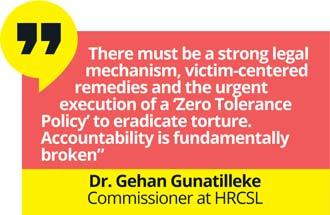
Commissioner at Human Rights Council Sri Lanka (HRCSL), Dr. Gehan Gunatilleke, emphasised on the disparity present within Sri Lanka’s legal framework. The Commission received over 500 torture complaints in 2023, and more than 700 in 2024 so far—an average of two or more complaints each day. Dr. Gunatilleke proposed the establishment of an independent investigative body, separate from the police, with sufficient resources, modeled after those in countries like South Africa, Canada, and the UK. “There must be a strong legal mechanism, victim-centered remedies and the urgent execution of a ‘Zero Tolerance Policy’ to eradicate torture. Accountability is fundamentally broken,” he concluded.
 Director (Legal and Law Enforcement) at the National Authority for the Protection of Victims of Crime and Witnesses (NAPVCW), Attorney at law, S.S.K. Kasturiarachchi spoke on the scope of the Amendment Act No. 24 of 2023. She highlighted how it expands protection to family members, allows remote testimony and enables compensation. However, she said, “The act’s effectiveness is undermined by systemic delays and the continued reliance on police-led threat assessments”. Moreover, she provided an explanation on ‘who can be labeled as a witness’ in a crime. According to Kasthuriarachchi, any person who has provided an affidavit or made a statement in support of a complaint or legal proceeding made by a victim of a crime can be named as a victim.
Attorney-at-Law Dulan Dasanayake echoed these concerns, pointing to the staggering gap between the number of complaints and the number of successful prosecutions. With only 115 cases filed under the Torture Act in thirty years, he called for the creation of an independent prosecutorial authority and urgent systemic reforms to combat impunity and uphold justice.
As Sri Lanka reflects on 30 years since the Torture Act came into force, the voices of survivors like Madhushan and campaigners like Priyanthi stand as stark reminders that legal protections mean little without enforcement. When justice is promised on paper, but denied in practice, how much longer must victims wait before the law truly speaks for them?