Reply To:
Name - Reply Comment
Goolbai Gunasekara
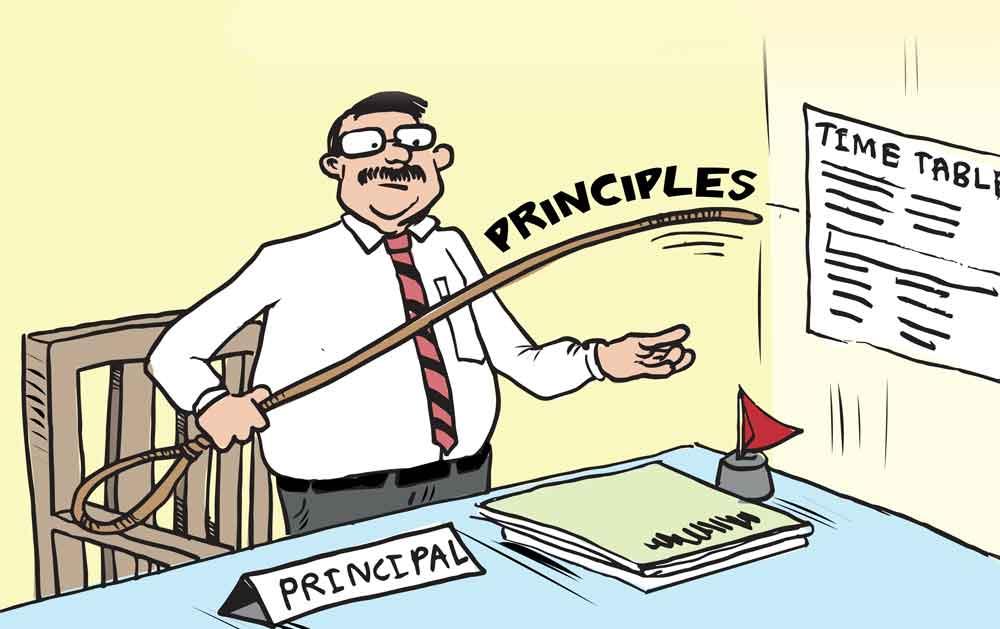
Principals in the early years of the 20th century commanded a kind of respect that was almost adulatory. And why did they do so? For one thing the well known private schools both in Colombo and the outstations ran their schools themselves with School Boards. The Government did not meddle. Each school was an entity with a Board of Management and was run by a Principal of its choosing. It has been an accepted fact that the missionary schools established by British and American missionaries had excellent standards of education albeit (and unfortunately) aimed at making Sri Lankans good little Colonials.
During my days as a Girl Guide (around 1947 or so) we still took the Girl Guide Oath with British overtones. In that climate Private Schools chose their own Principals. Many of them all over the island were also foreigners ( American as in the case of my own mother) and others. The Sirimavo Bandaranaike Schools' Government Take Over had not yet taken place and many private schools of all faiths ran their own schools.
Parents trusted Principals to maintain strict principles of justice and high standards of education. They did not dream of contradicting them. Certainly parents did not rush to ‘rescue’ their offspring the minute the school exerted any disciplinary action the way they do now. For instance, parents sometimes attempted to deny me ( as Head of Asian International School ) to mete out all punishments I felt were deserved. I remember one case when three older boys were punished (I cannot recall why) and they were suspended for one day. Within half an hour I had three calls from angry fathers…one from Bahrain, one from Bangalore and one from Bombay questioning – nay- protesting this ‘unfair’ treatment meted out to their sons. The Staff and I nicknamed it “The problem of the three B”. Truly those mobile phones try the patience of any Principal these days since within minutes their decisions are being contested by parents not even in the island..
Not thus were complaints made by OUR Principals handled by our parents. In fact we feared the parental fall-out far more than we feared the Principal. NEVER did parents take the side of us miscreants. They had little faith in our ability to behave with circumspection. In fact if we had any rights as students we did not know of them. Parents had an infinite, almost childlike trust in our Principals and Teachers and protest calls to the School’s Head were unheard of.
After the Schools' Take Over it was with considerable alarm that anyone involved in Education used to read of the appalling crimes perpetrated by Government Principals and teachers in the daily papers until the Government changed recently. Lately such cases seem to have diminished. Principals of outstation schools used to be interdicted, assaulted, arrested and even remanded for all sorts of ‘crimes’ ranging from abuse of power to rape. One must wonder, therefore, how those Principals got promoted to such high office if so clearly unsuited for the responsibility of running a school. How were they chosen?
All Government school Principals were selected by the Dept. of Education and promoted on seniority NOT necessarily on ability. I have been told that the process of selection does not depend on ‘suitability’ or ‘capability’ and definitely not on reputation. Principals get to run schools if they have been teachers long enough and have somehow been classified as being in the A Grade.
To be a successful Principal requires so much more than simply being an A Grade teacher in Government service. It is time the Government took a serious notice of the type of person to whom they hand out these positions of control specially when they are dealing with the youngsters of our country.
Schools had no say in the matter of choice and once Principals were put in place they had very little real authority to change anything in the school they ran. That authority resided in the Dept. of Education.
For instance what control can a Principal exert over teachers under him when he does not have the right to either hire or fire them? Really bad teachers cannot even be fired by the Dept of Education unless they have broken the law or done something so reprehensible they are publicly castigated or else actually arrested.
This happens oftener than it should. Papers used to be full of stories of child abuse by those who actually had no talent for teaching.
Coming back to Principals – is there any training for these Government posts or is the policy to keep them in office until retirement age deems it necessary? Is there no better way to ensure that our children do not have a fairer deal than what they now receive? (I am speaking mainly of out station schools). My own suggestion has been that parents could be given a greater say in school affairs. Perhaps they should interview prospective Principals who are now arbitrarily foisted on them. They can then see whether the candidate is suitable or not for their school. Parents are well able to judge and I feel a certain input from them would be very useful to all concerned.
We are told that our new Minister of Education, Dr. Harini Amarasuriya , is changing Dept. of Education methods and curricula to suit the age of AI. Principals could also be given a greater say in how such new subjects are taught. I believe it used to be done on a day by day ordering by the Dept. of Education. Principals could not deviate from this. Innovative methods were not the order of the day. They could not introduce anything new into the daily routine. In short they might as well have been automata.
I recall that about 20 years ago a Principal was severely reprimanded because he had allowed Drill periods at a time which was not officially laid down. Such lunacy did not bode well for the education of our children.
To be a successful Principal requires so much more than simply being an A Grade teacher in Government service. It is time the Government took a serious notice of the type of person to whom they hand out these positions of control specially when they are dealing with the youngsters of our country.
Experience has been described as “Compulsary Education” Whatever poor experiences we made in the past will hopefully become useful experiences for the future modern and new systems in Sri Lanka.