 Kamanthi Wickramasinghe
 Reply To:
Name - Reply Comment
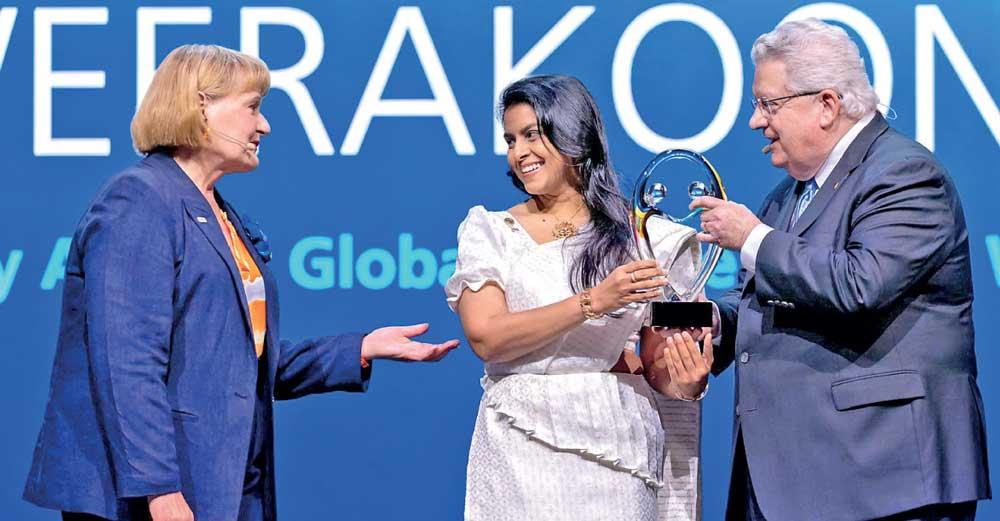
Weerakoon accepting the Rotary Alumni Global Service Award from RI President Stephanie Urchick and Foundation Chair Mark Meloney
Pushpi Weerakoon, a specialist in Peacebuilding, Transitional Justice, Migration Management, Development, and Diplomacy, recently made history as the first Sri Lankan to win the Rotary Alumni Global Service Award. This award recognises one outstanding Rotary alumnus from around the world and is presented to individuals whose service activities and professional achievements exemplify Rotary’s ideal of Service Above Self, often impacting lives internationally. Weerakoon, who currently serves as the Officer in Charge at the International Organization for Migration (IOM) Marshall Islands and the sub-regional Project Manager (Gender) for IOM Micronesia, Marshall Islands and Palau, feels proud about creating history and bringing the spotlight to Sri Lanka.
In a candid interview with the Daily Mirror, Weerakoon shared her story with us.
Excerpts;

“Sri Lanka must own the entire reconciliation process (even if we learn from international experiences). So that it could deliver home-grown solutions to bring answers and services to the survivors and victims’ families to provide closure and move forward”
Pushpi Weerakoon
 Q What inspired you to embark on a career in peacebuilding?
Like many Sri Lankans born during the conflict, even if I lived predominantly in Colombo during the first 19 years of my life, attending St Bridget’s Convent, I walked minutes away from bomb blasts while several of my school friends, family members and friends died or were injured during these encounters. Seeing the perils of the conflict made me constantly think of how one could contribute to resolving it. Going by the well-known professions available in the late 90s, the closest way seems to have been to become a human rights lawyer. In December 2004, I came home to Sri Lanka from England, where I was studying to become a Barrister. I remember watching breaking news early that morning about the devastating Tsunami just after we returned home after an annual pilgrimage to Adams Peak (I chose to attend this pilgrimage instead of going down south to Galle with friends. Had I chosen this option, I too would have become a victim of the Tsunami!).
The events which transpired immediately post-Tsunami changed my career, from the legal field to the peacebuilding field. As soon as we were allowed, I volunteered with groups helping the survivors of the Tsunami. This introduced me to Sri Lanka’s Alternative Dispute Resolution Institute (ADRI) and Legal Aid Commission’s Chairman, Hon S.S. Wijeratne. Under his guidance as the Director/Registrar of the ADRI, I led a group of lawyers to train government and grassroots level leaders in mediation skills, the application of the new Tsunami Mediation Law, and establish mediation boards in almost 80% of the districts at the height of the conflict. I travelled to the high-security conflict areas and tsunami-affected zones to conduct four-day workshops, almost three weeks a month for over a year. Spending time with victims’ families, survivors, military, government officials, and multiple factions opened my eyes to the multifaceted needs required to be fulfilled to bring solace to the communities enveloped by the conflict, rather than the ‘right or wrong’ approach, as I was mostly taught when practising to be a lawyer. I never went back to England to complete that practice. Instead, I continued to contribute to the Sri Lankan peacebuilding field.
In addition, from a very early age, I watched my parents always engage in social service by assisting those in need, be it during a natural or manmade disaster. Whether it is the annual floods in Ratnapura, alms giving organised at home, temple, kovil, church, mosque by the community or an individual, I found them contributing selflessly during any emergency, and this definitely rubbed off on me. I also recall how we helped our Tamil neighbours climb over the wall of our Colombo residence and come over to our place to avoid the attacks in the 80s. My parents instilled the importance of timely giving. By practice, they showed me how humanity transcends all boundaries, be it human or animal, religion, cast, gender or disability. For this, I’m eternally grateful to them.
Q How would you define peacebuilding?
It’s a long-term process which addresses the root causes of the problem, promoting reconciliation and sustainable positive social change, which transforms a conflict so that it will not arise again. It involves conflict prevention, management and resolution through nonviolent means such as Mediation, Negotiation, Arbitration and awareness raising, which brings about mutually acceptable win-win solutions addressing concerns and needs of all parties involved and instils respect for different identities, human rights and justice. Achieving sustainability in peacebuilding encompasses economic, social development, mental health, and psychosocial support for healing.
Q How did Rotary shape your journey as a peacebuilder?
As the Rotary Peace Fellow in 2007, I studied at Chulalongkorn University in Thailand. In addition to the opportunity to learn from world renowned professors in ‘Peacebuilding’ such as Tom Woodhouse (UK), Irene Santiago (Philippine), Jan Sunoo (South Korea/US), Joel Schaffer (US), Craig Zelizer (Columbia) and many more during class time, the students went on field trips to Cambodia, Burma Border and met the Karens and the Kachin indigenous communities. ‘Peace’ has been a sensitive subject to explore. The Rotary had meticulously organised these trips so that the students could safely speak to the different stakeholders of the past or existing conflicts and get hands-on experience on how the tools we learned in the classroom should be applied in real life.
That same year, I represented my batch at the Rotary Zonal Institute in Malaysia and addressed the gathering on what I gained from the Peace scholarship and the importance of popularising it worldwide. I was invited to do so by PRIP Bichai Rattakul and PRIP Rajendra Saboo, who were members of the panel which judged the Peace Scholars’ final presentations in Bangkok.
In 2009, Rotary enhanced my life again by giving me the Ambassadorial scholarship. I completed the Master’s in Conflict Transformation from the Centre for Justice & Peacebuilding (CJP) at Eastern Mennonite University in the USA with this scholarship. It gave me the privilege to study under Dr John Paul Lederach, better known as the Father of Conflict Transformation, Dr Howard Zehr, known as the grandfather of Restorative Justice, Dr Lisa Schirch, Dr Jayne Docherty, Dr David Brubaker, Dr Nancy Good, Dr Barry Hart and many other well-known scholars in the peacebuilding field.
Once nurtured as a Rotary Scholar, one gets naturally ‘adopted’ into the Rotary family due to the amazing relations/support system built among Rotarians and the scholars. At home in Sri Lanka, the district foundation chair and clubs invited me to share my experiences and knowledge at club and district meetings/trainings. In the same manner, I was invited by foreign clubs. I also continued to partner with Rotary Clubs whenever possible while continuing my career as a peacebuilder at the Reconciliation Unit at the Sri Lankan Presidential Secretariat, Open Government Partnership, International Development Law Organization and the International Organization for Migration (IOM/UN Migration Agency).
As an UN expat, whenever I was posted on a new mission, I’ve always had a sense of security and belonging in an unknown country, knowing that I could reach out to a Rotary Club, full of total strangers never met before but be guaranteed that I would not just receive a warm welcome but also assistance and protection. I have had many instances where my Rotary badge or T-shirt has been the only reason to have started conversations with strangers that have grown into lifelong friendships, joint projects, sister club agreements and career development prospects.
I was impressed by the methodical and impactful way the organisation served some of the most vulnerable communities around the world. Its steadfast commitment to finding solutions for some of the world’s pressing issues, such as Polio, is impressive. Since their 1st project to vaccinate children in the Philippines in 1979, the cases have reduced down to 99.9%, with it only being endemic currently in Afghanistan and Pakistan. While stationed in Pakistan with IOM, I was privy to the collaborative work done by Rotary, providing financial and logistical aid, with UNICEF assisting with communication strategies to increase the acceptance of the vaccination among the locals.
Q As a country that has experienced a conflict, what’s the role of peace builders in bringing about social cohesion, empathy and closure for victims of war?
Peacebuilders continue to play a role in post-conflict situations through training, raising awareness/education, policy and advocacy work, mediation, negotiation to sustain a peaceful and just society by assisting the social cohesion and trauma healing process. Continuing intercultural dialogue to build trust and collaboration among communities and making sure the transitional justice systems are operated methodically to continue to bring the different stakeholders of the conflict together to promote accountability, repair the harm, and cultivate healing is important.
Not only peace-builders, every consecutive government has a duty to their citizens to continue post-conflict activities, to make sure reconciliation and transitional justice mechanisms run smoothly in spite of individual party agendas and new policies.
Q Do you observe lapses in our transitional justice process?
It was a positive step to have set up the Office for Reparations, the Office for Missing Persons and the Office for National Unity and Reconciliation immediately post-conflict. The project I headed for IOM Sri Lanka worked with the Rehabilitation of Persons, Properties & Industries Authority (REPPIA), established in 1987, to reassess the compensation and services provided to the victims and survivors of the conflict to match their needs post 2009. We provided technical advice to draft the new law, briefed the Reparation commissioners and also negotiated to set aside monies for the first payments for the beneficiaries, since the act was passed.
But is there a credible mechanism to make sure that, in spite of the changing governments and their policies, these offices would receive continuous funding not just to sustain the staff but also to provide an effective service to the beneficiaries?
We should not forget that we are dealing with a national issue that transpired from 1983 to 2009, which culminated due to bad decision-making by some leaders since 1948. To guarantee non-repetition, it is important that we continue to work with the rest of the world to educate the new generations (especially those who have not visited Sri Lanka but have formed a view based on a biased narrative) about what actually did happen during the separatist movement from the late 70’s to early 2000s. We must provide reparations, find evidence of the missing persons and continue to expel lies which add fuel to grieving parties and rekindle the violence.
Sri Lanka must own the entire reconciliation process (even if we learn from international experiences). So that it could deliver home-grown solutions to bring answers and services to the survivors and victims’ families to provide closure and move forward. Foreign expertise and advice by individuals or institutions are valued, but there must be an uninterrupted, nationally led process.
Q What are the opportunities available for youth in the peacebuilding landscape?
The youth, full of energy and innovative ideas, are always treasured in peacebuilding initiatives, whether it is at the local community level or in the international sphere. They can become positive change makers by purely using social media and AI freely available to influence change. Volunteer with the local Interact, Rotaract, Rotary or other multi-faith/communal peacebuilding organisations, including UN agencies such as UN Volunteers and internships at other UN agencies (most with stipends). Take the initiative to write directly to the HR department with your CV and a covering letter inquiring about opportunities. Do the same with your community development centres, NGOs and INGOs. Most organisations love to hear fresh ideas from new blood. Request for informative interviews to get to know an organisation that interests you. As much as this will give you an idea of how the organisation is serving the community, it will also show you ways to use your unique skill sets to further enrich the service offered by them. This is how I became a volunteer at the Citizens Advice Bureau Buckinghamshire and also got recognised as the ‘Best Millennium Volunteer’ by the Education Minister in the UK.
I believe in the universal energy of vibration. We attract experiences and situations that resonate with our own vibrational frequency. So, serve wholeheartedly. Be grateful that you are presented with the opportunity to do so. In good time, you will be rewarded in many forms.
To solidify the youth’s contribution, the UN Security Council Resolution 2250 (2015) on Youth, Peace & Security calls for young people to be actively involved in direct and indirect peacebuilding initiatives and the decision-making process. These include advocacy, awareness raising, mediation, training in peacebuilding tools and economic empowerment such as livelihoods/entrepreneurialism, reintegration/exchange programs and political processes such as elections and direct promotion of human rights.
Q How do you feel about becoming the first Sri Lankan to win the Rotary Alumni Global Service Award?
It is always great to create history, especially when it puts the spotlight on Sri Lanka. I felt content. A rekindling of the joy of what I continue to do, since a peacebuilding frontliner’s work, irrespective of which country we come from, often goes unnoticed. This is so due to its sensitivity and dangerous nature. We do not divulge information to the public (unless it’s officially published in a report intended only for a specific audience). Even if some information gets publicity, it is done in an anonymous manner without mentioning personal names as a security precaution. I hardly ever speak about my work in detail with my family or friends unless, on a rare occasion, I’m pressed to do so. Even then, I find myself carefully choosing what to say as appropriate to the listeners rather than divulge an entire incident, which most times I’ve found have not been so pleasant, believable or understood by another, especially when they themselves have not experienced it. For a long time, I derived motivation to continue my peacebuilding service from the satisfaction I receive from seeing my beneficiaries happy. This award gave me the warm feeling of acknowledgement that I, as well as other peacebuilders in the frontline, wherever they provide their service in the world, are not alone.
Q What are some of the challenges you have faced in this journey?
The first and the hardest was to convince my Ammi that I wanted to do Arts for A/Ls and become a lawyer. She wanted at least one of her kids to become a doctor. My eldest sister got away from it by doing London A/Ls Commerce during a very short period and getting admission into an Australian university. After local O/Ls, I attended Gateway International to do my London A/Ls in Science. While studying at Gateway, I had a brief encounter with Principal Sir, the late R.I.T. Alles. The advice he gave me that day was invaluable and was something I experienced many times in this journey. He said that there will be many moments where it would be me and just me who’d have to pull through challenging times, and that it would be much easier if I was doing something that I was wholeheartedly invested in rather than a profession someone made me choose, even if it would have been by someone who loves me very much. His advice was enough to convince Ammi, too!
I’ve often considered unnoticed challenges as an adventure. Continuously having to adjust to a new country, culture and norms, that too not as a tourist but as close as much as possible from a locals lens to understand the intricate details of the issues in addition to getting used to new diets, weather patterns, medicine, leaving and making new friends/community/colleagues, contaminated environments and at times direct security attacks where there was no security provided or it was too far away, takes a toll on us mentally and physically.