Reply To:
Name - Reply Comment
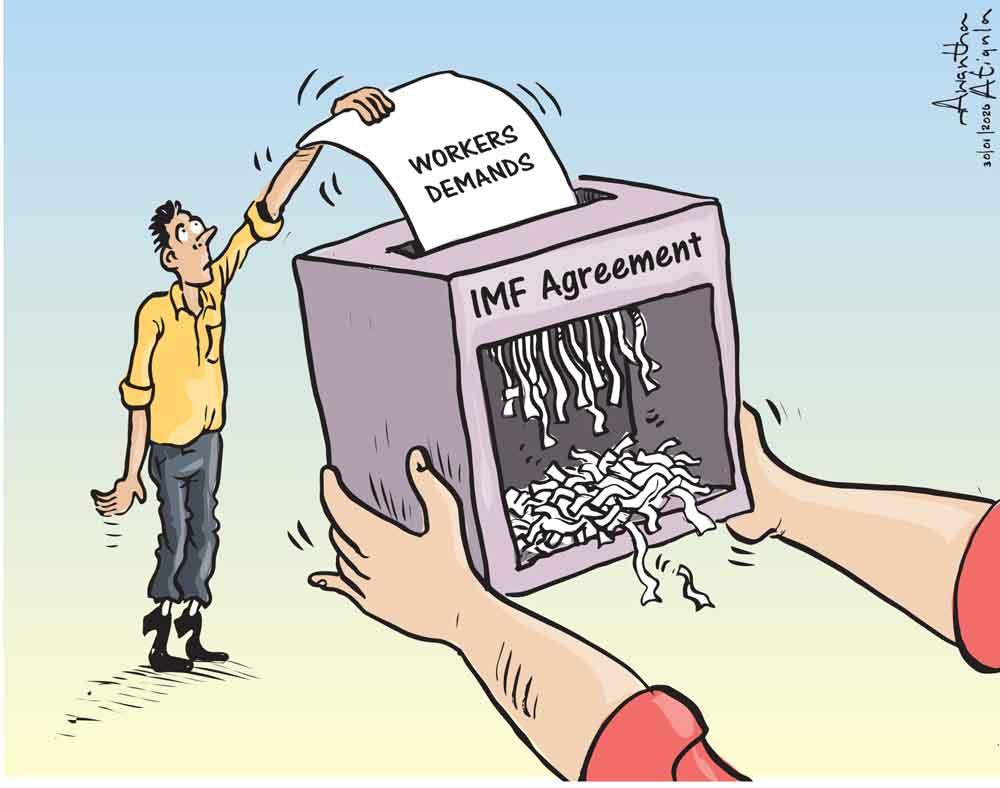
The cartoon depicts a worker standing on the left, stretching upward to insert a sheet labeled “Workers’ Demands” into a box-like machine. The box is prominently marked “IMF Agreement” and resembles a paper shredder, with strips of paper visibly hanging and piling up inside. Large hands, belonging to an unseen figure, hold the machine steady, emphasizing control over the process while the worker appears physically strained and uncertain.
Visually, the act of feeding the demands into the machine suggests a formal or procedural step, as if grievances are being acknowledged through an official channel. However, the shredding mechanism implies that once these demands enter the system, they are altered, fragmented, or rendered ineffective. The scale difference between the individual worker and the institutional apparatus reinforces a power imbalance, while the unseen operator adds a sense of distance and abstraction to decision-making.
The cartoon can be read as a commentary on the tension between labor expectations and structural economic agreements. Some viewers may interpret it as criticism of international financial frameworks that prioritize fiscal conditions over social concerns, while others may see it as a broader reflection on how complex policy processes often dilute or sideline grassroots demands. Rather than assigning intent to a single actor, the image invites reflection on how institutional mechanisms can unintentionally—or deliberately—reshape the outcomes of public and worker input.