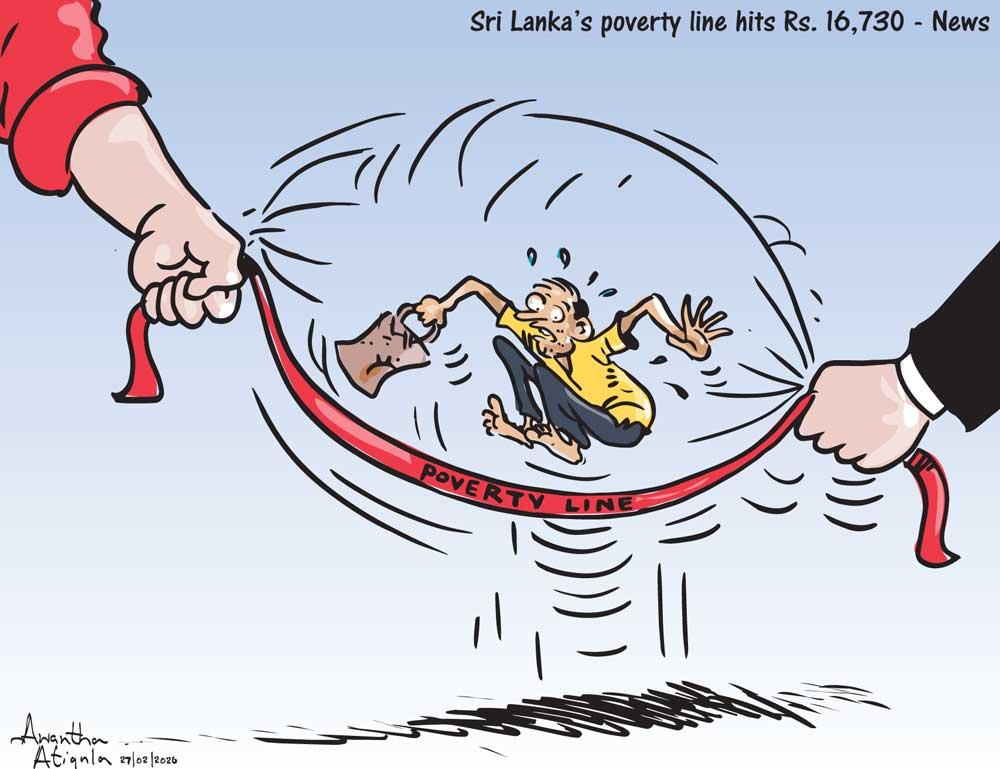
The cartoon references a news headline stating that Sri Lanka’s poverty line has risen to Rs. 16,730. In the image, a thin man clutching a small bag is trapped inside a loop formed by a red ribbon labeled “Poverty Line.” Two large hands from opposite sides pull the ribbon tighter, compressing the space around him as he appears distressed and physically squeezed.
The ribbon, typically associated with ceremonial markings or symbolic boundaries, is repurposed here as a constricting force. As the “poverty line” is pulled inward, the man inside is lifted and compressed, suggesting that adjustments to official thresholds can directly affect how individuals are categorized or pressured. The exaggerated motion lines and the man’s anxious expression reinforce the sense of strain caused by this tightening boundary.
Viewers may interpret the cartoon in several ways. Some may see it as a commentary on how statistical revisions to poverty benchmarks reflect worsening economic realities, placing more people within hardship classifications. Others may read it more broadly as a critique of how economic measures, while technical in nature, have tangible human consequences. Rather than disputing the data itself, the cartoon highlights the lived impact behind numeric thresholds and invites reflection on how economic definitions shape real-world experiences.