Reply To:
Name - Reply Comment
Sri Lanka’s export sector showed a tentative recovery in March, however beneath the monthly rebound, a sharper year-on-year decline indicates a growing external pressure as global trade conditions deteriorate.
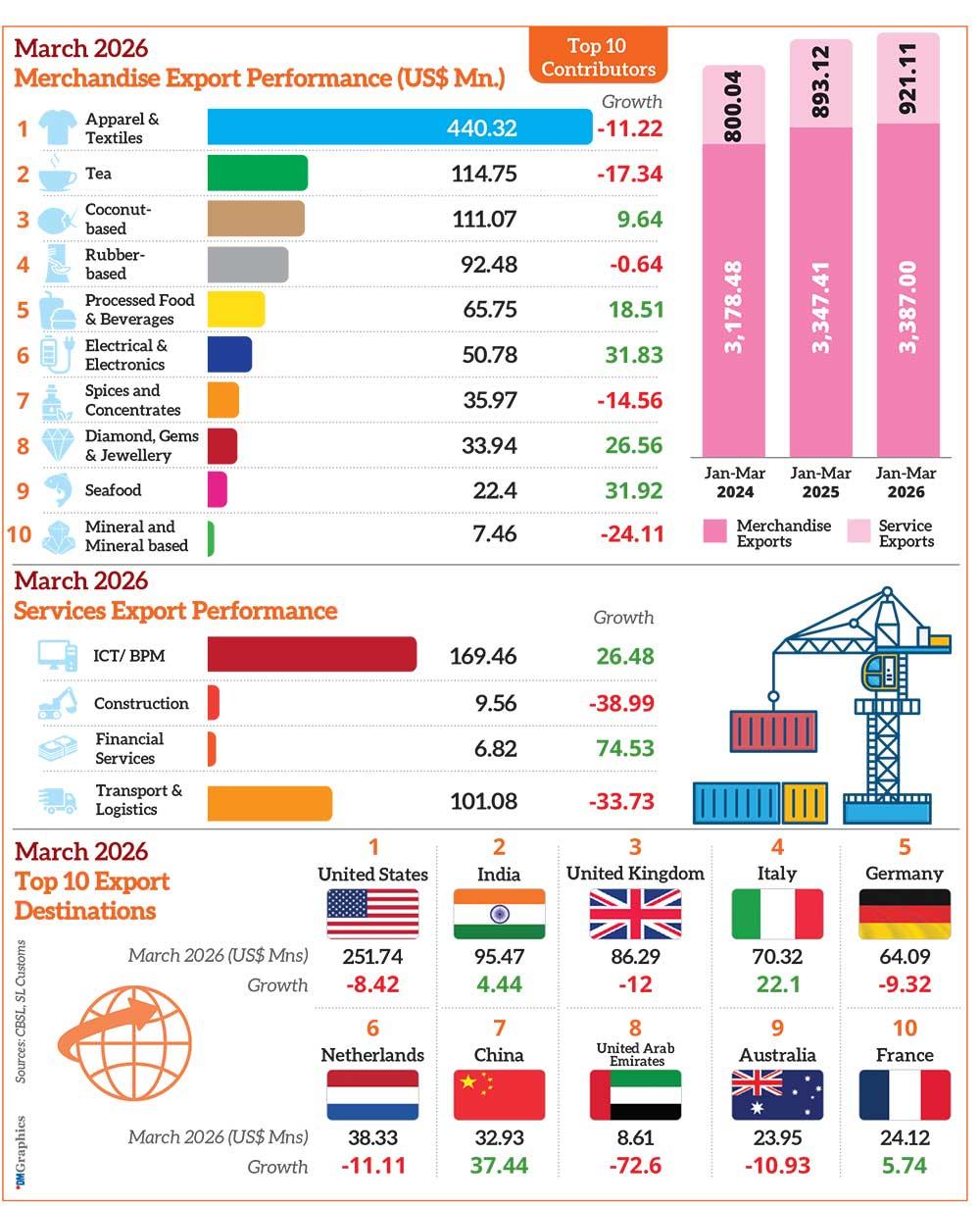
Total exports, including merchandise and services, reached US$ 1.47 billion in March 2026, down 5.2 percent from a year earlier, although up 9 percent from February.
The contraction was led by merchandise exports, which slipped nearly 5 percent to US$ 1.18 billion, alongside a 6.3 percent decline in services earnings.
Just as the case with regional peers, Sri Lanka’s export sector is increasingly being pulled between domestic stabilisation gains and a rapidly shifting global backdrop. The latter is currently reshaped by geopolitical tensions, particularly in the Middle East. The impact is already filtering through trade channels.
Exports to the United Arab Emirates, a key regional hub, saw a steep contraction in March, reflecting disruptions linked to escalating tensions in the Gulf. Meanwhile, core sectors tied to Western demand are softening, with apparel exports falling 11.2 percent year-on-year amid reduced orders from the United States and Europe.
Tea exports also declined sharply, with both volumes and earnings under pressure, exacerbated by weaker demand from markets such as Russia and parts of the Middle East.
The emerging pattern highlights the transmission into Sri Lanka’s external sector, which is via demand compression, trade route uncertainties, and rising logistics and energy costs.
Multilateral institutions in their latest outlook have already flagged these risks. The World Bank (WB) warned that while Sri Lanka’s recovery is gaining traction, it remains exposed to external vulnerabilities including global trade fragmentation and geopolitical disruptions. The Asian Development Bank (ADB) has similarly cautioned that elevated energy prices and uncertainty linked to global conflicts could weigh on export demand and external balances in the region.
However, March export data showed that higher-value segments continue to expand, with electrical and electronic components, seafood and processed food exports posting strong growth. Services exports, particularly ICT/BPM, remained stable, sustaining foreign exchange inflows even as traditional sectors face pressure.
Cumulative exports for the 1Q26 period, expanded 1.59 percent year-on-year to US$ 4.31 billion, supported by modest gains in both merchandise and services.
Merchandise exports grew 1.18 percent to US$ 3.39 billion, while services exports increased 3.13 percent to US$ 921 million.
EDB Chairman Mangala Wijesinghe said the cumulative growth reflects the sector’s “ability to navigate evolving global market conditions”, supported by sustained demand in key categories and ongoing market diversification efforts.
However, the underlying composition of growth points to a shifting export landscape.
Traditional pillars are weakening. Apparel exports declined over 8 percent in the first quarter, while tea earnings also contracted, highlighting continued vulnerability to demand cycles in advanced economies.
Meanwhile, emerging sectors are gaining ground. Electrical and electronic component exports surged over 44 percent during the quarter, while processed food, coconut-based products and seafood recorded strong gains, signalling a gradual repositioning of the export base.
Geographically, trade flows are also being redrawn. India has consolidated its position as Sri Lanka’s second-largest export destination, overtaking the United Kingdom with double-digit growth, while markets such as China, Italy and Belgium are showing resilience.
Still, dependence on traditional markets remains significant, with the United States, accounting for roughly 22 percent of exports, registering a decline, underscoring the exposure to weakening Western demand.