Reply To:
Name - Reply Comment
Advocates getting into Trans-Pacific Partnership Agreement
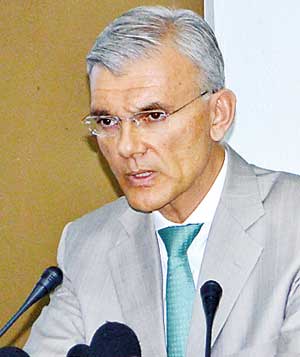 Bilateral Free Trade Agreement (FTA) with the United States of America (USA) does not make sense when Sri Lanka could aim for a much broader Trans-Pacific Partnership (TPP) agreement which gives market access to twelve countries including the USA, a globally acclaimed economist said.
Prime Minister, Ranil Wickremesinghe on several occasions said, his government was considering an FTA with the USA among other countries.
However Professor Razeen Sally said there would be no difference in commitments Sri Lanka will have to meet, between signing an FTA with the USA and joining the TPP, which is a mega regional agreement.
“Why a bi-lateral FTA with the United States when you can do the same FTA with eleven other members in addition, so that you can have extra market access?” asked Professor Sally.
Getting into regional FTAs makes the trade less complicated than bi-lateral FTAs as the former has a wider scope with much lesser agreements, while the latter requires entering into many agreements with so many other countries.
Sri Lanka is currently negotiating a FTA with China and mulls another with Singapore.
Speaking at the Ceylon Chamber of Commerce, Sally, Visiting Associate Professor at the Lee Kuan Yew, School of Public Policy, National University of Singapore said, bi-lateral agreement with the USA makes little sense in plugging into global supply chains as the, “supply chains do not operate bi-laterally”.
“If you are thinking in terms of global value chains— which is the way every country is thinking— you can’t think bi-laterally because value-chains are not bi-lateral. They are across the globe or they are across the regions. They want the seamless flow across many borders and frontiers.
Hence, TPP makes more sense in that respect because it has a much greater stretch covering value chains than would have just with the United States,” he said.
TPP agreement is the world’s largest regional trade agreement currently being negotiated among twelve nations – Australia, Canada, Japan, Malaysia, Mexico, Peru, United States, Vietnam, Chile, Brunei, Singapore and New Zealand.
The trade bloc accounts for 40 percent of the world economy and two-third of global trade.