Reply To:
Name - Reply Comment
By Nishel Fernando
 A new report from a group of eminent economic thinkers has proposed the formulation of an independent growth commission to guide Sri Lanka towards sustained economic recovery and transformation.
The report, titled “Sustaining transformative growth in Sri Lanka 2025-2030,” was convened by London-based ODI Global and the Colombo-based Centre for Poverty Analysis (CEPA).
The authors argued that such a commission is vital for building a national consensus on a long-term growth plan, drawing lessons from the economic success stories of countries such as South Korea, Malaysia, Singapore, India, and Vietnam. They said the initiative aims to break the cycle of “partial and inconsistent implementation of economic policies” that has historically constrained Sri Lanka’s development.
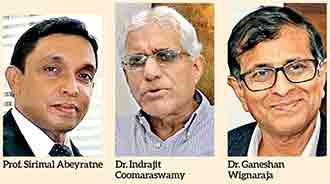
The report was drafted by a notable group including CEPA Executive Director Prof. Sirimal Abeyratne, former Central Bank Governor Dr. Indrajit Coomaraswamy, and Dr. Ganeshan Wignaraja, a Visiting Senior Fellow at ODI Global who served as the convenor. Other authors included Chandranath Amerasekera, Ravin Basnayake, Yvette Fernando, Dirk Willem te Velde, Esala Weerakoon, and Shea Wickremasinghe, all with extensive experience in the public and private sectors.
The study comes at a critical time. While acknowledging the noteworthy economic stabilisation since the 2022 crisis, with GDP growth reaching 5 percent in 2024 after six quarters of contraction, the report warned of “substantial risks of a relapse.” It projected that without significant structural reforms, growth could slide below 3 percent, worsening the country’s already high poverty levels. It noted that the share of the population living on less than US$ 3.65 a day was estimated to be 24.5 percent in 2024, more than double the 2019 level.
Beyond the call for a growth commission, the report outlined several urgent sector-specific proposals aimed at immediate impact. For the crucial tourism sector, identified as a “quick win,” the study recommended increasing spending on branding and marketing Sri Lanka as a “diverse and authentic tourism destination.” It suggested creating a tagline similar to “Incredible India” or “Malaysia Truly Asia” to boost the country’s image. The proposal also emphasised developing less-visited regions, including the North and East, and adopting international standards for safety, hygiene, and service quality to enhance value for money and ensure sustainability. To address food security and poverty, the report put forward a bold proposal to liberalise food imports as an emergency measure to tackle shortages and reduce high food prices. This was presented as part of a broader strategy to alleviate poverty, which has seen a dramatic reversal of previous gains, taking Sri Lanka back to poverty levels not seen since the early 2000s.
The report also suggested partnering with supermarkets to improve cold storage systems and using public buses to transport perishable goods to cut down on post-harvest losses.
The authors stressed that these reforms are essential to transform the economy, raise growth to a sustained 5 percent over the next five years, and avoid another painful debt restructuring when current financial arrangements are reviewed in 2027/28.
They said the ultimate goal is to create a pragmatic path for Sri Lanka to achieve sustainable and inclusive growth by 2030.