Reply To:
Name - Reply Comment
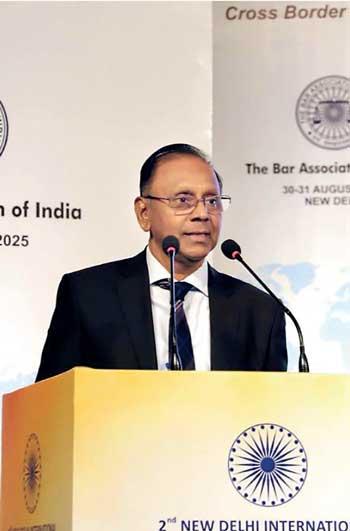 |
| Hiran M.C. de Alwis |
A unique legal principle from Sri Lanka’s Roman-Dutch law heritage, “unjust enrichment”, could be a key to unlocking innovative solutions for nations struggling with sovereign debt, a prominent Sri Lankan lawyer
has suggested.
The proposal comes as countries in the Global South seek new mechanisms to handle debt burdens exacerbated by external shocks.
Speaking at the 2025 New Delhi International Rule of Law Convention, Hiran M.C. de Alwis, Chairman of the Sri Lanka National Arbitration Centre, argued that the global legal system must facilitate new platforms to resolve these crises. He posited that Sri Lanka’s principle of “unjust enrichment” could be utilised in this context, offering a homegrown legal concept to address complex international financial challenges.
The core of de Alwis’ argument is a provocative question: what if the sovereign debt crisis was triggered by a force majeure-like situation? He pointed to the COVID-19 pandemic and the subsequent worldwide economic lockdowns, enforced under directives from global bodies like the World Health Organisation, as an unforeseen event beyond the control of
sovereign countries.
He contended that if such external factors, rather than just “imprudent domestic financial policies”, were the primary cause of a nation’s inability to service its debt, then a solution must be found within the Rule of Law that accounts for these circumstances.
This call for innovative solutions comes with a stark reminder of the dangers that debt crises pose. De Alwis warned that such crises present a cascade of dangers to the Rule of Law. He noted that governments might resort to arbitrary governance, unilaterally changing loan and
procurement conditions.
Furthermore, austerity measures required to manage debt can fuel public resentment, leading to the suppression of civil and political rights through emergency laws. The pressure to meet payments could also compel a state to impose strict fiscal policies that hinder domestic growth or even fail to honour international treaties, tarnishing its global reputation. Internally, budget cuts can cripple the legal system’s efficiency, delaying justice and potentially leading to state abuse and breaches of contract.
Expanding on his call for a new approach, de Alwis invoked the historical “Marshall Plan” as a model for a modern economic recovery strategy. He questioned whether multilateral agencies like the IMF and World Bank should initiate their own internal reforms to address these challenges, perhaps through mechanisms like a special drawing right fund for
crisis-hit countries.
However, he stressed that this was not a call for a one-way street. De Alwis emphasised that there is a “duty cast on these nations to improve governance” and implement structural reforms. He argued that any innovative approach to debt must be paired with credible, transparent auditing and improved governance structures within the debtor state, ensuring accountability
alongside relief.
This dual focus is set against the backdrop of Sri Lanka’s own recent economic journey. De Alwis highlighted that the nation “did a yeoman job” to progress from an economic standstill, successfully reducing inflation from a peak of 70 percent down to single digits. This, coupled with currency stability and a growth rate of 4 percent, demonstrates significant macroeconomic stabilisation. (NF)