Reply To:
Name - Reply Comment
By Shannine Daniel
Sri Lanka has done much better than India in terms of human development and social indicators but in terms of rapid economic growth, India has outperformed Sri Lanka, said former Chief Economic Advisor to Indian Government Dr. Aravind Subramanian.
He noted that this outperformance has happened despite much poorer human capital outcomes, even though many believe that having a solid human capital base is the foundation for economic growth.
He made these statements at a recent public lecture organised by the Central Bank.
“If human capital did not provide the basis for rapid economic dynamism in Sri Lanka, the opposite was true for India. When economic growth came along, it was this economic growth that had a major impact in improving human capital outcomes,” Dr. Subramanian asserted.
He noted that India’s most rapid reduction in poverty happened after economic growth took off. Even more strikingly, education outcomes in India improved because of economic growth.
He said this happened in two ways. One was that economic growth provided the resources for the state to start spending more on education and enrolment ratios and other indicators improved.
However, more subtly and more importantly, when growth took off, the returns to education increased.
The returns increased so much that the parents started demanding more educational facilities for their children.
If they could not get those facilities in public schools, they would send their children to private schools because public schools were not very functional, Dr. Subramanian said.
He also noted that even though Sri Lanka has always been a more open economy than India, Sri Lanka deglobalised at a time when India and other countries globalised rapidly and it has not recovered from that trend.
He said that the process of rapid economic growth that many developing countries, aside from Sri Lanka, witnessed during the 1990s and early 2000s, has reversed.
|
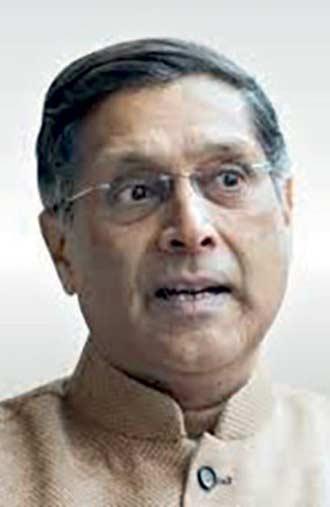
Dr. Arvind Subramanian |
“The external world is becoming more uncertain and more closed. So, that attribute of globalisation, which powered convergence and economic development, has stalled,” Subramanian stated.
He further noted that opportunities for developing nations would decline, due to the new regimes in China and the USA.
“Institutions around the world are becoming weaker. Macroeconomic policy is also becoming weaker once again in many parts of the world, with over indebtedness, more borrowing and fiscal laxity becoming worse,” he said.
Dr. Arvind Subramanian is an Indian economist. He was Chief Economic Advisor to the Indian government from October 2014 to June 2018.
He is currently a Senior Fellow at the Peterson Institute for International Economics.
He previously served as Professor of Economics at Ashoka University.