Reply To:
Name - Reply Comment
By Chandeepa Wettasinghe
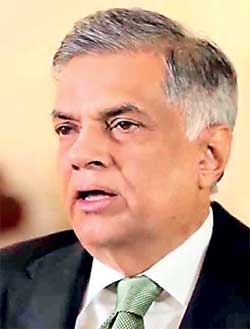 Prime Minister Ranil Wickremesinghe has given the bloated public sector a two-week deadline to return to productivity, warning of great consequences.
“I have given the government officials two weeks to change. We don’t want freeloaders. Either work or get out,” he said at the recent launch of the World Bank’s poverty research reports.
The statement bears resemblance to the ‘Disce Aut Discede’ motto of his alma mater Royal College, Colombo 07, which translates from Latin to ‘Learn or Depart’. “We have many weaknesses in our system because we have recruited weak officials,” Wickremesinghe said.
Taking the country’s Education Ministry as an example, he said he was surprised at the number of benefits and budgetary allocations demanded by these officials during the past budget cycle.
“If these public servants care more about their perks, how can we develop the ministry?” he questioned.
He said that the benefits of such officials will be reduced and the gains would be invested in improving education.
Wickremesinghe said that the bureaucracy is also inhibiting growth of the rural sector.
“Recently we did an assessment to see what goes to the people and what went to the bureaucracy. We have a large bureaucracy at the village level,” he added.
The bureaucracy has also slowed down progress across many sectors including tourism, power and energy and investments.
He noted that reforms would be brought on to evaluate and treat the public sector officials on a performance basis.
“I have communicated that each public agency will be given a one-year contract, and not one week more,” he said.
Institute of Policy Studies Executive Director Dr. Saman Kelegama pointed out that the current labour laws do not allow an employer to get rid of employees with bad performances, a situation which requires changing.
Australian National University Economics Professor Prema-Chandra Athukorale recently said that the current political situation does not provide space for labour reforms.
The size of Sri Lanka’s public sector has increased by 50 percent between 2006 and 2013.
This was due to the previous Mahinda Rajapaksa regime appeasing university graduates who had studied outdated curricula, who felt like they were entitled to a job upon graduation.
Public sector employment increased to 1.5 million with the past regime’s increased emphasis on nationalization and state-owned enterprises.
The World Bank said that around 25 percent of individuals entering the labour force initially seek employment in the public sector and the trend is weighing towards females, 30-35 percent of whom seek their initial job in the public sector.
The new regime increased the salary of the public sector by Rs.10,000 last year, placing further pressure on the private sector to increase salaries, amidst requests to that effect.
However, the momentum should shift to the private sector, as the government has pledged to create one million jobs, presumably in the private sector.
Wickremesinghe said that the private sector must become the engine of growth by competing in the international markets.