Reply To:
Name - Reply Comment
Incorporation of socio-economic rights into the constitution of a country does not guarantee their delivery to the people nor will ensure good governance, to a top political scientist specialized in constitutional law told a public forum in Colombo, last week. 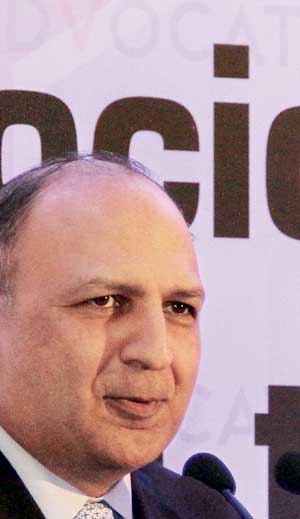
In the wake of Sri Lankan rulers are seen scrambling to draft a new constitution, Prof. Pratap Bhanu Mehta cautioned against inserting socio-economic rights in it, as such often leads to judiciary becoming more powerful than the legislature and also a privileged few being benefited over the poor.
Professor Mehta is the President and Chief Executive of Centre for Policy Research, one of India’s leading public policy think tanks. He has also taught at Harvard University, Jawaharlal Nehru University, and the New York University School of Law.
“Part of the fascination with constitutionalising these rights comes from a feeling of deep state failure. However Scandinavia and many advanced developed countries have ensured these rights without constitutionalising them.
The idea that constitutionalising these rights is a necessary condition for achieving a particular goal is simply a false idea.
We have a fascination with constitutionalising this because we think in the absence of a justifiable constitutional right, our legislature, ministers, and parliament, will not create the conditions to achieve these rights,” professor Mehta told a public seminar organized by Advocata Institute, a free market think-tank in partnership with the business magazine, Echelon. The key principle of constitution making is to restrain the state or monarch from centralising authority and to ensure the individual liberties such as right to life, liberty and property, which are generally referred to as ‘negative rights’.
In developed nations in the West and in Scandinavia in particular, such rights are ensured even when they fall outside the constitution and there is no need for them to be constitutionalised.
Free market capitalists argue against constitutionalising socio and economic rights, which are called the ‘positive rights’, because such moves empower government to tax people to re-distribute wealth to deliver on those rights.
Right to a fair trial is a ‘positive right’ where the government has to build and maintain the court system.
However over the years, particularly in developing countries, pressure has been mounting on such rights to be included in the constitution as a result of the political system failing to deliver such rights. But professor Mehta said that would not guarantee an improved outcome for citizens because implementation of such rights still depends on the political and administrative systems.
“The discourse on rights in developing countries emerges from a history of state failure. We want to go to court because legislature does not give us these rights. Paradox (is) if we live in a country where the legislature does not deliver these rights in the course of normal give-and-take representative politics, it is highly unlikely even if constitutionalized, the effective institutions to deliver these rights,” Prof. Mehta explained.
Hence he stressed it’s a false belief that constitutionalising rights improves governance.
“If we think that constitutionalising rights is a substitute for solving the governance problem, we are in for a rude shock,” he remarked.
Speaking further he cautioned against courts which are more powerful than legislature and executive.
“The only thing the constitutionalising such rights does is a risk. First of all, it increases the power of the courts over legislature and executive,” he said.
This is because socio-economic rights are polycentric, where trade-offs happen often times in resource allocation among education, healthcare etc. where the legislature needs to debate and decide—something that the courts cannot prescribe.
Secondly, the socio-economic rights are always an interactive learning process, which evolves over time considering the changes that are taking place—again something that cannot be achieved through a court order.
In any case, ultimately the implementation is in the hands of the legislature and the executive thus such court orders often go unenforced.
Revealing another perverse outcome of constitutionalising socio-economic rights, Prof.Mehta said it benefits a privileged few in a country over the poor majority, citing Brazil as a case in point.
In Brazil, where the healthcare system is most litigated, has shown that constitutionalising such rights has led to the privileged rich fighting in courts for most expensive treatments dispossessing the poor of the right to healthcare.
Hence Prof. Mehta said establishing a strong institutional implementation framework under the normal legislation is the best way to ensure the socio-economic rights of citizens than trying to incorporate them into the constitution, which in most cases backfires.