Reply To:
Name - Reply Comment
 |
| Ravi Jayasekera |
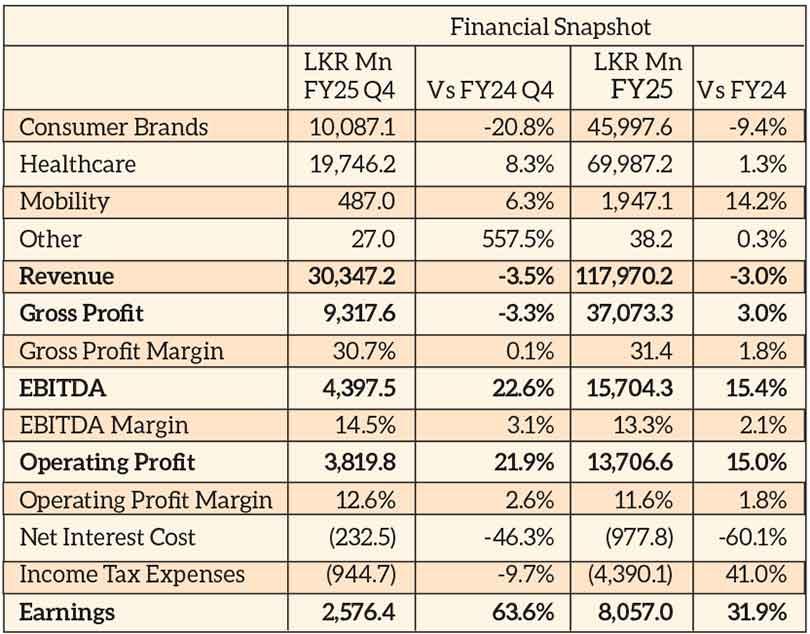
Hemas PLC reported a 31.9 percent rise in annual earnings to Rs. 8.1 billion, powered by strong performances in its healthcare and mobility segments, even as group revenue remained under pressure and consumer brands posted a sharp decline.
For the March quarter, group revenue dipped 3.5 percent year-on-year to Rs. 30.3 billion, but earnings surged 63.6 percent to Rs. 2.6 billion. The profit boost came largely from improved operating margins, efficiency gains, and a reduction in net finance costs.
The consumer segment remained a drag, with full-year revenue down 9.4 percent to Rs. 46.0 billion and earnings slipping 0.3 percent to Rs. 5.1 billion. The quarterly figures showed a deeper dip, with revenue falling 20.8 percent and earnings down 5.4 percent. Hemas said price cuts in earlier quarters and heightened market competition continued to weigh on performance.
In contrast, the healthcare sector delivered cumulative revenue of Rs. 70.0 billion and earnings of Rs. 4.3 billion, bolstered by improved working capital management and cost controls. Pharmaceutical revenues rose on the back of better distribution performance and lower finance expenses, while Hemas’ Morison unit began local manufacturing of two advanced cardiovascular drugs, a first in Sri Lanka.
Hospital operations also reported improved profit margins, with rising outpatient and inpatient revenues. Notably, Hemas Hospital Wattala commissioned a Rs. 1 billion Catheterisation Laboratory during the quarter.
The group’s mobility arm benefited from a rise in import volumes at the Port of Colombo and an increase in Emirates’ flight frequency between Colombo and Dubai. However, export and transshipment volumes remained weak, and freight rates stayed under pressure. Sector revenue held steady at Rs. 487.0 million for the quarter, with earnings rising to Rs. 266.7 million.
Hemas shares gained 16.2 percent during the March quarter, outpacing the broader market, which slipped 0.8 percent. The company announced a 5-for-1 share split to improve accessibility for local investors.
The macroeconomic environment showed tentative signs of recovery, with GDP expanding 5.0 percent in 2024 after two years of contraction. A stable rupee and easing deflation, alongside lower interest rates and energy tariffs, contributed to a more favourable operating backdrop.
Still, Hemas’ consumer business, particularly in home and personal care, continued to face volume pressure in categories such as Home Care and Personal Wash. The Learning segment also saw quarterly declines as inventory levels normalised and competition intensified.
In Bangladesh, where Hemas operates its international consumer business, easing inflation supported consumer sentiment. Price revisions helped maintain margins in its value-added hair oil segment, and the company launched a new male grooming line under the ‘Vibe’ brand.
“Looking ahead to the next financial year, the Group is poised to enter a phase of increased strategic investments guided by its Long-Range Plan. These investments will focus on unlocking new opportunities and delivering long-term stakeholder value,” said Hemas Acting Chief Executive Officer Ravi Jayasekera.