Reply To:
Name - Reply Comment
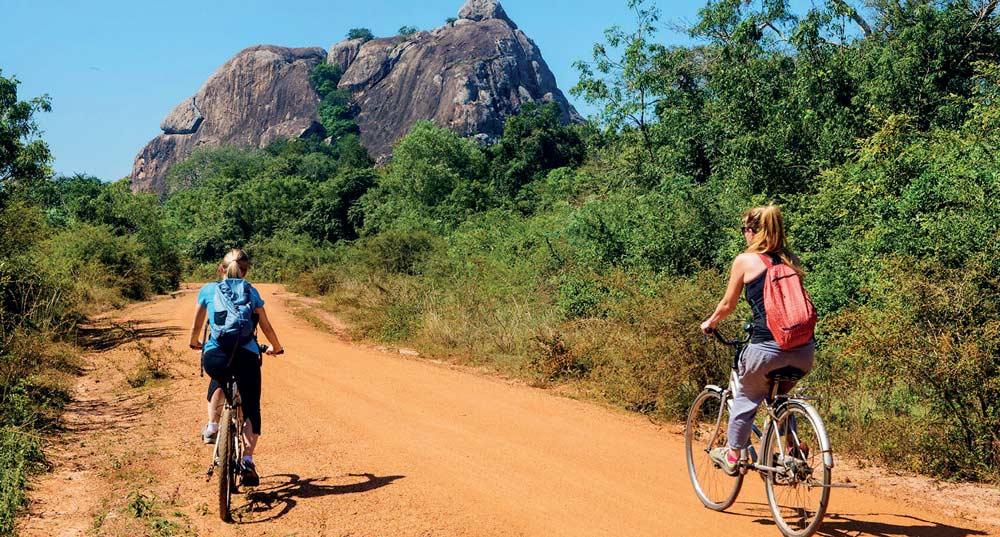
Recently, the arrivals to the country exceeded the earlier threshold, breaking a record. Yet, the debate around the future direction of the country’s tourism model has become increasingly polarised, especially between those advocating high-value generation (quality) vs. high arrival numbers (quantity).
Can Sri Lanka pursue only a high value growth strategy?
Quality over quantity?
Tourism has been identified as one of the key economic drivers of the economy and therefore, needs to be developed to its full potential.
However, the critical question is: What kind of tourism does Sri Lanka really need?
There is current thinking that Sri Lanka should be perusing exclusively ‘high-value – low-volume’ tourism, i.e. quantity over quality.
This perhaps has its origins in a tourism context to Bhutan, which focuses on low tourism numbers but targeting high-spending tourists. In fact, during the tourism boom in the pre-pandemic period, Bhutan accounted for only about 300,000 arrivals annually. Because of its unique positioning, product offering and positive perceptions created, Bhutan commands a compulsory minimum charge as sustainable development fee/government tax), which then ensures that tourism revenues stay high.
However, there is growing evidence that such an approach may not suit Sri Lanka’s scale, diversity or socioeconomic landscape. There is also the possibility that this model risks concentrating benefits among a few large players, sidelining the small and medium enterprises (SMEs) that form the backbone of the local tourism industry (said to be more than 50 percent). While this model may be relevant for smaller countries and microstates with ultra-fragile ecosystems, Sri Lanka’s context is fundamentally different.
Hence, perusing only quality will not work for Sri Lanka.
Focus on quantity? Other side of coin
Some of Sri Lanka’s Asian neighbours boast of yearly arrivals in the order of 35 million (Thailand), 25 million (Malaysia) and 17.5 million (Vietnam). These countries successfully drive and manage (to some extent) the mass market, with large economic benefits to the stakeholders, creating jobs and enhancing infrastructure. Yet, it can also lead to overtourism, overcrowding, environmental damage and cultural erosion, as is seen in some areas of these countries.
Unlike Sri Lanka, because of the relatively large size of these countries, they can, to a great extent, spread their tourism footfall on a larger landmass and manage the large influx.
So, it is quite clear that quantity alone is definitely not suitable for Sri Lanka.
What about carrying capacity?
We are a small island nation. We cannot go on increasing tourist arrivals forever in search of higher earnings. There has to be a cap on the total arrivals somewhere along the line.
As suggested in a study done last year by me and a colleague of mine, we deduced that this should be about 4.3-4.5 million annually. (https://www.linkedin.com/feed/update/urn:li:activity:7292688720233668608/).
This study generated considerable interest among a wide cross-section of tourism professionals (over 4,300 views on LinkedIn) and it seems to have gained acceptance by many in the trade today.
The cap is high enough to drive national growth but low enough to avoid overtourism. This total number should have a good mix of high and lower market categories, based on proper study and analysis that should be carried out. The volume will be kept under control and the mix must be managed.
So, we cannot keep on growing numbers indefinitely – we need to cap the arrivals at some point.
Then what? A mixed bag?
The solution then is a proper market mix. It should aim to combine quality with accessibility, economic impact and sustainability and resilience with inclusivity. It’s not about welcoming everyone; it’s about welcoming the right mix, in the right way and to the right places, in a controlled manner (arrivals ramping up to a maximum of about four, five million annually.)
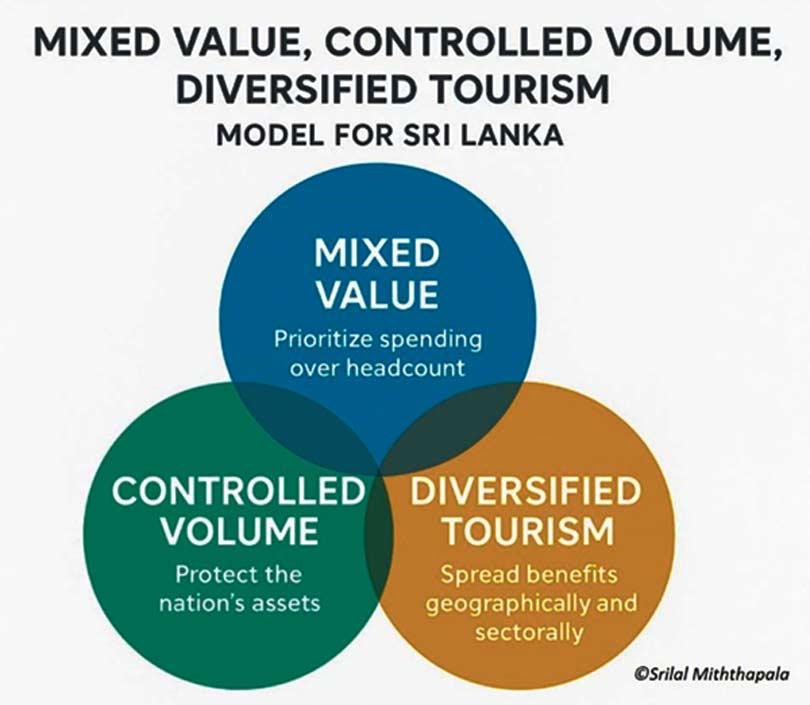
Sri Lanka should therefore adopt a more pragmatic, equitable approach — a mixed value, controlled volume and diversified (MVCVD) model. (See graphic)
 Mixed-value: Rather than pursuing mass tourism, Sri Lanka should aim to attract a blend of high-value and mid-value tourists. High-value visitors bring more foreign exchange per person, are often less intrusive to the environment and demand quality services that drive innovation and skill development. Mid-value tourists maintain steady visitation, helping to stabilise employment and SME engagement across the country.
Controlled-volume: Unchecked tourism growth can strain infrastructure, degrade natural resources and diminish visitor experience (which is actually happening now). Carrying capacity limits should be enforced in key sites—national parks, cultural heritage zones and coastal areas and for the country as a whole.
Diversified: A range of products, services and experiences, geographically spread across cultures and market segments, to maximise impact and minimise risk and guard against market fluctuations. Tourism must spread beyond the traditional hubs of Colombo, Kandy, Galle and the South Coast to emerging regions such as the North, East and inland areas. Can reduce regional inequality, create local employment and promote cultural exchange.
This is what marketing guru Phillip Kotler talks about. “Market segmentation is the process of dividing a market into distinct groups of buyers who have different needs, characteristics or behaviours and who might require separate products or marketing mixes.”
Kotler emphasised that instead of trying to appeal to the whole market with one strategy, businesses should tailor their offerings to specific segments where they can compete most effectively.
Hence, once the appropriate segments are identified, suitable and relevant marketing and promotion activities can be initiated for each segment to ensure that targets would be met.
Advantages of MVCVD strategy
1. Empowering small businesses and local communities – Over 50 percent of tourism businesses in Sri Lanka are SMEs — and they thrive not from exclusivity but from access to a steady flow of lower-yielding but mostly engaged travellers. A controlled-volume model ensures that enough tourists circulate through the country to support these businesses. It also encourages more entrepreneurial activity, reduces dependency on aid or subsidies and directly benefits thousands of livelihoods.
2. Reducing overtourism – Instead of concentrating visitors in a few well-known locations, a diversified strategy opens up the hitherto underdeveloped parts of the country. This will reduce environmental pressure, reduce seasonality and help spread economic benefits to lesser-known regions. Proper destination management and planning and marketing support are essential to achieving this potential but the outcome is a more balanced and resilient industry.
3. Creating a higher spend per visitor through value addition – Not all value is monetary and not all luxury is expensive. A mid-budget tourist, who explores ancient cities, eats in local restaurants, joins a village cooking class and hikes a nature trail may spend more (and stay longer) than a high-end tourist who stays inside a five-star boutique resort. By investing in creating richer and more meaningful products and services, proper interpretation and ‘storytelling’, heritage conservation, local experiences, authenticity and exemplarity service quality, Sri Lanka can boost per-visitor value across all market segments.
4. Matching global travel trends – Today’s global travellers are looking for experience and authenticity – not just sights. They value authenticity and sustainability. Sri Lanka’s rich cultural biodiversity, spiritual heritage and hospitable people are the perfect fit. Rather than chasing ultra-wealthy tourists, the country can attract conscientious travellers who seek meaningful connections and are willing to pay for them — not just with money but with time and respect.
5. Building a resilient tourism economy – A diversified base of experiences, source markets and price points is essential to weather global shocks. Whether it’s political unrest, pandemics or climate change, reliance on a narrow tourist profile leaves countries vulnerable. Diversified, mixed value and controlled-volume tourism allows for flexibility. It ensures that no single source market, travel season or niche experience becomes a single focal point, vulnerable to failure.
A MVCVD model is therefore not just a middle ground — it is a strong and suitable strategy for Sri Lanka tourism. It recognises the true strength of Sri Lanka: not in exclusivity but in its extraordinary diversity, authenticity and humanity.
(In a forthcoming study, I will try to present the market mix transition that could be put in place for Sri Lanka tourism to achieve some realistic earnings targets, while maintaining the arrival caps.)