Reply To:
Name - Reply Comment
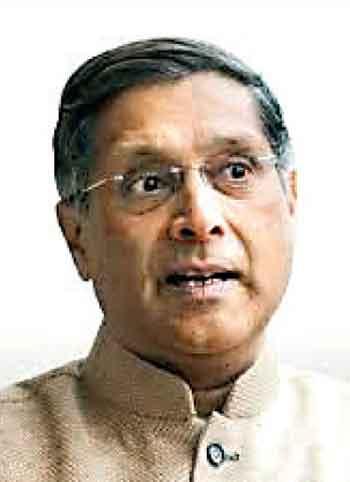 |
| Dr. Arvind Subramanian |
By Shannine Daniel
Sri Lanka’s steadily declining tax-to-GDP ratio is the heart of a much deeper problem in the country, former Indian Chief Economic Advisor Dr. Arvind Subramanian stated at a recent public lecture organised by the Central Bank.
Looking at the data on tax collection from emerging countries from the 1990s and 2020s, Dr. Subramanian revealed that in 1990, Sri Lanka was a positive outlier, as it collected more taxes than expected, given its level of per capita GDP.
However, by 2023, it became a negative outlier, which collected too little taxes, given its level of per capita GDP.
“Both India and Sri Lanka, as democracies, have been fiscally vulnerable because every interest group in a democracy has the freedom to say ‘give us something’. In India, many constituencies make a claim on the state and they get rewarded,” Dr. Subramanian stressed.
He also revealed that after 1990, India’s tax-to-GDP ratio was “virtually flat”, despite having a period of steady economic growth.
“This was a problem in an era of rapid growth, as taxes should rise. China, during a period of rapid growth, increased its tax-to-GDP ratio by five to 10 points.”
He added that India tried to “keep everyone out of the tax debt”, which was why the tax-to-GDP ratio was low, despite the rapid growth.
“Interest payments in India absorbed so much of the country’s budget that it crowded out development and other expenditures like defence,” he further noted.
Dr. Subramanian argued that although the manifestation of a weak fiscal state in both countries was very different, both countries had a similar problem of under-collecting taxes.
He added that Sri Lanka was probably underperforming even more than the existing data suggests.
Dr. Subramanian also acknowledged that from the 1970s to 1990s, the economists who were studying development economics would “rave” about Sri Lanka, with some even calling it the ‘Scandinavia of South Asia’.
“Sri Lanka had the lowest infant mortality rates and lowest poverty levels. It was a model for other countries in the region to follow and it provided an example for how the healthcare system could be run,” Dr. Subramanian asserted.
“Given its level of per capita GDP, it was a completely positive outlier and it did so much better on many social indicators,” he added.
The lecture was titled ‘Reviving growth while maintaining stability: Lessons for Sri Lanka from the Indian experience’.