Reply To:
Name - Reply Comment
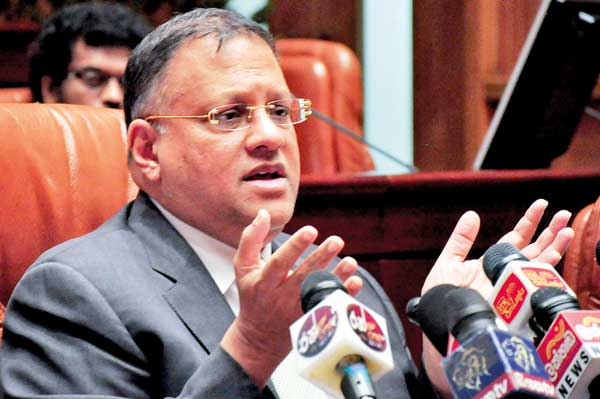 With the recent policy measures seen coming into effect through less money circulated in the economy and slowdown in imports, the Sri Lankan economy will have a “soft landing”, but the inflation numbers still remain worrying, the Central Bank Governor Arjuna Mahendran said.
The core inflation – the underlying inflation in the economy – reached 5.7 percent year-on-year in February, “which is high and as the Central Bank, we don’t want the inflation to exceed 5 percent. Core inflation at 5.7 percent, we can’t take things for granted,” Mahendran told a media briefing held yesterday on the current status of the economy.
In anticipation of further overheating of the economy, the Central Bank was compelled to tighten its monetary policy in January through a 1.5 percent hike in the banks’ reserve ratio followed by a 50 basis point hike in the key policy rates.
The International Monetary Fund (IMF), at the conclusion of its Article IV consultation this week however advocated the Central Bank to be on a tightening bias going forward due to fears of possible rise in core inflation and private credit growth due to a long lag in the country’s monetary policy transition.
But, Governor Mahendran is not in favour of further tightening monetary policy, should the credit growth slow.
“That (tightening) is not necessary if the economy continues to achieve a soft landing as we planned.
So, we are hopeful that there won’t be a need for further hikes in interest rates,” he said but did not completely rule out a rise in rates if the growth of credit suddenly continues to spike up.
However, the country’s Central Bank appears to have now caught in a devil’s alternative between raising and easing rates.
“I am being accused of either raising rates or not keeping rates low enough,” Governor Mahendran said in a lighter vein. Sri Lanka’s Central Bank has nevertheless remained growth biased as seen from their recent monetary policy decisions because they were quick to relax the monetary conditions no sooner the economy cools down. Sri Lanka’s monetary policy targets the inflation.
The Governor, going by the data however gave a positive outlook of the economy for the remainder of the year and projected a 5 - 5.5 percent growth in gross domestic product – in line with the IMF and much conservative than the government’s 6.7 percent target.
“On a positive note, the data is suggesting that the economic activities are strong,” he said.
Sri Lanka’s economy slowed to 4.8 percent in 2015 from 4.9 percent in 2014 while the fourth quarter growth fell sharply to 2.5 percent from 5.6 percent in the previous quarter mainly due to the slowdown in the construction sector as a result of the stalled government-led, debt funded infrastructure projects.
The Governor also pinned his hopes on the resumption of Chinese-funded projects from the second half of the year and the sealing of the IMF deal in two weeks, which could also
While asserting that the IMF package is still not a done deal, Governor Mahendran said the programme, which could be between US $ 1.0 to US $ 1.25 billion, is more of a confidence booster than its quantum.
“As I have continuously said the quantity is really not the main thing.
The main thing is for us to have an agreement with the IMF because that acts as a catalyst for other agencies like the World Bank, Asian Development Bank, Japan International Cooperation Agency and other bi-lateral lenders to come in and lend to the Sri Lankan government and to the private sector, Mahendran said.
The development financiers such as World Bank give governments long term project lending and budgetary support while the IMF provides short term balance of payment support.
An earlier attempt to obtain budgetary support from the IMF in early 2013 fell apart as such facilities are out of scope of the multilateral lender unless in an extreme situation such as in a bankruptcy such as seen during Greek bail-out – a member of the European Union.
While admitting the meetings with the IMF staff team was positive on a potential deal, the Governor said, “It is still not a done deal. There will be a lot of further negotiations to be held”.
However both parties are hopeful a deal could be struck within the next two weeks.
The Central Bank Deputy Governor Dr. Nandalal Weerasinghe and the Director Economic Research, Mahinda Siriwardana are now taking part in the Spring Meetings of the IMF and World Bank in Washington D.C for which the Governor and the Finance Minister, Ravi Karunanayake will soon join.